


EN
How CEO Appointment At HP (HPQ) Has Changed Its Investment Story
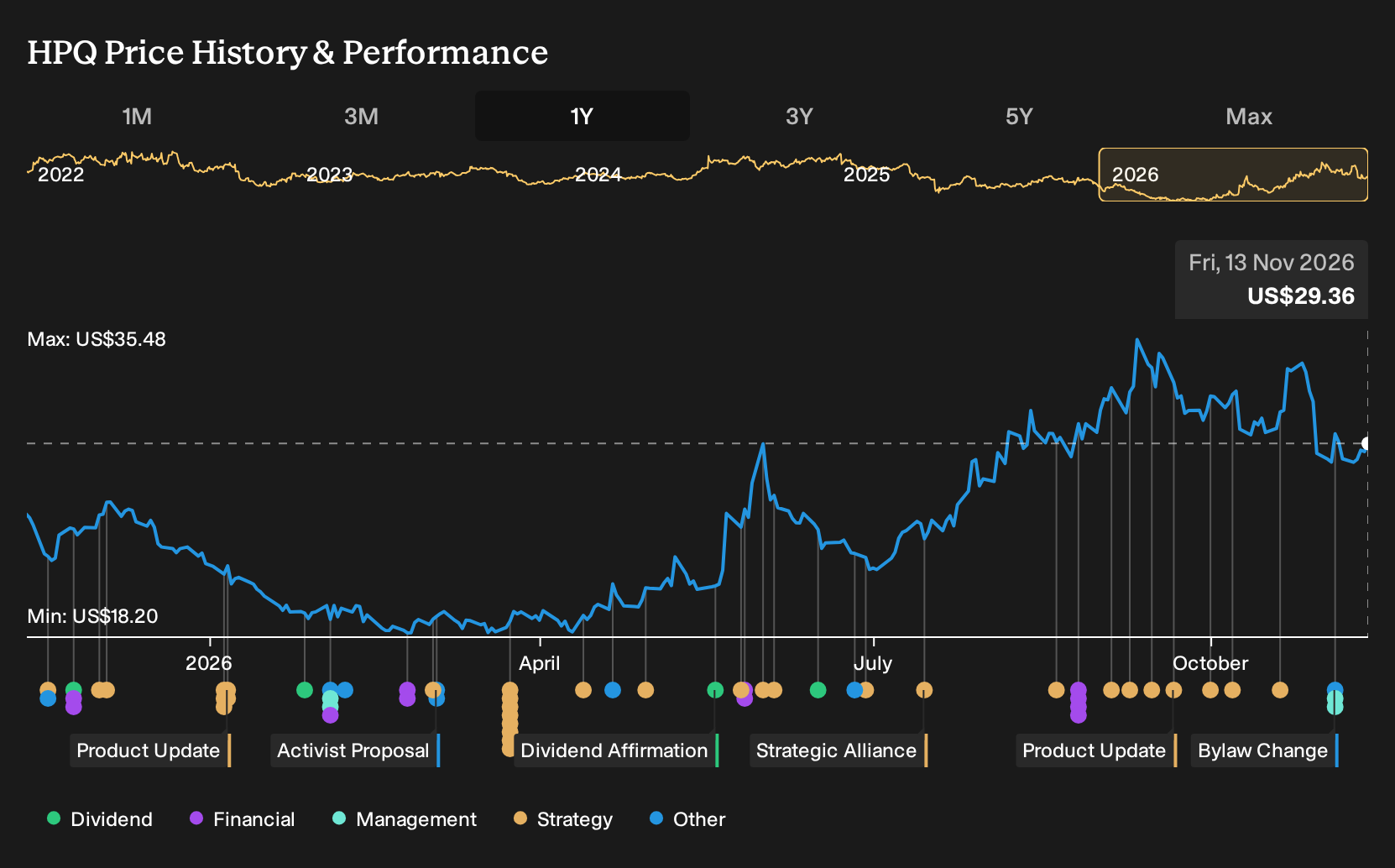
- HP Inc. has expanded its board from 12 to 13 seats and confirmed that Emma Walmsley will become Chief Executive Officer on January 4, 2027, with interim CEO Bruce Broussard transitioning to Chair and Chip Bergh remaining on the board.
- The leadership reshuffle concentrates operational decision making with Walmsley while shifting Broussard into board oversight, at a time when HP is placing greater emphasis on AI PCs, services and cost programs to support margins in Personal Systems and Print.
- We will now explore how HP's investment narrative could shift as Emma Walmsley prepares to take over as Chief Executive Officer.
Scan how HP's leadership reset fits into the wider AI hardware story by comparing it with a curated group of 53 AI infrastructure stocks that could shape the next upgrade cycle.
HP Investment Narrative Recap
To own HP, you need to be comfortable with a PC and print business that is leaning hard into AI capable hardware, richer configurations and more recurring services, while still carrying high debt and negative shareholders equity. The analyst consensus Narrative on Simply Wall St leans on earnings that are forecast to grow 5.38% a year and relatively low P/E based valuation support.
In the near term, the key catalyst is whether AI PCs, premium devices and services can support margins while PC units and print supplies face pressure and input costs stay elevated. The main risk is that pricing power, cost savings and service growth do not offset these headwinds, which would make that margin story harder to sustain.
The most relevant announcement here is Emma Walmsley’s appointment as Chief Executive Officer from January 4, 2027, with Bruce Broussard moving to Chair and the board expanding to 13 directors. That move concentrates operational authority with Walmsley while keeping continuity at board level, which matters for execution on AI PCs, services and cost programs.
For you, the link to catalysts is straightforward. HP has a clear plan around AI PCs, structural cost actions that target US$1b in annual savings by FY 2028 and a push into more recurring services and higher value print. The leadership reset shapes who is accountable for hitting those targets and managing the balance between debt, dividends and long term reinvestment.
HP's narrative projects US$63.2b revenue and US$3.0b earnings by 2029. This is based on an assumed 2.2% yearly revenue growth and an earnings increase of about US$0.5b from current earnings of US$2.5b.
Uncover why HP's fair value indicates a 7% potential downside to its current price, representing a premium that may not hold.
Exploring Other Perspectives
One alternate view focuses on HP’s AI at the edge plans as a risk rather than a growth driver. The most bearish analysts were assuming revenue drifts to about US$56.0b by 2029 and earnings of US$2.7b. That is a far more cautious stance. The CEO change could eventually push those expectations in either direction.
Explore 5 other HP fair value estimates, including one that suggests as much as 35% downside from the current price!
Form Your Own Verdict
Don't just follow the ticker. Dig into the data and build a conviction that's truly your own.
- A great starting point for your HP research is our analysis highlighting 4 key rewards and 2 important warning signs that could impact your investment decision.
- See our latest analysis for HP. The report includes a comprehensive fundamental analysis summarized in a single visual, the Snowflake, making it easy to evaluate HP's overall financial health at a glance.
Looking for more investment ideas beyond HP?
Once you have a view on HP, it can help to cross check that thinking against other opportunities using the Simply Wall St screener.
- If capital preservation is a priority, review a curated 31 resilient stocks with low risk scores that may offer steadier profiles for more cautious portfolios.
- For investors hunting for potential mispricing, scan a targeted 32 high quality undervalued stocks that combines quality fundamentals with appealing price tags.
- If balance sheet strength matters most to you, focus on companies in the list of solid balance sheet and fundamentals (24 results) to compare leverage and financial resilience.
Have feedback on this article? Concerned about the content? Get in touch with us directly. Alternatively, email editorial-team@simplywallst.com