


EN
Why Analysts Think AMD Could Emerge as the Biggest Winner From Nvidia’s Turmoil
In a surprising turn, Nvidia (NVDA) founder and CEO Jensen Huang stepped down unexpectedly this week after allegations of multiple affairs, including one with an alleged Chinese spy. For Advanced Micro Devices (AMD), this could be a game-changer. The chipmaker has been on a roll this year, and analysts think a leadership gap at Nvidia may send business AMD’s way.
AMD already boasts surging data-center demand and an impressive artificial intelligence (AI) portfolio. With AMD focused on execution and Nvidia in flux, AMD could scoop up more GPU and CPU orders. In short, AMD is doing everything fine right now — with record revenue growth and design wins — so any uncertainty at Nvidia only sharpens its appeal.
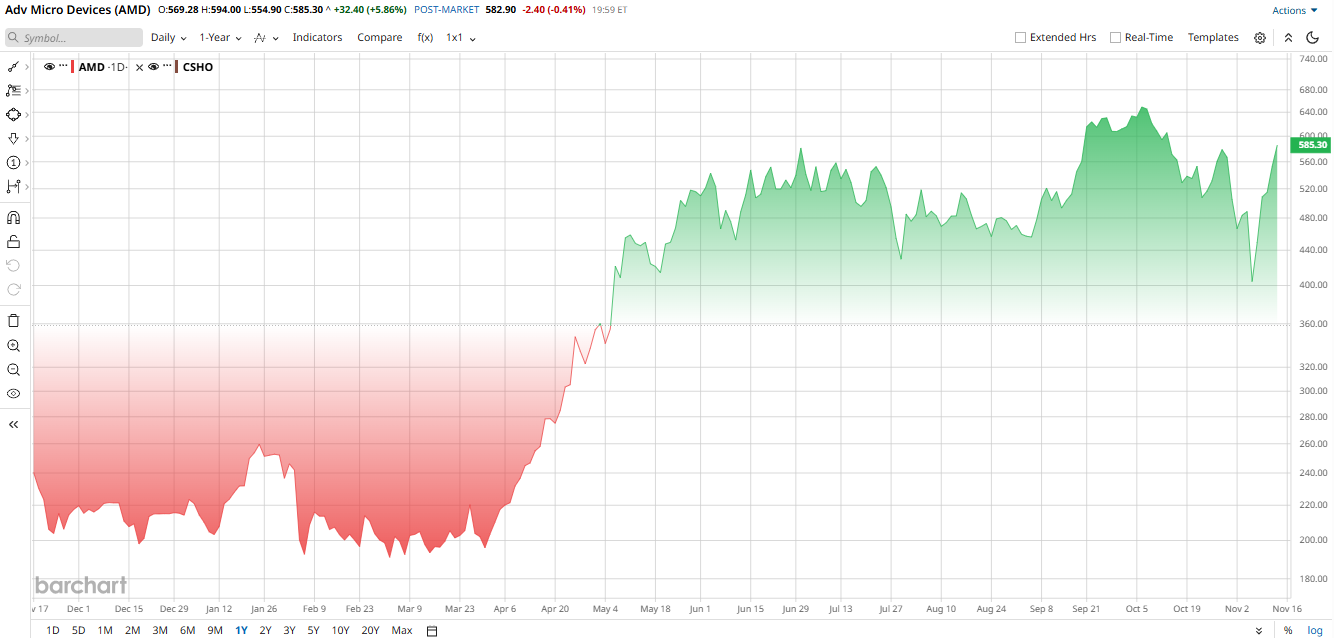
Shares of company are also performing outstandingly, gaining more than 149% year-to-date (YTD), fueled by strong data-center results and growing chip demand. Let's take a closer look.
Nvidia's CEO Shake-Up and AMD’s Opportunity
Nvidia’s leadership change could shake up the duopoly in AI chips. With Jensen Huang out and CFO Colette Kress appointed as interim CEO effective immediately, a brief leadership vacuum has emerged as Nvidia's board searches for a permanent replacement.
Some analysts see this as a tailwind for AMD stock. As Nvidia faces heightened scrutiny and uncertainty, William Blair analysts “see an opportunity for AMD” through its custom-program offerings. In practice, big cloud customers and hyperscalers often split work between Nvidia and AMD tech; any pause at Nvidia may accelerate that shift.
Similarly, Morgan Stanley pointed out that AMD’s CPU business is showing strength and expects its new Helios AI rack to gain share next year. Indeed, AMD recently ramped its Helios rack, combining MI455X GPUs and EPYC Venice CPUs, and it is already being tested by Meta Platforms (META). This positions AMD as a direct contender if some customers look for alternatives.
Nonetheless, AMD’s gains aren’t guaranteed. Nvidia still has dominant ecosystem advantages. TECHnalysis Research’s Bob O’Donnell said AMD's recent report provided a “greatly needed boost” to AMD’s AI infrastructure story, but AMD must keep execution sharp. Meanwhile, Gabelli Funds’ Hendi Susanto added that investors see the results ”as confirming its technology leadership and its strong position to keep gaining market share."
So far, so good. But leadership dynamics can change quickly, and a new Nvidia CEO or board moves could stabilize the company soon. In any case, the immediate impact has been positive: AMD stock rallied on the news, and analysts are revisiting assumptions about market-share shifts.
AMD Reports Q2 Results
Earlier this month, AMD reported unprecedented third-quarter revenue of $13.4 billion, a 45% year-over-year (YOY) increase that also topped the $13.09 billion forecast by analysts. Data-center revenue rose 97% YOY to $8.5 billion on demand for EPYC server chips and Instinct MI450 graphics processors that support workloads for AI.
Profitability soared, and net income went up 95% to $2.4 billion, or $1.46 per share. Adjusted earnings, which excludes certain items, jumped 74% to $2.09 per share, ahead of the $1.94 forecast by analysts.
However, cash flow from operations fell to $1.2 billion from $1.8 billion a year earlier, as inventory changes used $3 billion of cash.
During the Q3 earnings call, CEO Lisa Su said Instinct and EPYC products continued to enjoy strong demand. Su predicted further growth in Q4 as AMD has been raising Helios rack system production and Venice server processor.
Looking ahead, AMD expects Q4 revenue to be roughly $17 billion, plus or minus 3%. This figure suggests an average YOY increase of approximately 66%.
What Are Analysts Saying About AMD Stock?
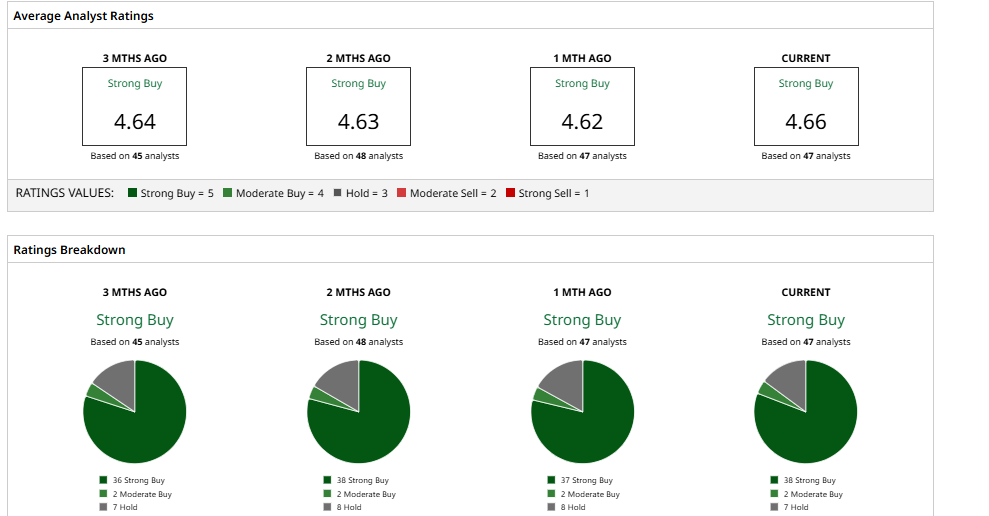
Wall Street is bullish on AMD. Analysts have a consensus “Strong Buy” rating for AMD stock with an average price target of $660.84. That suggests approximately 25% potential upside from current levels.
Morgan Stanley recently upgraded its price target to $510 from $465 while maintaining an “Equal-Weight” rating. Meanwhile, KeyBanc kept its target at $725 with an “Overweight” rating. On the more bearish side, Goldman Sachs lowered its target on AMD stock to $675 on valuation concerns, but the firm remains positive due to its optimism over the company's growth prospects. Finally, Wells Fargo also cut its target to $650 per share.
Overall, analysts seem to have optimism for AMD. While Nvidia is under the microscope, AMD will need to execute on its opportunities.
On the date of publication, Nauman Khan did not directly have a position in any of the securities mentioned in this article. All information and data in this article is solely for informational purposes. For more information please view the Barchart Disclosure Policy here.