


EN
From Seasonal Rankings to Trade Selection: A Feeder Cattle Example
Introduction
Last week, we used Sugar to introduce a more structured way to select seasonal spread trades. We examined ten years of historical results, ranked opportunities within the market, and organized them on an annual timeline. This week, Feeder Cattle adds another dimension: choosing among several candidates that have already met an initial set of research requirements. Two structures associated with priorities #6 and #7 attracted attention. Applying a tighter screen helped distinguish the preferred opportunity. The distinction matters because screening serves two purposes. An initial screen narrows a large universe to a manageable research list. A more demanding screen then helps identify the strongest candidates within that list.

What the priority list tells us
The priority list organizes contract structures and seasonal windows according to their historical results. It provides a framework for deciding where to focus as the calendar advances. A priority number is a relative ranking within that research. It does not establish that every trade associated with the structure offers the same opportunity. Entry dates, exit dates, and the resulting historical statistics can differ. As we approach the December entry window, priorities #6 and #7 are the only combinations on this list currently at or near their identified entry windows. These are the Feeder Cattle March–May spread (#6), with a broad February exit, and the May–August spread (#7), with a broad April–May exit. Although other structures rank higher historically, these two are the most timely candidates for closer screening now.

A highly ranked structure may therefore deserve attention while another structure offers a more attractive individual trade at the current entry window. Feeder Cattle illustrates how the broader ranking and the detailed screening process work together.
Two levels of screening
The initial screen uses minimum readings of 25% for APW, 25 for PL/DD*Win, 20 for RIDX, and 60 for Corr5. These requirements help reduce the large number of possible trades to a pool worth examining. The tighter screen raises those levels to 35%, 35, 30, and 70, respectively.
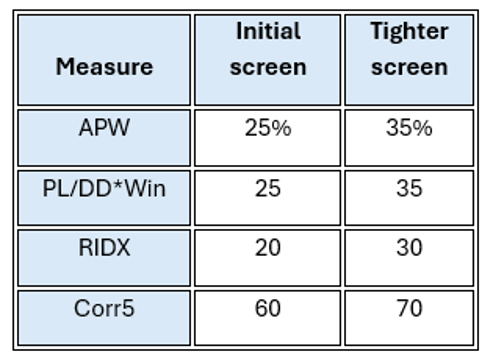
Each measure contributes a different perspective:
- APW indicates how frequently historical trades achieved the average-profit benchmark, adding context beyond simply finishing with a gain.
- PL/DD*Win combines historical profit relative to drawdown with win rate, helping assess the balance between return and adverse movement.
- RIDX, or Regression Index, evaluates the quality of the seasonal pattern. Higher readings indicate a more clearly defined seasonal tendency.
- Corr5 compares the recent five-year seasonal pattern with the longer-term pattern, helping assess whether recent behavior remains aligned with the broader history.
Together, these measures support comparison across candidates. No single statistic captures every characteristic of a trade.
What Pass and Fail mean here
In this review, the Pass/Fail designation refers to the tighter screen. A Fail does not necessarily mean the trade is unsuitable. It means the candidate did not satisfy every requirement at that more selective level. A trade that passes the initial screen can remain under consideration even if it fails the tighter screen. If no candidates meet the tighter requirements, I may still select an opportunity from the broader qualifying group after reviewing its statistics, seasonal behavior, and portfolio fit. That flexibility is part of the process. The initial requirements establish the research pool; the tighter requirements help prioritize choices when several alternatives are available.
Applying the process to Feeder Cattle
The two structures under review produced different results against the tighter screen:
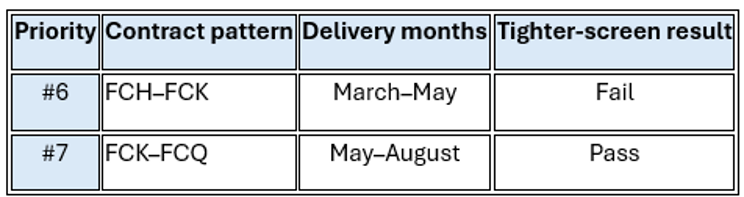
Both are two-leg calendar spreads. Selling January–May means selling January and buying May. Selling May–August means selling May and buying August. The position depends on the changing relationship between delivery months. Priority #7 becomes the preferred candidate in this comparison because it meets the tighter requirements. Priority #6 retains its historical ranking, but its screening result gives it a lower preference in the current review. This is a relative selection decision, not a permanent rejection of the structure.
The entry week refines the choice.
The annual timeline places both structures around a broad December entry window. Priority #6 extends toward February, while priority #7 extends toward April–May of the following year. The detailed list adds weekly precision. Priority #7 includes candidates in week 47, with additional entries appearing in weeks 51 and 53. Only one of the listed week-47 trades passed the tighter screen.
That result focuses attention on a specific candidate within the preferred structure. It does not establish that every priority #7 entry has equivalent characteristics. Later candidates require their own review as their windows approach.
From research to a portfolio decision
The Sugar example showed how historical priorities and an annual timeline organize the opportunity set. Feeder Cattle shows how screening helps choose among the individual trades that emerge from that research.
For this review, priority #7 and its passing week-47 candidate receive preference. If nothing had passed the tighter screen, the initial qualifying list would still provide alternatives to examine.
Passing either screen does not guarantee a profit or trigger an automatic entry. Liquidity, position size, current market conditions, and portfolio exposure still matter. The objective is to use consistent research standards to make better comparisons while retaining judgment about which opportunity deserves capital.
Additional Details
Dual Edge Research publishes 2 weekly newsletters offered at one low price:
- The Bull Strangle Newsletter focuses on stocks and options, combining stock ownership with disciplined option-selling techniques designed to generate consistent income while managing risk.
- The Smart Spreads Newsletter focuses on seasonal commodity spreads, a historically proven approach that seeks opportunities across agricultural, energy, metal, and financial futures markets.
Each strategy is designed to stand on its own, but together they provide a diversified approach that can perform across a wide range of market environments. For traders looking to deepen their education, The Bull Strangle Strategy and Trading Commodity Spreads are both available on Amazon.
Visit BullStrangle.com to subscribe for just $1 for the first month.
For a video overview of the Bull Strangle Newsletter
For a video overview of the Smart Spreads Newsletter
Darren Carlat
Dual Edge Research
(214) 636-3133
DualEdgeResearch@gmail.com
Disclaimer
This information is for informational purposes only and should not be considered investment advice. Past performance is not indicative of future results, and all investments carry inherent risk. Consult with a financial advisor before making any investment decisions.