


EN
Did Nvidia CEO Resignation Just Shift Intel (INTC) Stock's Investment Narrative?
- Intel faces a new securities class action lawsuit alleging that earlier public statements did not fully reflect PC market weakness, inventory issues, supply constraints and the balance between AI data center demand and pressure on key client segments.
- The legal claims focus on how operational strains in Intel’s PC and AI businesses were communicated, which puts fresh attention on execution, disclosure quality and management credibility.
- We will examine how Intel’s x86 and US foundry investment narrative compares with these lawsuit allegations and AI partnership uncertainty.
Compare how other AI infrastructure plays are priced and positioned next to Intel by reviewing our hand picked 53 AI infrastructure stocks.
Intel Investment Narrative Recap
To own Intel here, you need to believe the heavy spending on x86 CPUs, AI accelerators and US foundry capacity can turn an unprofitable chip maker with US$59.9b in revenue into a more efficient, trusted supplier. The short term swing factor is whether AI driven data center demand can offset ongoing PC softness and memory bottlenecks.
The securities lawsuit goes straight at that story. It questions how clearly Intel described PC weakness, inventory issues and capacity constraints just as investors focused on an AI uplift. The biggest near term risk is not only operational strain in the Client Computing and Physical AI Group, but also any hit to management credibility or disclosure quality.
Among the recent developments, the RadixArk collaboration around SGLang feels closely tied to these concerns. Intel is pitching an AI inflection that leans on existing x86 software strengths that Suen, a Simply Wall St Community investor who wrote the Narrative, highlights as a core reason to back the business. This partnership makes that thesis more tangible on the software side.
Optimizing an open inference stack for Intel CPUs and accelerators reinforces the idea that developers can stay on standard x86 hardware yet still reach competitive AI performance. For investors watching the lawsuit and the Nvidia partnership uncertainty, execution on SGLang and similar efforts becomes a practical catalyst. It helps show whether Intel can convert AI headlines into repeatable workloads that support both data center and foundry utilization.
Suen’s narrative reaches a fair value of US$500.93 for Intel by applying a 69.2% a year revenue growth rate and a future profit margin of 15.6%. Together, these assumptions imply a much larger and more profitable US based x86 and foundry platform than today’s business profile.
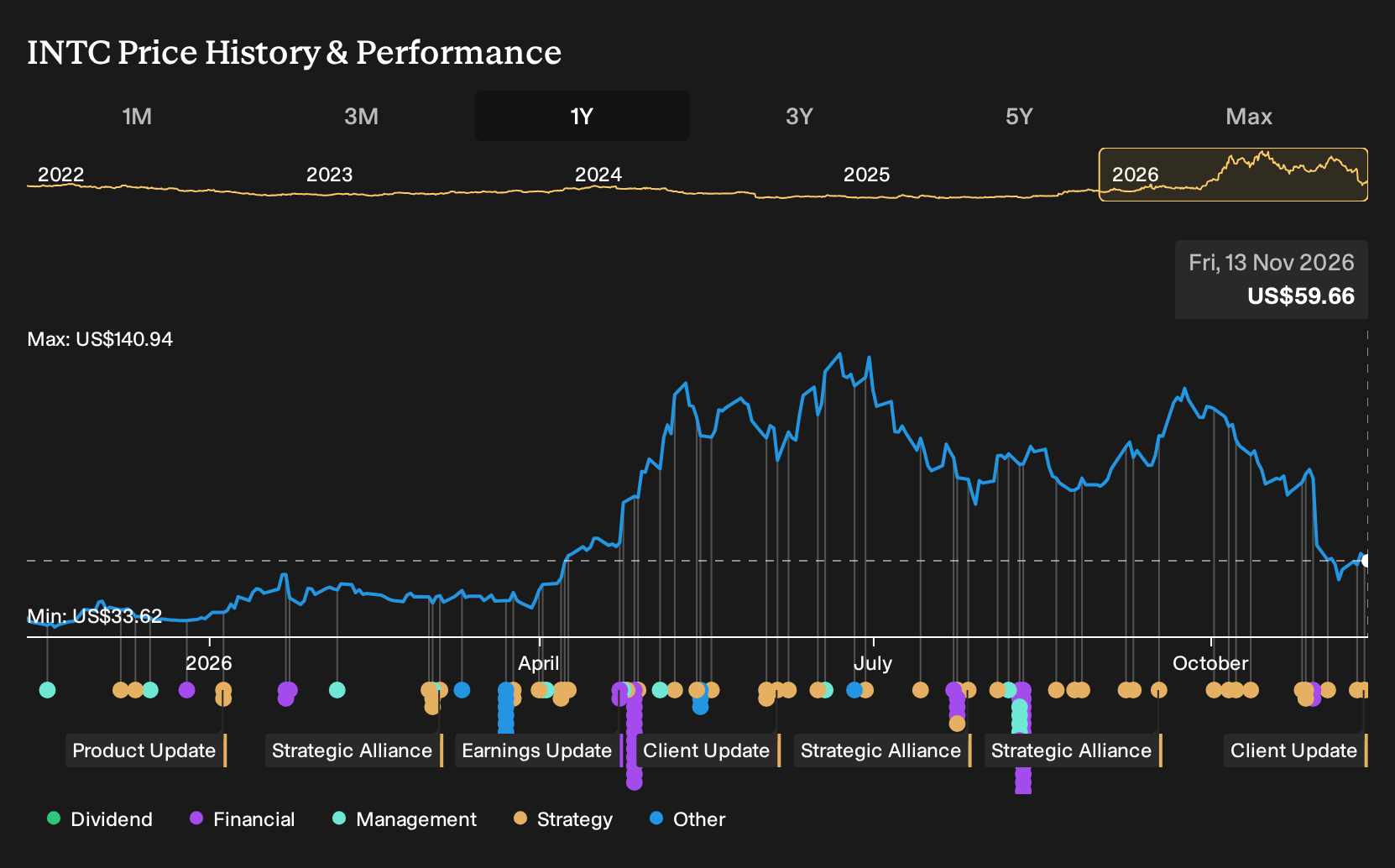
Uncover why Intel's fair value indicates a 740% potential upside to its current price and how this gap could narrow quickly.
Exploring Other Perspectives
Fifteen fair value estimates from the Simply Wall St Community span a wide band, from US$42.88 at the low end to US$500.93 at the top. This shows how far opinions on Intel diverge. Set that against fresh legal claims, AI partnerships and government involvement, then decide how these contrasting views could matter for your own thesis.
Explore 14 other Intel fair value estimates, including one that suggests as much as 740% upside from the current price!
Form Your Own Verdict
Don't just follow the ticker. Dig into the data and build a conviction that's truly your own.
- A great starting point for your Intel research is our analysis highlighting 3 key rewards and 1 important warning sign that could impact your investment decision.
- See our latest analysis for Intel. The report includes a comprehensive fundamental analysis summarized in a single visual, the Snowflake, making it easy to evaluate Intel's overall financial health at a glance.
Looking For More Ideas Beyond Intel?
Once you have a handle on Intel, it can help to widen the lens and line it up against other opportunities with clear, data driven filters.
- If you want potential mispricings with quality fundamentals on your radar, scan through our 32 high quality undervalued stocks that could sit alongside Intel on your watchlist.
- For investors who care about balance sheet strength before anything else, start with the list of solid balance sheet and fundamentals (24 results) and compare how those businesses stack up against Intel's risk profile.
- If you are hunting for under the radar ideas with strong underlying numbers, the 20 high quality undiscovered gems can surface candidates that might complement an Intel focused portfolio.
Have feedback on this article? Concerned about the content? Get in touch with us directly. Alternatively, email editorial-team@simplywallst.com