


EN
Earnings Update Might Change The Case For Investing In Gartner Stock
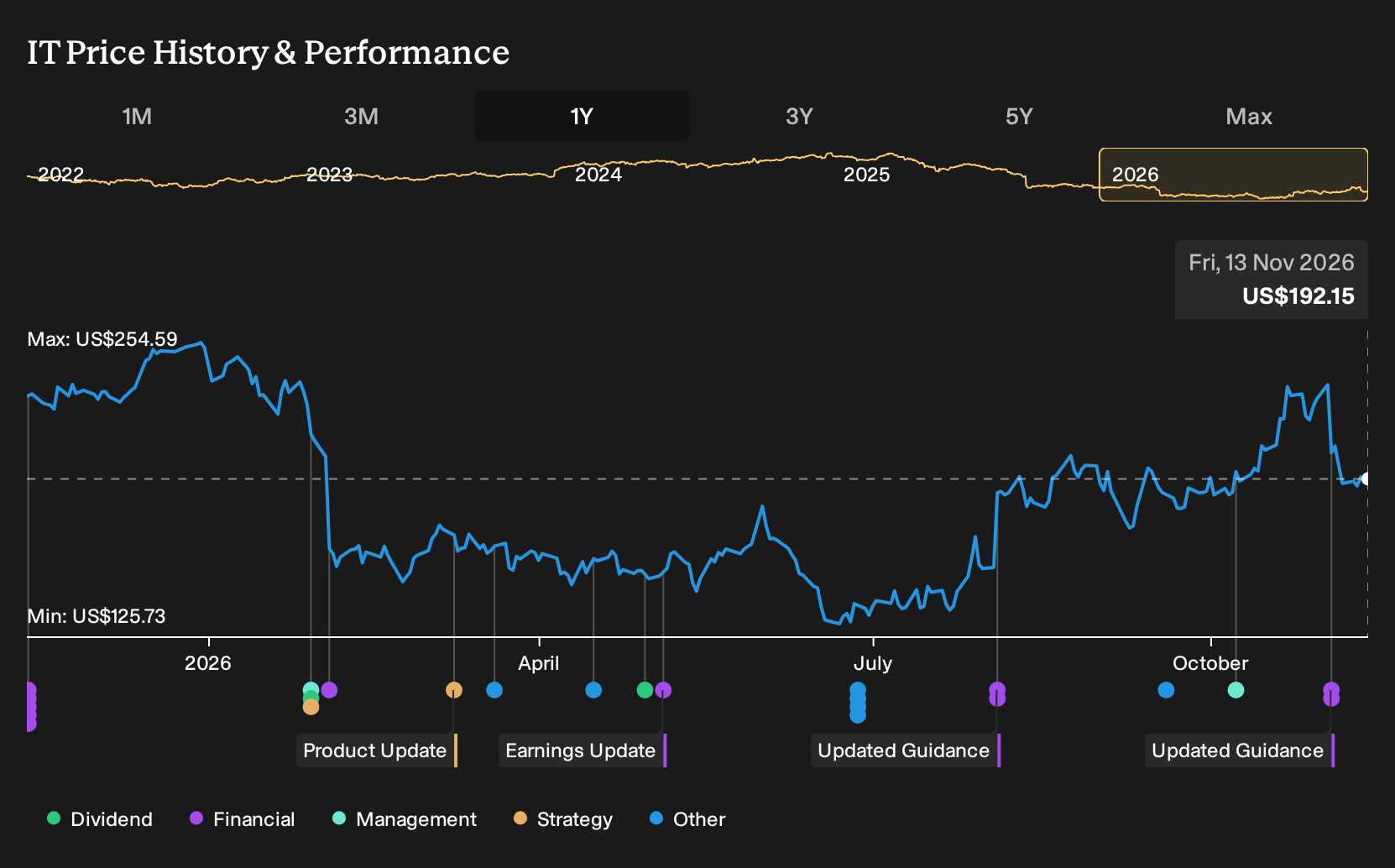
- Gartner reported third quarter 2026 results with revenue of US$1,504.79 million and net income of US$214.42 million, alongside updated full year guidance targeting revenue at or above US$6.405 billion on an FX neutral 1% growth basis.
- The mix of slightly lower revenue and sharply higher earnings per share highlights how Gartner's cost structure and business model can support profitability even when top line performance is flat to softer.
- This article will examine how Gartner's stronger earnings per share, together with modest 2026 revenue guidance, shapes the investment narrative from here.
Scan how Gartner's cautious 1% FX neutral revenue target compares with peers that are also prioritizing earnings quality in slower top line conditions through our curated 32 high quality undervalued stocks.
Gartner Investment Narrative Recap
To own Gartner, you need to believe that its subscription insights, conferences and consulting can keep converting executive interest in areas like AI, digital transformation and cybersecurity into steady contract value. The analyst consensus Narrative on Simply Wall St leans on that premise, along with disciplined costs and strong free cash flow, as the core of the story.
The latest quarter largely reinforces that earnings quality is the near term catalyst, not rapid top line expansion, given FX neutral revenue guidance of about 1% for 2026. The biggest operational risk still sits with slower decisions and tight budgets at key clients, which could cap contract value growth and test current profitability levels.
The updated full year 2026 outlook, with revenue guided at or above US$6.405b on an FX neutral 1% growth basis, is the clearest recent signal for your near term thesis. It ties directly into the core catalyst from the analyst consensus Narrative on Simply Wall St, which is Gartner converting higher engagement into durable contract value while keeping margins supported.
That guidance also highlights where execution risk lives today. If macro and geopolitical pressures continue to drag on sales cycles, or if products like AskGartner and the expanded research library fail to translate into stronger contract value, then maintaining current earnings power could become harder, even with tight cost control and strong cash conversion.
What Gartner's Long Term Estimates Assume
Analyst forecasts for Gartner give you a sense of what needs to happen beyond the 2026 guidance that management just set. The current consensus builds in steady expansion in contract value rather than a sharp acceleration, paired with modest improvement in profitability and continued buybacks to lift earnings per share.
Gartner's narrative projects US$7.1b revenue and US$1.1b earnings by 2029. This implies 3.2% yearly revenue growth and an earnings increase of about US$145.6m from US$954.4m today.
The earnings bridge is relatively compact. Analysts expect profit to move from US$954.4m today to US$1.1b in 2029, with profit margins edging up from 14.8% to 15.0%. That is a very small margin shift, so most of the earnings lift comes from the assumed mid single digit top line compounding together with a lower share count.
Share repurchases feature heavily in this story. Forecasts build in a 7% annual reduction in shares outstanding over the next three years, which can push earnings per share higher even if operating profit only steps up gradually. For you as an investor, that makes the pace and consistency of buybacks an important variable to track alongside contract value trends.
The 2029 endpoint used by analysts also anchors the current P/E debate around Gartner. Consensus assumes the business trades on about 12.8x those 2029 earnings, which is the same multiple referenced in the Simply Wall St report and is compared there to a higher P/E level for the broader US IT group. That relative multiple view is one reason the stock is described as roughly fairly priced at a current share price of US$193.0 versus a consensus target of US$201.46.
Price targets themselves span a range. The most optimistic analyst sits at US$231.0 while the lowest forecast is US$170.0. That spread tells you that small changes in views on future margins, buyback intensity or contract value growth can shift perceived fair value quite a bit, even when everyone is working from broadly similar revenue and earnings anchors for 2029.
For anyone assessing Gartner today, those explicit assumptions on 3.2% annual revenue growth, roughly US$7.1b of sales and US$1.1b of earnings by 2029 are the numerical backbone behind the current consensus. The key question is whether your own expectations for client budgets, AI related engagement and the pace of share repurchases line up with that framework or sit meaningfully above or below it.
Uncover why Gartner's fair value indicates a 5% potential upside to its current price before other investors close the gap.
Exploring Other Perspectives
One bullish angle on Gartner leans heavily on conferences as a catalyst. The highest analysts had been modeling revenue of about US$7.5b and earnings of roughly US$1.2b by 2029, assuming strong BTI and AI pull through. With 2026 guidance now at US$6.405b, those upbeat assumptions may be reconsidered. Treat this as a moment to compare several narratives rather than accept only the baseline view.
Explore 3 other Gartner fair value estimates, including one that suggests potential upside of as much as 74% from the current price!
The Verdict Is Yours
Don't just follow the ticker. Dig into the data and build a conviction that's truly your own.
- A great starting point for your Gartner research is our analysis highlighting 4 key rewards and 2 important warning signs that could impact your investment decision.
- See our latest analysis for Gartner. The report includes a comprehensive fundamental analysis summarized in a single visual, the Snowflake, making it easy to evaluate Gartner's overall financial health at a glance.
Looking for more investment ideas beyond Gartner?
Once you have a view on Gartner, it often helps to zoom out and compare it with other companies that share similar qualities, whether you care more about value, resilience or income.
- If you want to focus on potential mispricings backed by solid fundamentals, start with a curated set of value opportunities through 32 high quality undervalued stocks.
- For investors who care most about balance sheet strength and financial durability, filter for companies with robust finances using the list of solid balance sheet and fundamentals (24 results).
- If you are hunting for under-followed stories with strong numbers, widen your watchlist with a targeted 20 high quality undiscovered gems.
Have feedback on this article? Concerned about the content? Get in touch with us directly. Alternatively, email editorial-team@simplywallst.com