


EN
What Siemens Shareholders Got Right
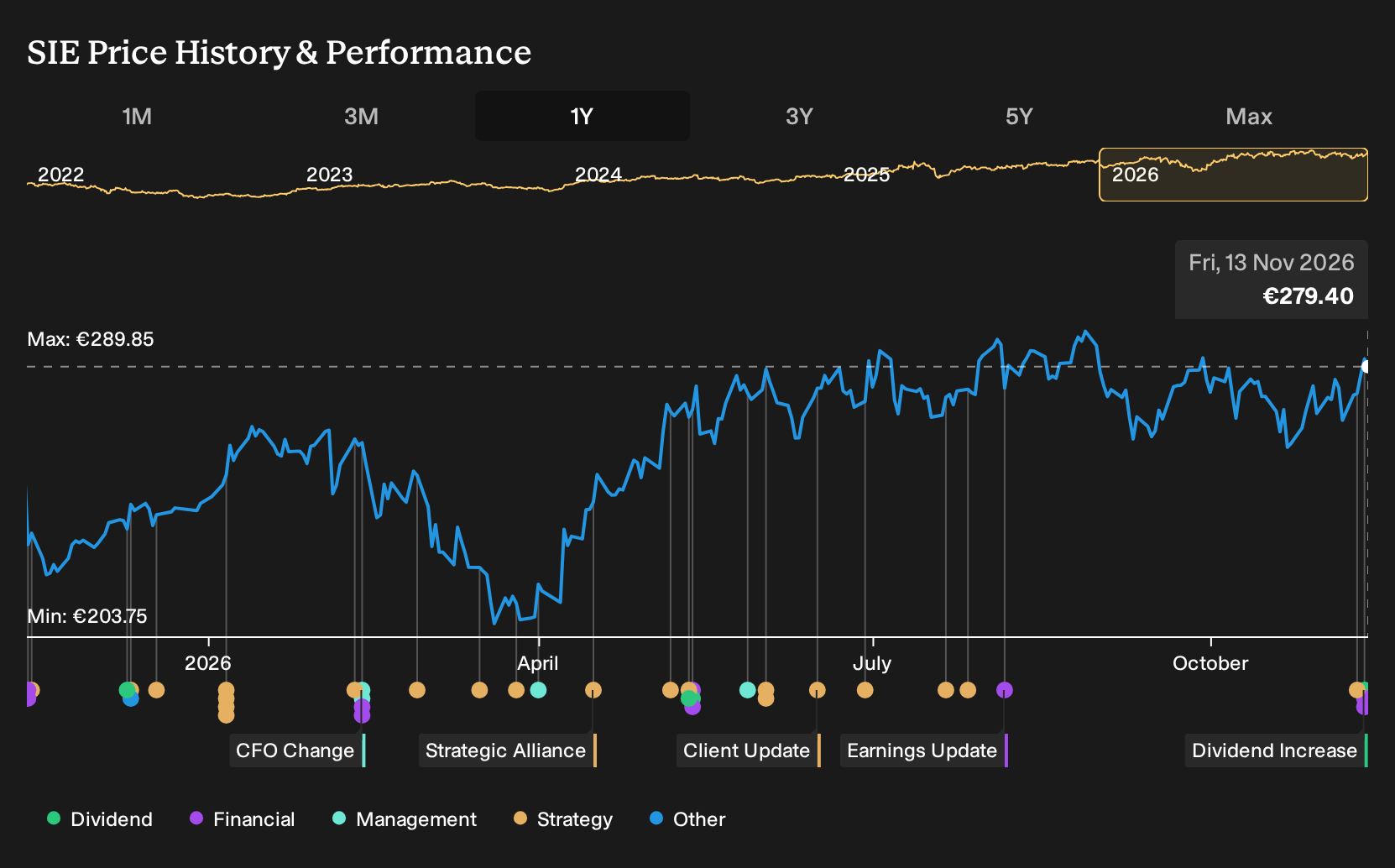
Analysts spent late 2025 arguing over whether Siemens was roughly fairly priced, with one set of assumptions pointing only slightly above the market price and another pointing below it. For Siemens shareholders, the return over the past year was 23.9%, including dividends. If you had been weighing those conflicting fair values on 13 November 2025, what exactly in the record would have justified taking that risk?
A Narrative on Simply Wall St is one investor's written case for a company, with its growth, margin and multiple assumptions spelled out. Those assumptions imply an estimated Fair Value.
The move put Siemens in the middle of this trade. Scan 53 AI infrastructure stocks for other companies exposed to it.
The Two Siemens Stories Investors Had In Front Of Them
The shares cost €227 at the start of the period, and Siemens investors were weighing two very different but plausible stories.
On the bullish side, one Narrative saw Fair Value at €246, 9% above the start price, built on 6.1% annual revenue growth and profit margins reaching 11.2% within about three years.
The more cautious view put Fair Value at €208, 8% below the start price, assuming 5.0% yearly revenue growth, a 17.0% profit margin over five years, and a future P/E of 18.0x.
What The Results Changed For The Siemens Argument
Siemens later reported Q4 2026 revenue of €23,683m and net income of €2,191m, with net margin at 9.3% versus 7.7% a year earlier. That mix of higher sales, higher profit and a wider margin leaned toward the bullish case that expected healthier profitability, although it did not directly test the specific 11.2% or 17.0% margin targets yet.
The useful takeaway is simple. When a thesis hinges on better margins, track net margin alongside revenue and earnings in each report and check whether it is actually creeping toward the level the story needs.
What Siemens' Recent Run Already Prices In
Siemens trades at €279 after a 23.9% gain over the past year. The bullish analyst Narrative on Simply Wall St sees Fair Value above that level based on a stronger mix from Smart Infrastructure and industrial software partnerships rather than just broad AI excitement.
The Narrative argues today's price still does not fully credit the possibility that higher margin Smart Infrastructure and Digital Industries cash generation can be sustained while Siemens works through restructuring and Mobility pressure.
"A key factor is that Siemens maintains execution on higher-margin Smart Infrastructure and Digital Industries guidance, while turning its record backlog and data center orders into sustained free cash flow growth despite restructuring costs and Mobility headwinds."
Not everyone reads the same price the same way. → See the higher figure this Narrative lands on, and how it gets there
Siemens And The Power Behind It
Siemens puts equipment and software inside factories, trains and data centers. Nearby, another industrial player concentrates on the electricity that keeps everything running.
Your chips, sensors and drives are useless if power is unstable. This other business focuses on generation hardware and control systems that help support dependable supply.
It also sells transformers, grid gear and software that move electricity from plant to plug. That matters as AI projects and electrification plans demand tougher, smarter grids.
The puzzle for you is simple. If Siemens stands to benefit when industry spends on automation, who stands to benefit when the grid itself must scale to match?
One Narrative has put that dependency into a written case. → See the power-grid company one Narrative values 58% above its price
Have feedback on this article? Concerned about the content? Get in touch with us directly. Alternatively, email editorial-team@simplywallst.com