


EN
How Investors Are Reacting To Ashland (ASH) Earnings And 2027 Outlook
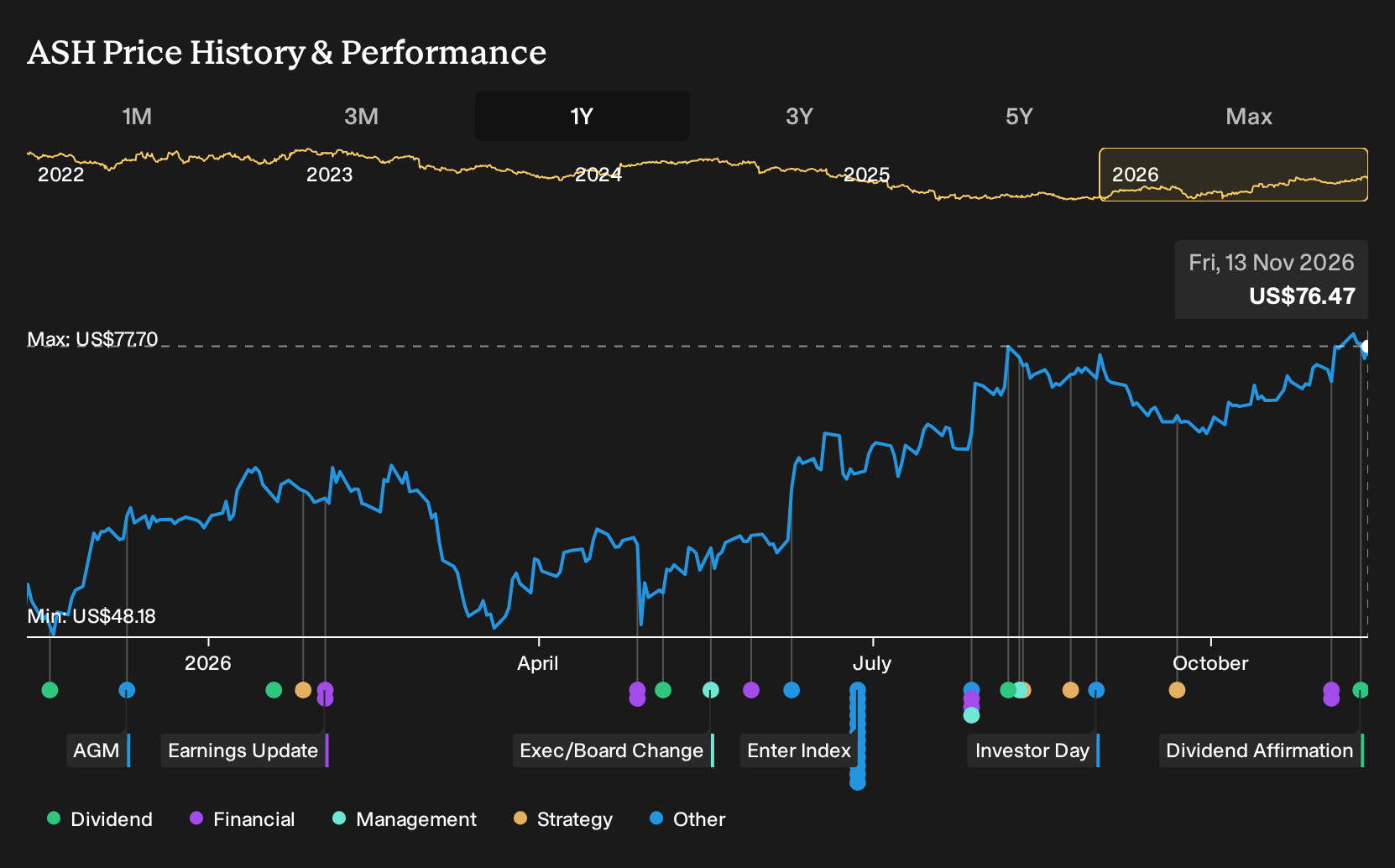
- Ashland reported fourth quarter 2026 sales of US$498 million versus US$478 million a year earlier, booked a net loss of US$16 million for the period, issued fiscal 2027 sales guidance of US$1.905 billion to US$1.975 billion, and the board approved a US$0.42 per share quarterly cash dividend payable on December 15, 2026.
- The combination of a quarterly loss, a full year 2026 profit of US$4 million after a prior year loss of US$845 million, and quantified 2027 sales expectations gives investors additional detail on Ashland’s recovery efforts and how management balances investment needs with ongoing cash returns through dividends.
- Next the focus turns to how Ashland’s new 2027 sales outlook may influence the existing investment narrative around specialty platforms and execution.
Scan how Ashland’s mix of modest 2027 sales targets and a maintained dividend compares with other potential opportunities through our curated list of 32 high quality undervalued stocks.
Ashland Investment Narrative Recap
Owning Ashland means believing the specialty ingredients portfolio can convert current operational fixes into steadier earnings while demand in life sciences and personal care holds up. The analyst consensus Narrative on Simply Wall St leans on that idea, with manufacturing optimization and platform products eventually feeding higher margins and more predictable cash generation.
The latest quarter shows that thesis is still in transition. A small full year profit alongside a fourth quarter loss and only modest 2027 sales guidance keeps the near term catalyst squarely on execution at key plants and on cost savings actually landing. Ongoing legal scrutiny remains the biggest overhang on sentiment.
The most relevant update for that thesis is Ashland’s 2027 sales outlook of US$1.905b to US$1.975b. It frames how quickly management expects the manufacturing clean up, cost actions and higher value product mix to flow into the top line. This matters if you are watching those platform bets in life sciences and personal care.
That range also interacts with catalysts highlighted in the analyst consensus Narrative on Simply Wall St, such as targeted US$50 million to US$55 million in annual manufacturing savings and growing exposure to sustainable materials. The guidance does not resolve legal or balance sheet risks, including dividend and interest coverage, so execution and cash discipline stay central to the Ashland story.
Ashland's current analyst narrative points to revenues of US$2.0b and earnings of US$195.1 million by 2029, based on revenue growth of about 3.2% per year and an earnings increase of roughly US$120 million from US$75.0 million today.
Discover why Ashland's fair value points to a 5% potential upside to its current price, which could narrow quickly.
Exploring Other Perspectives
One alternate view focuses on dividend risk. The most cautious Ashland analysts were already treating the stock as fairly priced, even while assuming revenue of about US$2.0b and earnings near US$216.7 million by 2029. That more pessimistic narrative now meets fresh earnings and a maintained payout, which could shift how you see the trade off.
Explore another Ashland fair value estimate, including one that suggests it could be worth just $80.18.
Form Your Own Verdict
Don't just follow the ticker. Dig into the data and build a conviction that's truly your own.
- A great starting point for your Ashland research is our analysis highlighting 3 key rewards and 2 important warning signs that could impact your investment decision.
- See our latest analysis for Ashland. The report includes a comprehensive fundamental analysis summarized in a single visual, the Snowflake, making it easy to evaluate Ashland's overall financial health at a glance.
Looking For More Investment Ideas Beyond Ashland?
If the Ashland story has sharpened your thinking on risk, income and balance sheets, use that same lens to scan a wider opportunity set with the Simply Wall St Screener.
- For investors who want resilient candidates first and volatility second, start with a curated set of 31 resilient stocks with low risk scores that may better suit a capital preservation mindset.
- If income is the priority and you are weighing Ashland’s payout against other options, compare its yield and stability with a focused group of 6 dividend fortresses that concentrate on cash returns.
- When quality and financial strength matter more than a familiar ticker, broaden your search through a list of solid balance sheet and fundamentals (24 results) that can help you spot sturdier alternatives.
Have feedback on this article? Concerned about the content? Get in touch with us directly. Alternatively, email editorial-team@simplywallst.com