


EN
How Strong Earnings Will Impact MetLife Stock (MET)
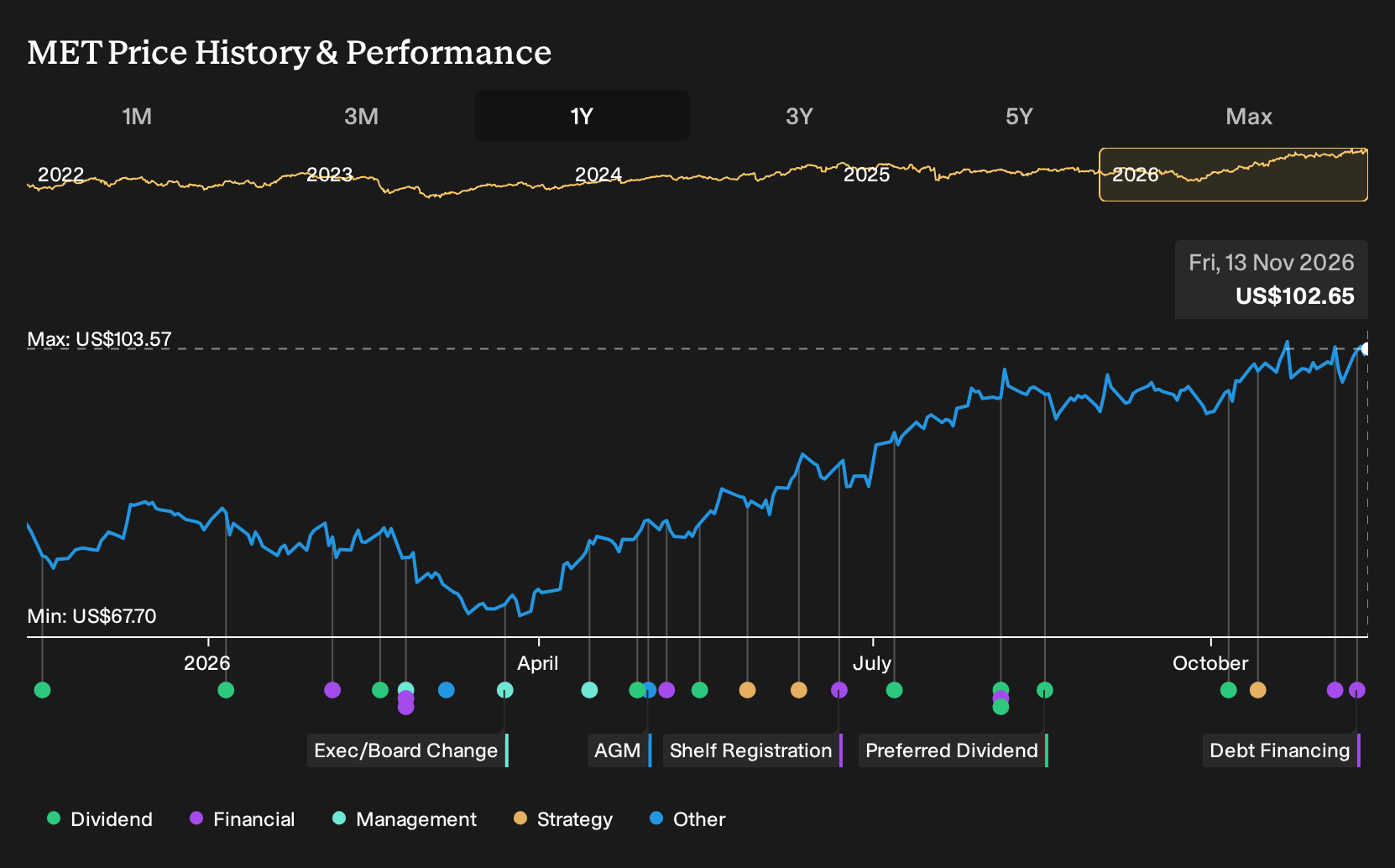
- MetLife reported third quarter 2026 revenue of US$20.522b and net income of US$2.397b, with diluted EPS from continuing operations at US$3.67.
- The company also amended and restated a revolving credit agreement that allows borrowings and letters of credit up to US$4.0b, with potential expansion to US$5.5b for general corporate use.
- This analysis considers how MetLife's stronger quarterly earnings shape the existing investment narrative and whether they reinforce or challenge it.
Scan how MetLife's latest earnings and fresh credit capacity compare with other insurers by reviewing a curated 31 resilient stocks with low risk scores designed to pair resilient balance sheets with steadier risk profiles.
MetLife Investment Narrative Recap
To own MetLife, an investor has to believe the New Frontier plan, cost control and international segments can keep supporting earnings quality even as headline growth expectations stay moderate. The latest quarter’s higher revenue and net income help that case, but the short term focus still sits on whether fee based lines and spreads can hold up.
The biggest risk flagged in the analyst consensus Narrative on Simply Wall St is pressure on MetLife Investment Management earnings and Retirement and Income Solutions spreads. The amended revolving credit capacity looks more like plumbing than a catalyst. It adds flexibility, but does not materially change near term earnings drivers or risks.
The amended and restated credit agreement out to 2031 is the announcement that ties closest to this story. It gives MetLife committed access to up to US$4.0b, with an option to increase that to US$5.5b if no default exists, and facilities can support general corporate uses rather than a single project.
For you, the link back to catalysts is about execution, with a relatively high debt load already identified as a risk. Reliable bank liquidity can support the New Frontier program, tech investment and retirement flows, yet it also keeps attention on how the insurer prices risk, manages spreads and converts that balance sheet flexibility into durable earnings.
What The Current Forecasts Assume For MetLife
MetLife's narrative projects US$91.4b revenue and US$7.1b earnings by 2029. This implies 3.4% yearly revenue growth and an earnings increase of about US$2.1b from the current US$5.0b level.
Uncover why MetLife's fair value indicates a 7% potential upside to its current price, which could narrow quickly.
Exploring Other Perspectives
Two fair value estimates from the Simply Wall St Community span roughly US$110 to US$162 per share, which shows how far apart retail views on MetLife can be. When you set that against continued pressure on fee based earnings and spreads, it becomes clear why opinions differ so widely. Explore those contrasting viewpoints directly.
Explore another MetLife fair value estimate, including one that suggests it could be worth just $110.31.
Decide For Yourself
Disagree with existing narratives? Extraordinary investment returns rarely come from following the herd, so go with your instincts.
- A great starting point for your MetLife research is our analysis highlighting 4 key rewards and 1 important warning sign that could impact your investment decision.
- See our latest analysis for MetLife. The report includes a comprehensive fundamental analysis summarized in a single visual, the Snowflake, making it easy to evaluate MetLife's overall financial health at a glance.
Looking For More Investment Ideas Beyond MetLife?
If MetLife is only one piece of your watchlist, it can help to line it up against other companies with similar qualities and different risk and return profiles. The Simply Wall St Screener lets you quickly filter for themes that match your approach.
- If you care most about financial resilience and staying power, start with a list of solid balance sheet and fundamentals (24 results) that can help you focus on companies with stronger foundations.
- Income focused investors can scan for dependable cash returns by using a 6 dividend fortresses built around higher yielding payouts.
- If you prefer to hunt for mispriced opportunities, broaden your research with a 20 high quality undiscovered gems that highlights less crowded ideas with solid fundamentals.
Have feedback on this article? Concerned about the content? Get in touch with us directly. Alternatively, email editorial-team@simplywallst.com