


EN
Why Did Tokyu REIT (TSE:8957) Move Today?
Tokyu REIT (TSE:8957) has put income in focus after declaring a semi-annual dividend of ¥4,030 per share, payable on April 15, 2027, with an ex-date of January 28.
At a share price of ¥180,400, Tokyu REIT has seen its 1-day share price return rise 2.15%, even though the year-to-date share price return is down 12.17% and the 1-year total shareholder return has declined 7.79%. The 3 and 5-year total shareholder returns of 13.57% and 15.90% suggest longer term holders have still seen positive outcomes overall.
Capitalize on Tokyu REIT's dividend momentum by scanning a curated 28 dividend fortresses that could appeal to the same income-focused approach.The market reaction to Tokyu REIT’s latest move is clear, but the valuation picture is not. Does a share price around ¥180,400 reflect fair value, or is there a gap to analyst estimates near ¥194,750?
Preferred P/E of 16.2x for Tokyu REIT: Is it justified?
Tokyu REIT trades on a P/E of 16.2x, a level that sits above both its direct peers and the broader Asian Office REIT group at the latest close near ¥180,400.
The P/E ratio compares the current share price with earnings per share. For a real estate trust like Tokyu REIT, it signals how much investors are willing to pay for each unit of current profit. This matters when payouts such as the recently declared dividend are a central part of the story.
A P/E of 16.2x that is described as expensive suggests the market is paying a higher price for each yen of earnings than for similar REITs. That premium sits against mixed signals, such as earnings growth of 11.7% over the past year but a 0.4% annual earnings decline over five years, and a dividend that is not well covered by profits. These factors may limit how easily earnings can support both income and valuation over time.
Compared with the peer average P/E of 15.2x and the Asian Office REITs industry at 14.2x, Tokyu REIT trades on a clearly richer multiple. The current rating therefore prices the trust above sector norms rather than in line with them.
Result: Price-to-earnings of 16.2x (OVERVALUED)
See what the numbers say about this price — find out in our valuation breakdown.
Still, the income story around Tokyu REIT could be challenged if earnings weaken further or if the dividend continues to be poorly covered by profits.
Find out about the key risks to this Tokyu REIT narrative.
Another View on Tokyu REIT’s Value
The earlier P/E discussion described Tokyu REIT as expensive at 16.2x earnings, yet the SWS DCF model points in the opposite direction. On that framework, a share price of ¥180,400 sits about 68% below an estimated future cash flow value around ¥563,433 per unit.
That kind of gap suggests a very different type of risk. Instead of focusing on whether you are paying too much for each yen of current profit, you are weighing whether the assumptions inside the cash flow model are too generous or whether the market is pricing in heavier headwinds than the P/E indicates. Which set of expectations appears more reasonable?
Look into how the SWS DCF model arrives at its fair value.
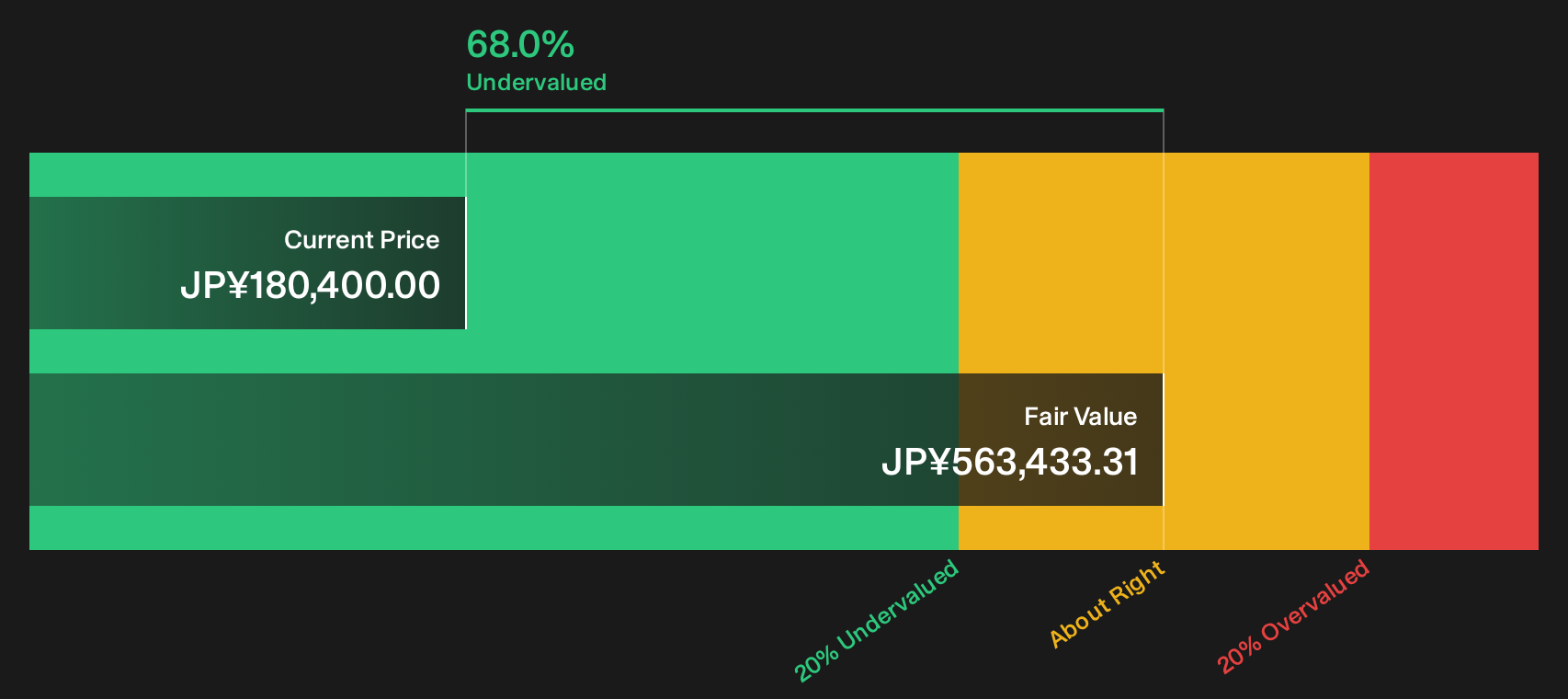
Simply Wall St performs a discounted cash flow (DCF) on every stock in the world every day (check out Tokyu REIT for example). We show the entire calculation in full. You can track the result in your watchlist or portfolio and be alerted when this changes, or use our stock screener to discover 19 high quality undervalued stocks. If you save a screener we even alert you when new companies match - so you never miss a potential opportunity.
Next Steps
Conflicting signals on Tokyu REIT can easily pull you in opposite directions, so move quickly, review the data in full, and weigh both the 2 key rewards and 4 important warning signs.
Looking for more income ideas beyond Tokyu REIT?
If Tokyu REIT has your attention today, expand your watchlist with a few focused stock ideas that could sharpen your income and diversification plan.
- Target reliable cash returns by scanning a curated pool of higher yield opportunities through the 28 dividend fortresses.
- Hunt for quality at sensible prices by running your filters across the 72 high quality undiscovered gems before others catch on.
- Reduce portfolio stress and focus on resilience by reviewing companies that pass the 20 resilient stocks with low risk scores.
Have feedback on this article? Concerned about the content? Get in touch with us directly. Alternatively, email editorial-team@simplywallst.com