


EN
Is Goosehead Insurance (GSHD) Undervalued On Its Filing Delay And Restatement News?
Goosehead Insurance (GSHD) is back under the microscope after telling investors it will miss the Q3 10-Q deadline and will restate earlier financials, while a shareholder law firm probes its revenue recognition practices.
At about $46.10 a share, Goosehead Insurance has seen momentum swing sharply, with the 1 day share price return of 0.96% coming after a 7 day share price decline of 17.01% and a 90 day slide of 30.46%, while the 1 year total shareholder return is down 33.22% despite earlier guidance reaffirmation and the recent restatement-driven delay in Q3 reporting.
Broaden your watchlist beyond Goosehead Insurance by scanning a curated group of 31 resilient stocks with low risk scores that may offer a different balance of volatility and business transparency.
The selloff, the restatement overhang, and the guidance reaffirmation now converge at roughly $46 a share. Does that setup still skew the risk and reward in favor of fresh Goosehead Insurance buyers, or not?
Most Popular Narrative: 26% Undervalued
Against a last close of $46.10, the analyst consensus Narrative on Simply Wall St marks Goosehead Insurance’s fair value at about $62.08, pointing to a sizeable valuation gap that rests on execution, capital returns, and margin resilience.
Goosehead Insurance's capital light model, together with over 1 million Class A shares repurchased for US$53.7 million year to date in Q2 2026 and a remaining authorization of US$144.6 million, supports ongoing buybacks alongside US$25 million to US$35 million of annual investment in digital and AI tools. This can lift per share earnings and improve return on capital over time.
See why 10 investors see Goosehead Insurance as 26% undervalued.
Result: Fair Value of $62.08 (UNDERVALUED)
Still, the narrative around Goosehead Insurance can unravel if technology spending weighs on profitability for longer than analysts expect or if organic growth softens further.
Find out about the key risks to this Goosehead Insurance narrative.
Another Take On Goosehead Insurance Valuation
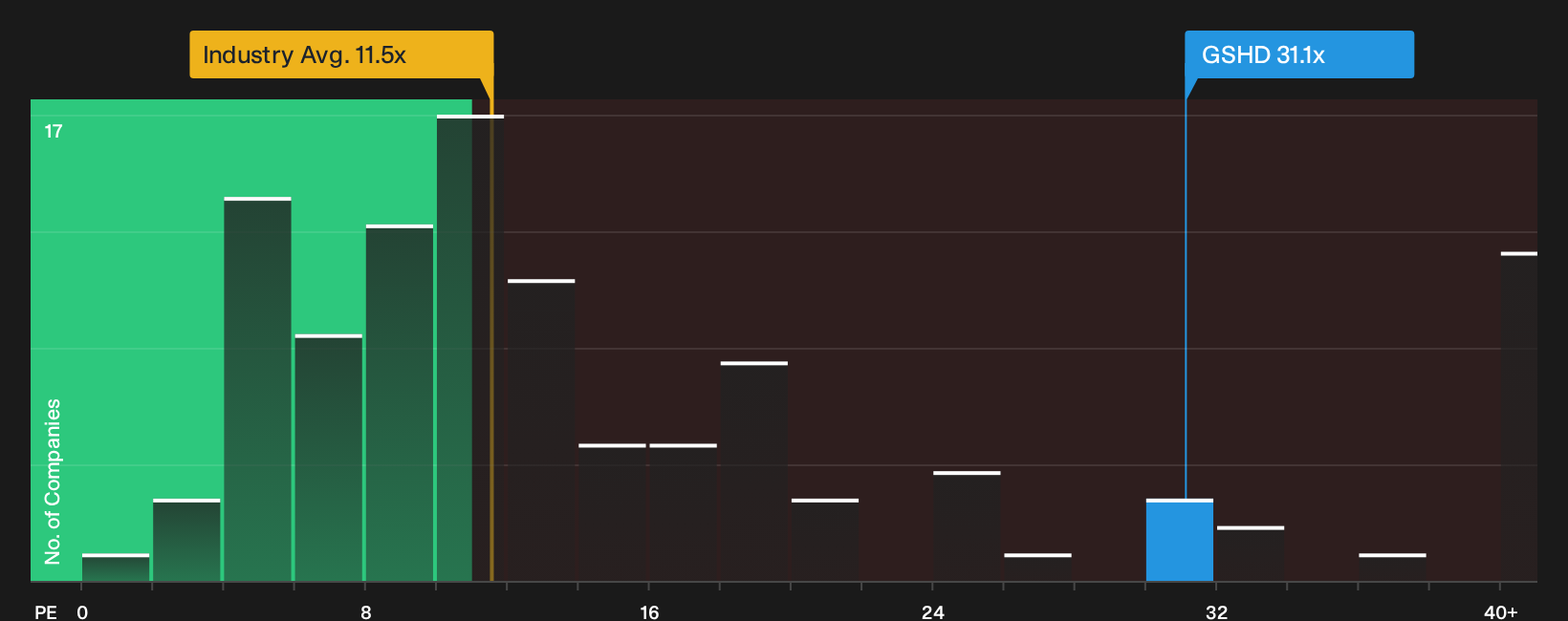
The first view paints Goosehead Insurance as undervalued using forward-looking fair value estimates. A different lens, the simple P/E ratio, tells a tougher story. At 31.1x earnings, the stock trades at a heavy premium to the US Insurance sector on 11.5x and above a fair ratio of 22.2x. This raises the risk that sentiment, not fundamentals, has less room for disappointment. Where does that leave an investor weighing upside against the chance of a valuation reset?
See what the numbers say about this price — find out in our valuation breakdown.
Next Steps
Mixed signals around Goosehead Insurance do not have to leave you on the sidelines, especially when fresh information can shift sentiment fast. Weigh both caution and optimism for yourself by looking through the 3 key rewards and 2 important warning signs.
Looking for more investment ideas beyond Goosehead Insurance?
If Goosehead Insurance has earned a spot on your radar, consider rounding out your watchlist with a few focused ideas that can help you decide where to deploy fresh capital.
- Identify potential mispricings and sort through quality companies that screens highlight as attractively valued using the 32 high quality undervalued stocks.
- Strengthen your portfolio’s resilience by scanning a list of solid balance sheet and fundamentals (24 results) that may better handle shocks and funding pressure.
- Search for tomorrow’s potential standouts early by reviewing 20 high quality undiscovered gems before the wider market takes a closer look.
Have feedback on this article? Concerned about the content? Get in touch with us directly. Alternatively, email editorial-team@simplywallst.com