


EN
Wolfe Research Just Endorsed Nvidia Amid Turmoil: Its Leader Is Gone, But Not Its Power
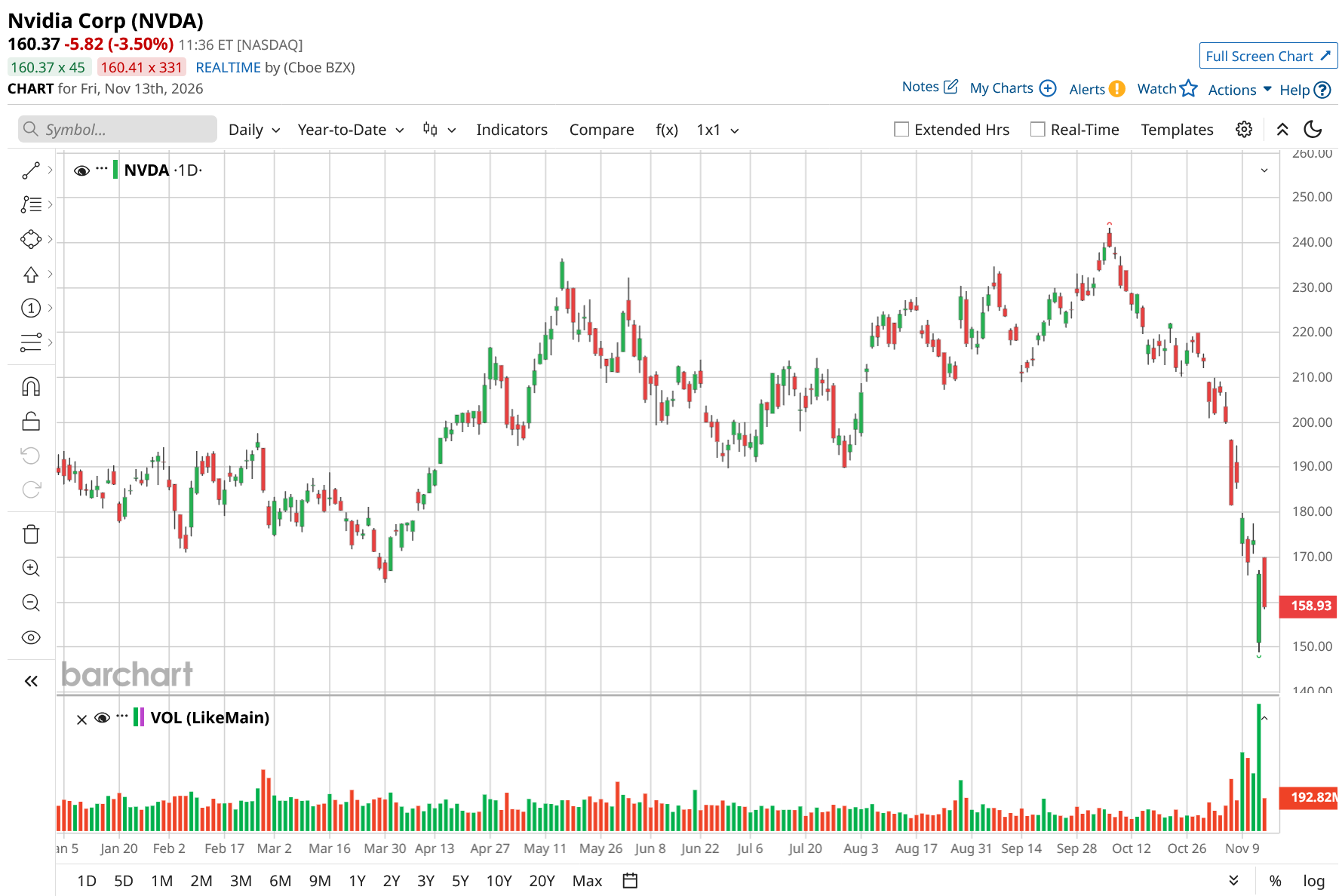
Shares of Nvidia (NVDA) cannot catch a break right now. They ended more than 4% lower in yesterday's trading session after the man in the middle of the storm—Jensen Huang—resigned from his position as the CEO of the company. The company promptly announced CFO Colette Kress as interim CEO to stem the decline.
Having said that, some of the leading institutions on Wall Street continue to back the company. Following Mizuho, another leading name on Wall Street has voiced its support for the chip giant in Wolfe Research's Chris Caso. In an interview with CNBC, Caso opined that Huang's departure from the company would not affect it in the long term, as it already had its product lineup ready.
Caso also highlighted the stock's cheap valuations as a reason for owning it now. Trading at less than 10 times its projected 2028 earnings, Caso said, “With respect to the stock, I think much as the horses have left the barn on this.”
Nvidia's Power Wielder Is Gone, Not Its Powers
Caso's argument may have some legs, as even after all the controversies, Nvidia is now only barely the worst-performing “Mag Seven” stock of the year; until this week, it had been Tesla (TSLA). While NVDA stock is down 14.2% on a year-to-date (YTD) basis, TSLA has declined by 13.3% in the same period. So, how should NVDA stock be viewed as an investment now?
Quite favorably if one looks beyond all the noise emanating right now. Nvidia still holds a market share of more than 80% in GPUs, and the demand for its Grace Blackwell and the latest Vera Rubin AI rack-scale systems remains strong, with CUDA being the company's most defensible moat. These strengths have not suddenly disappeared.
CUDA provides developers with a comprehensive platform for harnessing the parallel-processing capabilities of Nvidia GPUs, supported by an extensive collection of optimised libraries, programming tools, and frameworks, and over nearly two decades, it has become deeply embedded in AI research, model development, and enterprise computing workflows.
This is not to say that there is no competition. AMD (AMD) has ROCm, and Intel (INTC) has OneAPI. However, while ROCm has been around for 10 years, OneAPI has been in existence for just about seven years. Thus, the head start that CUDA has got is crucial, and it has become deeply entrenched in the developer community, making switching to other systems a costly affair (no pun intended).
Rock Solid Financials
Interim CEO Colette Kress deserves credit for commendably steering Nvidia's finances over the years, playing a crucial role in it becoming one of the most valuable companies of the world. This was reflected in the most recent quarter as well.
In its most recent results for the second quarter of fiscal 2027, Nvidia reported revenue of $96.2 billion, representing a 106% rise from the year-over-year (YoY) period and surpassing consensus estimates. Data center revenue advanced 117% YoY to $89 billion. For the third quarter of fiscal 2027, the company guided for a total revenue of $108 billion plus or minus 2%.
Earnings per share climbed 120% YoY to $2.22, exceeding the consensus estimate of $2.09 and extending Nvidia’s streak of consecutive earnings beats. Gross margins expanded to 75% from 72.4% in the prior-year period. Although the company’s projected gross margin of 74% for the third quarter drew some criticism from observers seeking potential soft spots in the investment case, shares advanced after the second-quarter results, ending a four-quarter sequence in which the stock declined immediately following earnings announcements.
A notable point from the second-quarter earnings discussion was Amazon’s (AMZN) plan to deploy 2 million Nvidia graphics processing units for Amazon Web Services through the second quarter of fiscal 2029. This announcement helped ease concerns that large hyperscalers such as Amazon might develop their own chips or application-specific integrated circuits and reduce dependence on Nvidia products.
Net cash from operating activities in the second quarter rose to $24.1 billion from $15.4 billion in the year-ago period. The total included $7.8 billion in gains from equity investments in companies such as OpenAI, SpaceX (SPCX), CoreWeave (CRWV), and Nebius (NBIS). At the same time, accounts receivable increased substantially during the quarter, a development that has fueled ongoing discussion about potential circular financing risks. Nvidia ended the quarter with $22.4 billion in cash, well above its short-term debt balance of $1 billion.
Nvidia is scheduled to report its third-quarter results on Nov. 17 after the market closes, and all eyes will be on Kress, with clarity expected on her roadmap for the company.
Analyst Opinion on NVDA Stock
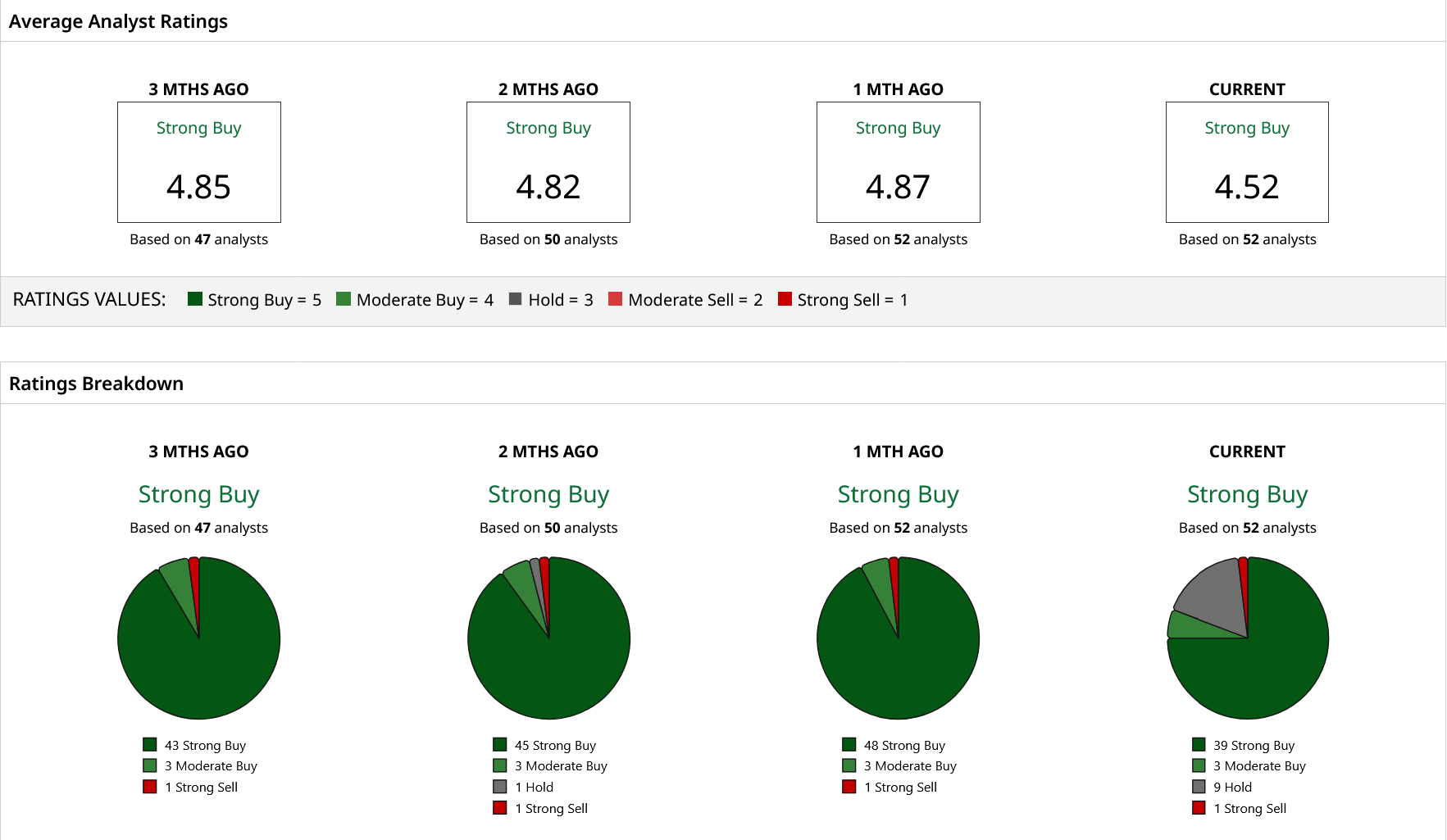
Given this, analysts continue to assign a consensus “Strong Buy” rating to NVDA stock. Out of 52 analysts covering Nvidia, 39 have a “Strong Buy” rating, three have a “Moderate Buy” rating, nine have a “Hold,” and one analyst has a “Strong Sell” rating. The mean target price of $292.40 indicates a potential upside of 84% from current levels.
On the date of publication, Pathikrit Bose did not directly have a position in any of the securities mentioned in this article. All information and data in this article is solely for informational purposes. For more information please view the Barchart Disclosure Policy here.