


EN
SMCI Stock Alert: Super Micro Computer Slammed By Alice Huang-Linked Server Smuggling Probe
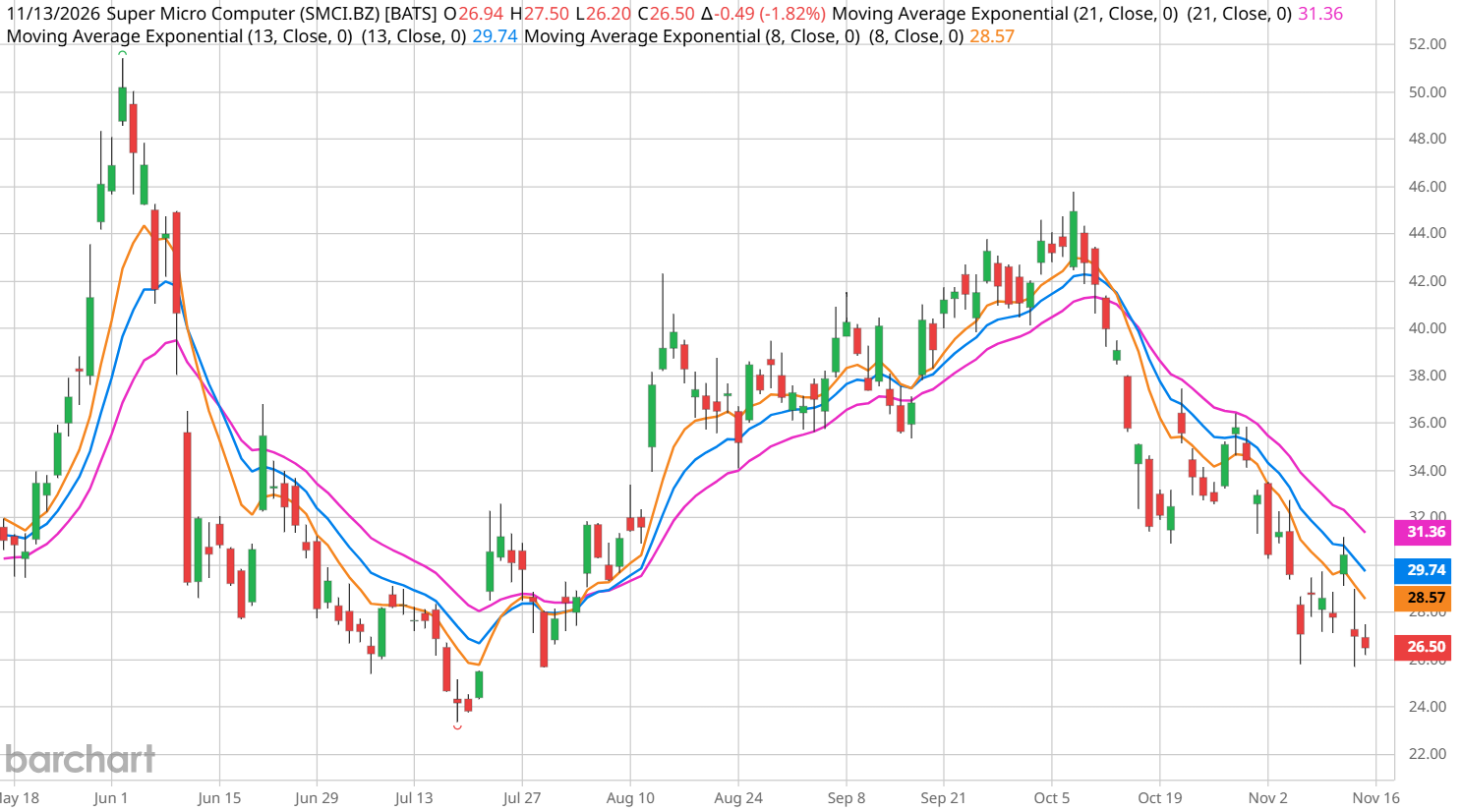
Super Micro Computer (SMCI) plunged 11.3% on Thursday to close at $26.99 after word emerged that Manhattan federal prosecutors are examining whether entities linked to Alice Huang helped smuggle the company's servers into China, extending a roughly 31% one-month slide.
Yet the most telling detail may be what didn't move — peers Dell (DELL) and HPE (HPE) held steady during the selloff, suggesting investors are isolating compliance fears in Super Micro rather than punishing the AI server category as a whole. That divergence is the real story behind Thursday's rout.
The drop also came alongside a leadership crisis at Nvidia (NVDA) and Jensen Huang's resignation, adding another layer of turbulence for an AI hardware supply chain already on edge. SMCI has opened weak again today, off 2% in the early going.
A New Probe on Top of an Old Overhang
The new investigation compounds an existing legal overhang that includes the March indictment of co-founder Wally Liaw over roughly $2.5 billion in allegedly diverted servers, as well as a guilty plea from a former contractor.
Friday brought fresh pressure as documents surfaced showing 52 Super Micro units with H100 or H200 chips among servers pledged as collateral by a Shanghai firm founded by Alice Huang and later controlled by her sister, while Singapore publicly faulted the company for limited cooperation with its investigation.
Super Micro Pushes Back
Super Micro maintains that it sold the identified servers in compliance with export laws, has never counted Megaspeed as a customer, and has not received any new notice from US agencies. Those claims put the burden on prosecutors, who have yet to signal whether charges will follow.
Management also points to an August independent review that cleared current senior leadership of involvement in the earlier diversion scheme — a defense that so far hasn't stopped the stock from bleeding.
SMCI's Growth Engine Is Still Roaring
Fiscal first-quarter revenue ballooned 298% to $19.9 billion, and management raised full-year guidance to a range of $72 billion to $82 billion. That top-line surge stands in sharp contrast to a share price that has shed nearly a third of its value in just a month.
Geographic exposure also tilts away from the controversy, with about 80% of revenue coming from the US and only about 5.5% from Asia — a split that undercuts the idea that China-related risk threatens the core business.
However, that growth is offset by genuine fundamental weaknesses, including gross margin compressed to 12.8% and free cash flow of negative $481 million. Concentration is another pressure point, with one customer accounting for 44% of sales while the company carries $8.6 billion in debt.
A 4x Multiple Says It All
At roughly 4x forward earnings — a strikingly low multiple for a company that nearly quadrupled its quarterly revenue — the market is clearly assigning a steep discount for legal, governance, and concentration risk.
The contrast with Dell and HPE reinforces that the SMCI stock discount is company-specific, and effectively a compliance penalty rather than a verdict on AI server demand.
What’s Next for SMCI Stock
Near-term catalysts include Nvidia's November 17 earnings, Jensen Huang's congressional testimony before Thanksgiving, and possible tighter export licensing across Southeast Asia. Nvidia's results will be closely watched for read-through on AI server demand, especially given the turmoil surrounding its leadership.
Until prosecutors signal whether charges will follow, the stock is likely to trade on headlines rather than fundamentals. That makes SMCI a high-beta, speculative position suitable only for investors who can tolerate binary legal outcomes, where a 298% growth story can be overshadowed by a single courtroom filing.
This article was created with the support of automated content tools from our partners at Sigma.AI. Together, our financial data and AI solutions help us to deliver more informed market headline analysis to readers faster than ever.
On the date of publication, Sarah Holzmann did not directly have a position in any of the securities mentioned in this article. All information and data in this article is solely for informational purposes. For more information please view the Barchart Disclosure Policy here.