


EN
Where Will SoFi Stock Be in 2030? Its Goal Is 100 Million Products.
Key Points
Several of SoFi Technologies’ key metrics are showing strong growth.
Two of its lesser-watched measures of progress, however, are demonstrating sensational growth.
Progress on one of these measures is important because it allows SoFi to cost-effectively add recurring revenue.
The primary purpose of any for-profit company turning as much revenue as possible into as much profit as possible. How it intends to plausibly do that, however, is just as important to interested investors.
While online bank SoFi Technologies (NASDAQ: SOFI) celebrated its customer headcount growing 35% year over year to 17.1 million during the third quarter of 2026, that's not the only metric that matters. Neither are revenue growth of 44% (to $1.4 billion) or the 70% year-over-year improvement in EBITDA (to $470 million).
Missed AI’s "Act 1"? Act 2 Could Be 15x Bigger. Most investors think they missed the AI boat because they didn't buy Nvidia in 2005. But according to our analysts, we’re only at the end of "Act 1"—the R&D phase. "Act 2" is the global rollout. Continue »
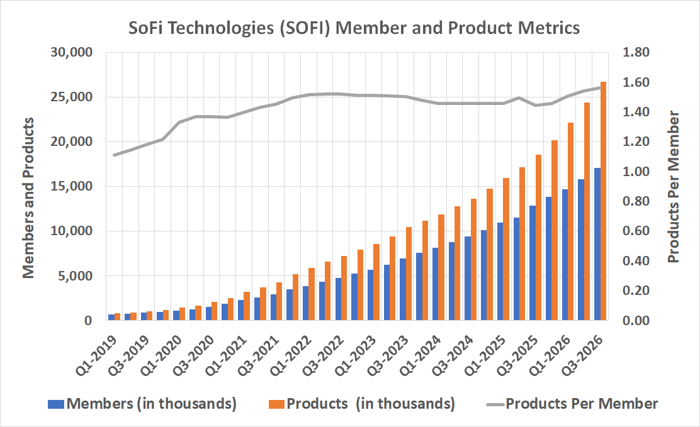
Just as important right now for SoFi is the number of individual products or services -- like brokerage accounts, savings, insurance, credit cards, etc. -- its customer base now uses. This number grew 44% to a record 26.7 million in Q3, as more than half of its current customers signed up for another service.

Image source: Getty Images.
It matters because any company's most likely and most cost-effective sales prospect is an existing customer already in its ecosystem.
Extending current trends
Don't misunderstand. Maximizing net income is still the ultimate goal. Clear, plausible pathways to reaching a goal, though, bolster the bullish case for any publicly traded outfit. This one is no exception.
And SoFi Technologies' growth outlook is not only compelling, but plausible.
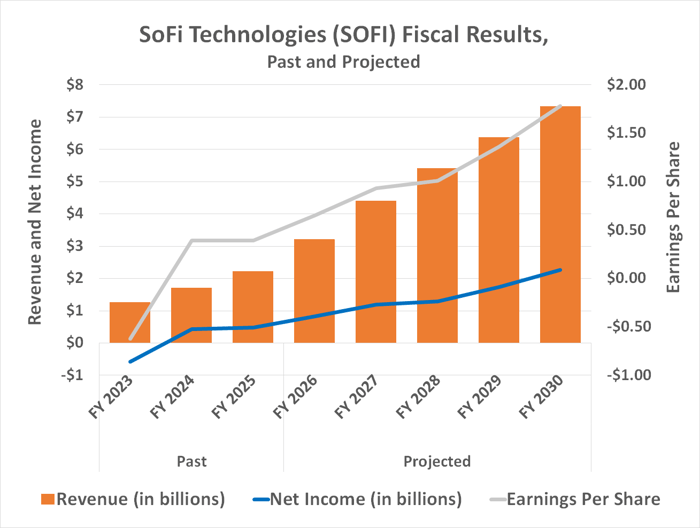
Yes, the company's got longer-term revenue and earnings goals. For instance, SoFi Technologies is aiming to generate at least $8 billion in annual revenue by 2030, up from a little over $5 billion this year, and $6.4 billion in sales next year, $2.24 billion of which should be turned into EBITDA. And based on nothing more than its current fiscal trajectory, these are very achievable targets.
Data source: Morningstar. Chart by author.
This long-term outlook may actually understate what's in store, however, given SoFi's secret weapon hiding in plain sight. That's its existing customer base of 17.1 million customers, which has steadily grown from a headcount of just over 1 million as of the first quarter of 2020. As it turns out, this is a fantastic source of opportunities for continued growth.
Looking ahead
CEO Anthony Noto made no bones about it during Q3's earnings conference call, explaining, "We see a clear path to achieving 100 million products by the end of 2030." That's a 4x increase over its total right now.
The company doesn't necessarily need to quadruple its membership base to reach that target, though. The longer SoFi Technologies remains in business and the longer its customers utilize the online bank's offerings, the more comfortable they become with the brand. That's why, as of Q3, every member now uses an average of 1.56 SoFi products, up from 1.47 a year earlier, and well up from 1.36 as of 2020.
Data source: SoFi Technologies. Chart by author.
Assuming the growth pace of both numbers remains in place until then, SoFi Technologies should have no problem reaching Noto's goal. Revenue and earnings are sure to follow suit.
Perhaps more important to interested investors, assuming the company can continue growing like it is, SOFI shares could conceivably at least double in value by 2030. Some of this potential growth is already priced in, but at only 18 times next year's projected per-share profit of $0.90, certainly much of it isn't.
James Brumley has no position in any of the stocks mentioned. The Motley Fool has no position in any of the stocks mentioned. The Motley Fool has a disclosure policy.