


EN
‘SaaSpocalypse’ Fears Hit Microsoft Stock Again. Don’t Rush to Buy the Dip.
“SaaSpocalypse” fears have been hitting software stocks intermittently over the last couple of years. We've seen instances where a competing product launch from an artificial intelligence (AI) company has triggered a selloff in software stocks. For instance, ArtCraft used Claude to come up with an open-source suite of products that rivalled Adobe (ADBE), triggering a selloff in the stock.
Now, we have a Claude connection with Microsoft (MSFT) as Anthropic has launched its own spreadsheet software. Expectedly, MSFT stock fell on Nov. 11 after the news broke. Anthropic’s launch comes shortly before its proposed listing later this month, and it is not uncommon to see companies making big announcements or product reveals heading into their IPOs. Here we are talking about one that could rank among the biggest public debuts ever.
MSFT Stock Falls Amid SaaSpocalypse Fears
Coming back to Microsoft, the stock has grappled with SaaSpocalypse fears previously also, and it is among the reasons that drove its underperformance among Mag 7 stocks. Things, however, changed after the company’s June quarter earnings, and it rose the most among the Mag 7. MSFT subsequently built on those gains to rise nearly 38% in Q3 to log its best quarter since 1998.
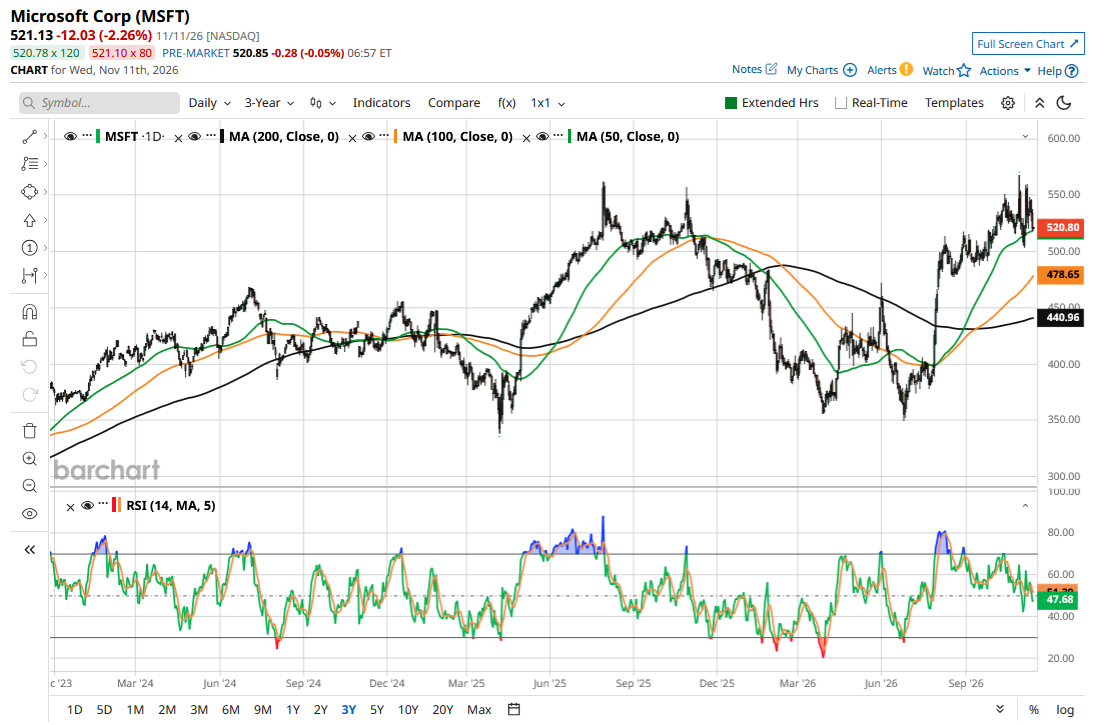
I was bullish on Microsoft this year, but ahead of its fiscal Q1 2027 earnings last month, I noted that its re-rating story has largely run its course. With MSFT stock coming off its 2026 highs, let’s explore whether the risk-reward is looking any attractive now.
AI Startups Are Both an Opportunity and Threat for MSFT
Unlike traditional software stocks whose very business model is at risk from AI startups offering similar services, in Microsoft’s case, AI is both an opportunity, as well as a threat. For instance, Anthropic is a customer for Microsoft’s cloud services. Strong demand from AI companies has helped drive cloud demand, and leading players are reporting strong growth.
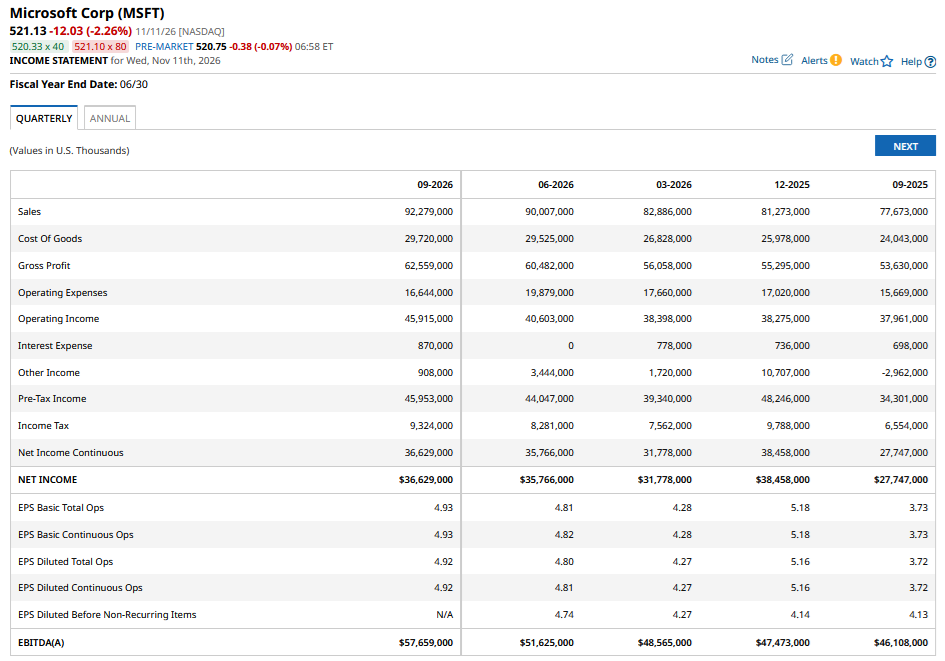
For instance, Azure revenues grew 48% year-over-year (YoY) last quarter, and the company expects them to grow between 49% and 50% in the current quarter. While most of us know Microsoft for its Office and Windows suite of products, Azure is now the company’s single biggest business line, accounting for almost 36% of its revenues.
Microsoft is the second-largest cloud company in the U.S. after Amazon (AMZN) and is among the biggest beneficiaries of strong demand amid the AI pivot. Like fellow Big Tech companies, Microsoft has backed AI startups, and, apart from being OpenAI’s biggest shareholder, it has invested in Anthropic and plans to participate in the company’s pre-IPO private placement. Put simply, Anthropic’s success would not only help buoy demand for Microsoft’s cloud service but also mean gains on its investment in the company.
That is not to suggest that Claude’s Excel-style software doesn’t pose any threat to Microsoft, as it would compete with the company’s 365 suite and could impact its growth. Notably, growth in Microsoft 365 commercial seats slowed down to 5% in the most recent quarter, which the company partially attributed to “weaker sales execution.”
However, Microsoft is notorious for its bundling strategy, and customers generally buy a wider suite rather than a single application. While Claude’s spreadsheet software could attract some of Microsoft’s customers, I doubt they would end up canceling their subscriptions. This would particularly hold true for enterprise customers that rely on Microsoft’s bundled licensing. On a similar note, Claude’s Sheets and Whiteboards are off by default for enterprise customers.
All said, risks from AI startups are for real, and it needs to be factored into valuations. Microsoft is expected to post an adjusted EPS of $20.01 in the current fiscal year, which gives us a forward price-to-earnings (P/E) multiple of around 26x. I don’t see much margin of safety in MSFT at these levels and would therefore be wary of buying the dip. At the same time, they are not exorbitant enough to sell the stock, and I would therefore keep holding MSFT while awaiting any major movement in its stock price for my next move.
On the date of publication, Mohit Oberoi had a position in: MSFT , AMZN . All information and data in this article is solely for informational purposes. For more information please view the Barchart Disclosure Policy here.