


EN
Bread Financial (BFH) Stock Looks Below Fair Value After Its 272% Run
Bread Financial Holdings has turned in a powerful run over the past few years, and the share price now reflects a very different business than it did three years ago. With that backdrop, the real puzzle for you as an investor is whether the current valuation of Bread Financial is properly anchored to its earnings profile.
- The stock has surged 271.6% over the past 3 years, which puts the spotlight squarely on whether that gain lines up with the strength and resilience of its earnings.
- The company leans heavily on its ability to generate profit from private label credit and payment solutions, so the durability of credit spreads, funding costs and credit losses can directly shape how much you might be willing to pay for each dollar of earnings.
- The analysts covering Bread Financial Holdings have run their own numbers. See what analysts think Bread Financial Holdings's shares could be worth.
The stock's next move may depend on whether Bread Financial's current share price can be supported by its earnings power today and what those profits may look like over time.
If you want more context for Bread Financial's earnings story, compare it with other companies through 32 high quality undervalued stocks.
Does Bread Financial Holdings Look Undervalued on Earnings?
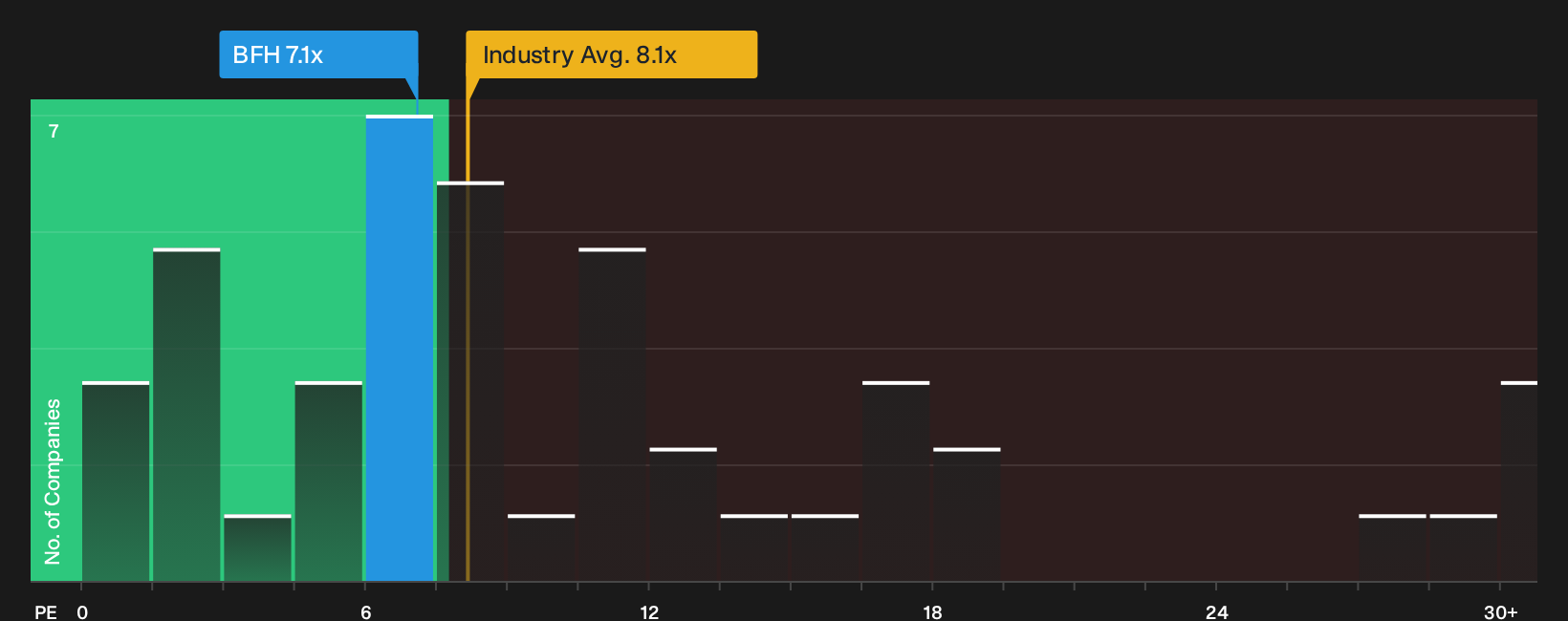
The P/E ratio fits Bread Financial Holdings well because earnings power is central to how investors judge a consumer finance business. Right now the stock trades on about 7.1x earnings. That is below the Consumer Finance industry average of roughly 8.1x and also well under the wider peer group on about 15.6x. As a result, the market is paying a lower price for each dollar of Bread Financial's profit than for many comparable lenders.
The Fair Ratio model, which adjusts the benchmark P/E for Bread Financial's own return on equity, balance sheet profile and other fundamentals, points to a higher multiple than the one investors are currently paying. That gap suggests the market price may be underestimating the earnings the company can sustain relative to similar businesses, although you would still want to weigh credit risk, funding costs and the cycle for consumer borrowing before leaning on that signal too heavily. Explore the numbers behind Bread Financial Holdings's P/E valuation.
The Bread Financial Holdings Narrative: What Would Justify Today's Price?
Narratives pick up where the P/E question leaves off for Bread Financial Holdings by spelling out which paths for future growth, profitability and earnings would need to play out for the shares to be worth significantly more or less than today. Each one sets out Bread Financial Holdings' implied fair value as a thesis about how the business might perform that you can track over time, rather than treating it as a one off snapshot, and they sit on Simply Wall St's Community page.
On Bread Financial Holdings, one camp sees technology and credit discipline creating headroom, while the other worries rising partner and funding costs keep a lid on earnings power.
Bull case: 15% undervalued
This view comes from the analyst consensus Narrative on Simply Wall St, which leans on efficiency gains and balance sheet repair.
"Bread Financial Holdings continues to invest in technology modernization, digital product development, and AI-driven solutions. These are already yielding tens of millions of dollars per year in efficiency gains..."
Discover why this Narrative puts Bread Financial Holdings at 15% undervalued.
Bear case: 6% overvalued
This angle reflects the bearish analyst Narrative on Simply Wall St, which focuses on mix shifts and rising partner economics.
"While new co-brand and big-ticket retail programs and Bread Pay installment loans are contributing a growing share of loan growth, these products carry lower APRs and rely more heavily on retailer share arrangements..."
Explore why this Narrative puts Bread Financial Holdings at 6% overvalued.
One more thing about Bread Financial Holdings that could change the story
Valuation only tells part of the picture, because the people deciding where Bread Financial Holdings takes risk, and how they get rewarded for it, can tilt outcomes in ways the numbers alone never show. See who runs Bread Financial Holdings and how they are paid.
Have feedback on this article? Concerned about the content? Get in touch with us directly. Alternatively, email editorial-team@simplywallst.com