EN
Silicon Industry Branch: Industrial silicon faces both contraction in supply and cost, and the market may continue to fluctuate in a narrow range
The Zhitong Finance App learned that the Silicon Industry Branch published an article stating that this week the industrial silicon market showed a pattern of “a slight increase in the focus of futures and continued to stabilize”. Compared with last week, the biggest change is not the price, but the pace of supply contraction: the shutdown of stoves rapidly changed from “expectations” to “reality” during the dry water period in the southwest. The number of kilns opened in Sichuan and Yunnan plummeted, but downstream fatigue was hedged, and prices still lacked the courage to break through unilaterally.
Market performance: futures rose slightly, spot price appreciation was stable
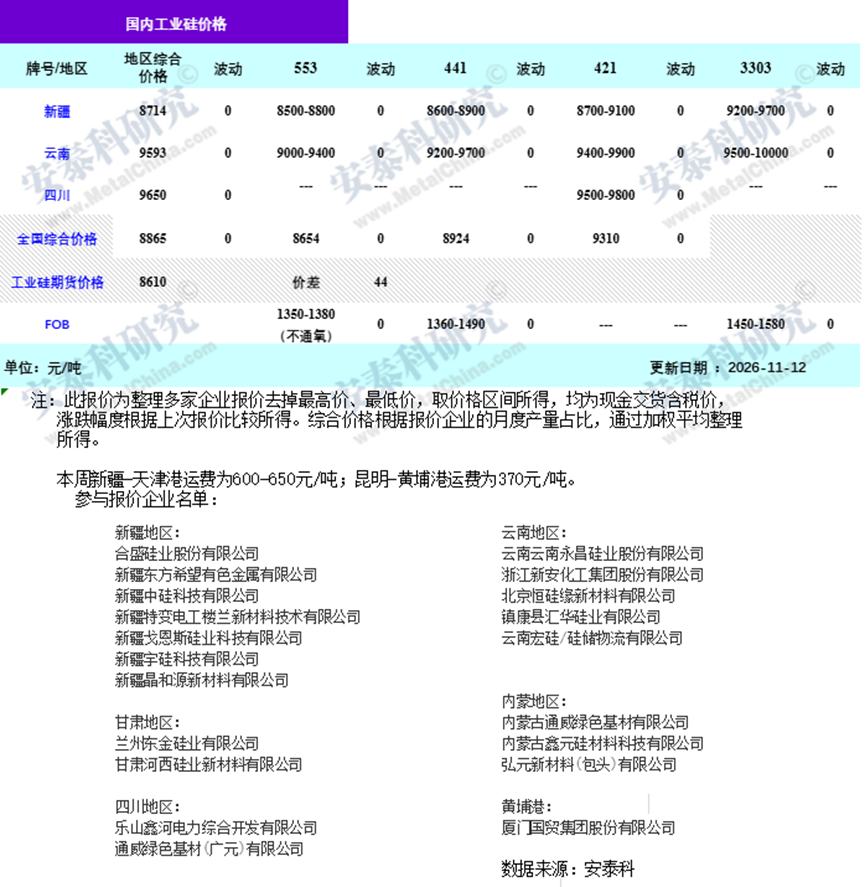
In terms of futures, the focus of this week's main 2612 contract moved slightly higher than last week, but it still hasn't left the trend. According to data from the Guangzhou Stock Exchange, the main contract closed at 8,610 yuan/ton on November 12, up 50 yuan/ton from 8,560 yuan/ton last Friday (November 5). The market was repeatedly tugged in the 8,500-8,670 yuan/ton range. The long and short sides did not compromise between the cost line and weak demand. Their holdings remained around 142,000 hands, and there was a strong sense of capital wait-and-see.
On the spot side, according to Antec's November 12 quotation, the national comprehensive price is 8,865 yuan/ton, which is the same as last week. By specification, 553 #报8654元 /ton, 441 #报8924元 /ton, and 421 #报9310元 /ton were all the same as last week. Looking at the subregions, prices in Xinjiang, Yunnan, and Sichuan were 8,714 yuan/ton, 9,593 yuan/ton, and 9,650 yuan/ton respectively, all the same as last week. In terms of export FOB, prices are the same as last week.
Judging from the transaction situation, trading in the spot market is light. Manufacturers' prices are strong, and it is difficult to find low-price supplies, but downstream also mainly consumes their own inventory, there are not enough new orders, and actual transactions are mainly small orders that are just needed. This situation of “buyers and sellers continue to wait and see the game near the cost line” is due not only to the increase in electricity prices during the dry water period and the double cost and supply support brought about by the shutdown of power plants in the southwest, but also due to sluggish purchasing intentions due to weak downstream demand.
Supply side: The shutdown of furnaces in the southwest has accelerated across the board, and the resumption of production in the north has basically stalled
There was a substantial shift on the supply side this week: production cuts in Southwest China have completely moved from “expectations” to “fulfillment.” In the southwest production area, the impact of the increase in electricity prices during the dry water period began to be concentrated. The number of kilns opened in the Sichuan and Yunnan regions has plummeted. Most downstream silicon companies that lack supporting support have substantially withdrawn from production, leaving only a few companies with Changxie or their own electricity to maintain low load operations. This time, the southwest supply center moved downward in a cliff-style manner, and this contraction was rigid and irreversible during the dry water period. Looking at the main production areas in the north, there was no way to fill the early market concerns about the resumption of production. The actual situation is that large factories in Xinjiang show no signs of resuming production, the probability of new additions to resume production in Inner Mongolia and Gansu is minimal, and overall supply growth in the north has basically stagnated. Taken together, the current supply-side shows a pattern of “sharp decline in the southwest and no increase in the north.” The net contraction has increased significantly compared to the previous period. The bearish power of the early market based on the “resumption of production hedging” logic is fading, and the substantial supporting effect of supply contraction on prices is increasing.
Demand side: poor polysilicon conduction, increased silicone production reduction
There was no change in the demand-side trend this week, but there are signs worth wary of in the details. In terms of polysilicon, production cuts continue, but the current sticking point is not production, but transmission. Polysilicon companies insist on selling at no lower than full cost, but downstream silicon wafer prices continue to decline, making it difficult to agree on upstream and downstream prices, and price transmission in the industrial chain is at an impasse. As a result, although polysilicon continues to be produced, the actual intention to purchase industrial silicon is weaker than production data — companies prioritize consumption of their own raw material inventory, and slow down additional purchases. In terms of silicones, production cuts are increasing. Some domestic monomer plants began implementing emission reduction plans this week, and procurement demand for industrial silicon has shrunk further under operating rates. Against the backdrop of production cuts and expansion, silicone's expectations of increasing industrial silicon completely fell short. On the aluminum side, the performance was relatively stable. Maintaining on-demand procurement of industrial silicon was not a drag, but it was not a support. Overall, the problem on the demand side is not “how much was reduced,” but “how much was bought.” The production of polysilicon is declining, but procurement is falling faster; the production of silicone is declining, and procurement is naturally shrinking. Industrial silicon is facing a demand environment where “downstream production is being cut and they are unwilling to stock up”.
Looking ahead to the future market: the bottom is strong, but breaking the game requires new variables
In the short term, the price is likely to continue to bottom out in the 8,500-8,900 yuan/ton range. Production cuts in the southwest provided bottom support, while weak procurement of polysilicon and silicone suppressed the height of the rebound. The key variables to break the current impasse are two points: one is whether the supply pattern of major production areas in the north is completely clear, and the other is whether demand for polysilicon can be released in a phased and concentrated manner. However, judging from current information, the probability that these two major variables will be realized within November is not high. On the one hand, price transmission in the polysilicon industry chain has been blocked, causing its procurement pace to continue to be slow; on the other hand, major production areas in the north also currently lack clear signs of increasing or decreasing production. The market is likely to continue to fluctuate in a narrow range near the cost line until substantial variables are implemented.