


EN
$7,670 Could Become $30,000 If Nvidia Rebounds Sharply After Huang’s Exit
When CEOs get into hot water, the company (and shareholders) usually get scalded.
Jensen Huang, the first and only CEO Nvidia (NVDA) has ever had, has just stepped down after reports of an affair and alleged ties to a suspected Chinese spy, and the stock slid to $166 as of Thursday’s close.
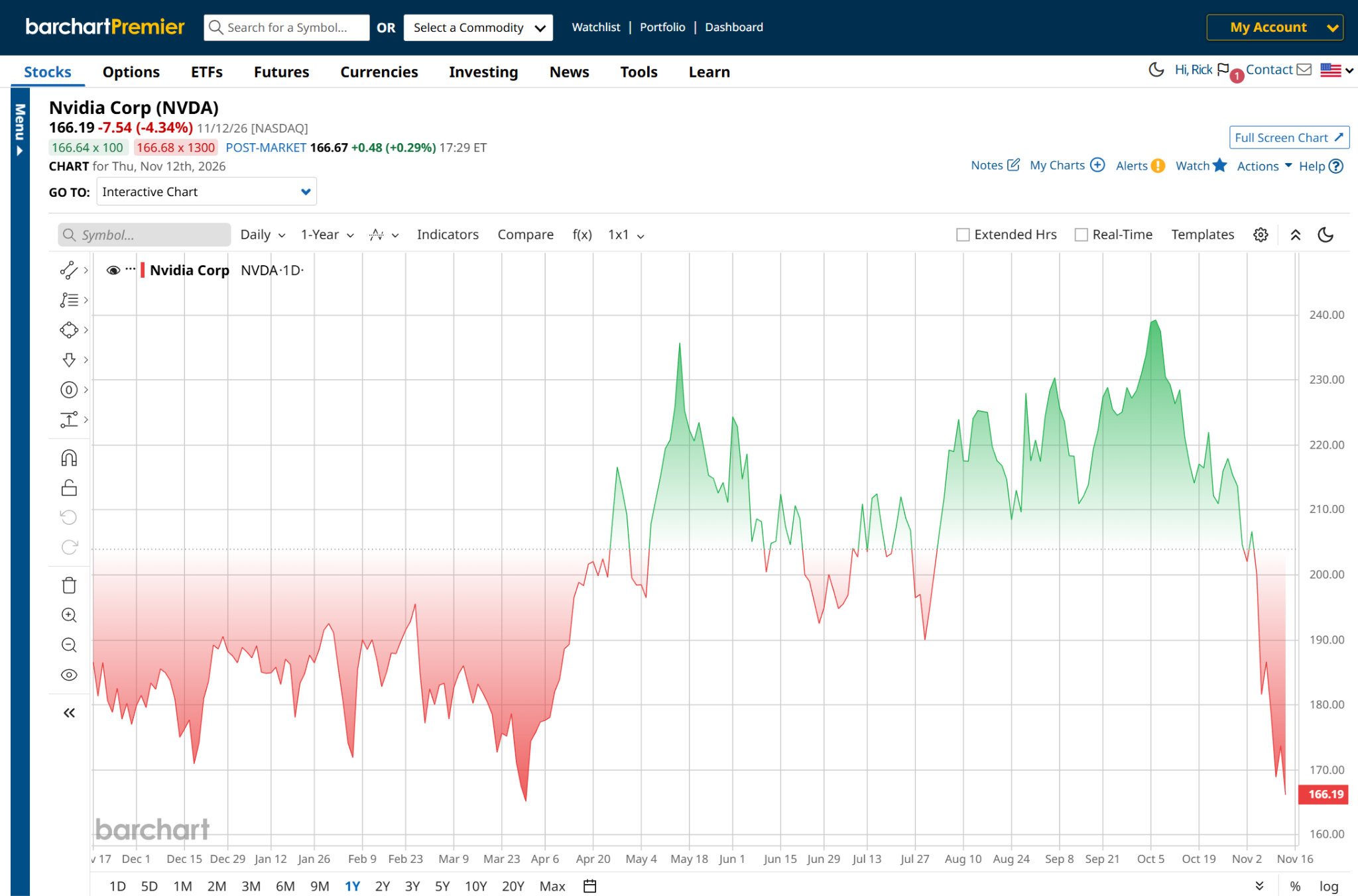
With Colette Kress stepping in as interim CEO and earnings coming up on November 17, uncertainty hangs over the stock. That’s exactly the kind of setup where bulls start wondering if this is a buying opportunity.
But buying 100 shares at $166 means putting up more than $16,000, which isn’t realistic for everyone. Thankfully, options offer another way to get in on the action, through deep in-the-money long calls. In fact, one call costing $7,670 could be worth $30,000 if Nvidia rallies to $400 by expiration, and below I’ll show what it’s worth from $150 to $400, along with the risks. Let’s talk about how.
How Deep In-the-Money LEAPS Calls Cut the Cost of Nvidia Exposure
Call options are time-bound contracts that give the buyer the right, but not the obligation, to buy an underlying asset at a set strike price on or before the expiration date. The goal is to profit from a bullish move in the underlying stock, ideally before the contract expires.
In-the-money (ITM) means an option has real, or intrinsic, value. For call options, this happens when the stock trades above the strike price. If you’re holding a 100-strike call on a stock trading at $150, your option is in the money with an intrinsic value of $50. But options can also carry time, or extrinsic, value, which means they often sell for more than $50.
Now, LEAPS, or Long-Term Equity Anticipation Securities, are simply standard option contracts that expire in one year or more.
Put those two ideas together, and a deep ITM LEAPS call is a long-term call option with a strike price well below the stock’s current market price. It’s a bit like renting the stock for a fixed period, say one to two years, and this lets you participate in much of the upside without paying for the full 100 shares outright. These calls also carry less theta, or time decay, which measures how much value an option loses each day just because time passes.
Deep ITM LEAPS calls typically have a delta of around 0.80 to 0.95. Delta, like theta, is an options Greek, and it measures how much an option’s price should change for every $1 move in the underlying stock. So the higher the delta, the more closely the option’s price tracks the stock.
Finding the Nvidia LEAPS Call on Barchart and What It Costs
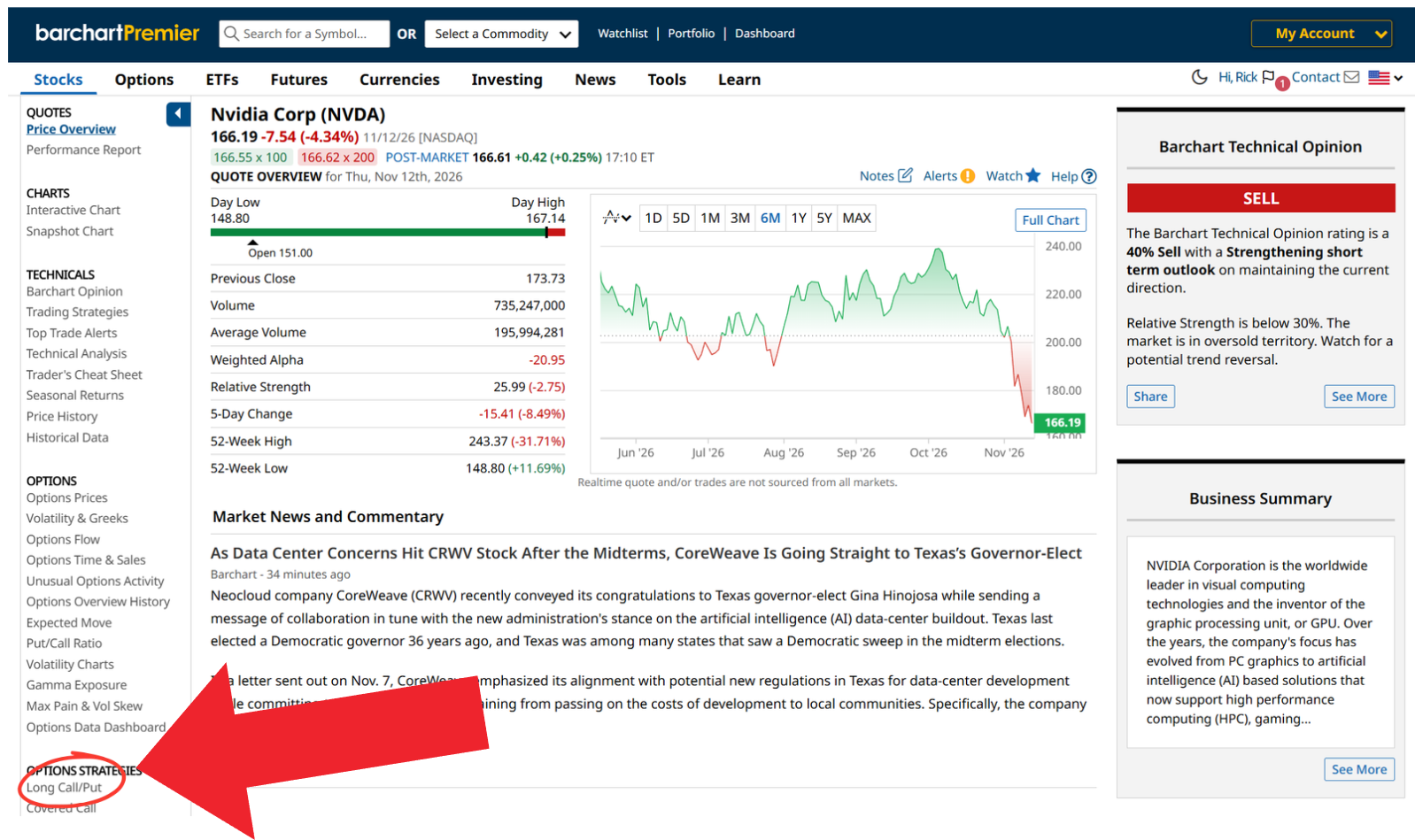
To find LEAPS calls on Nvidia, simply go to the Long Call/Put Option Scanner from the company’s Barchart profile page.
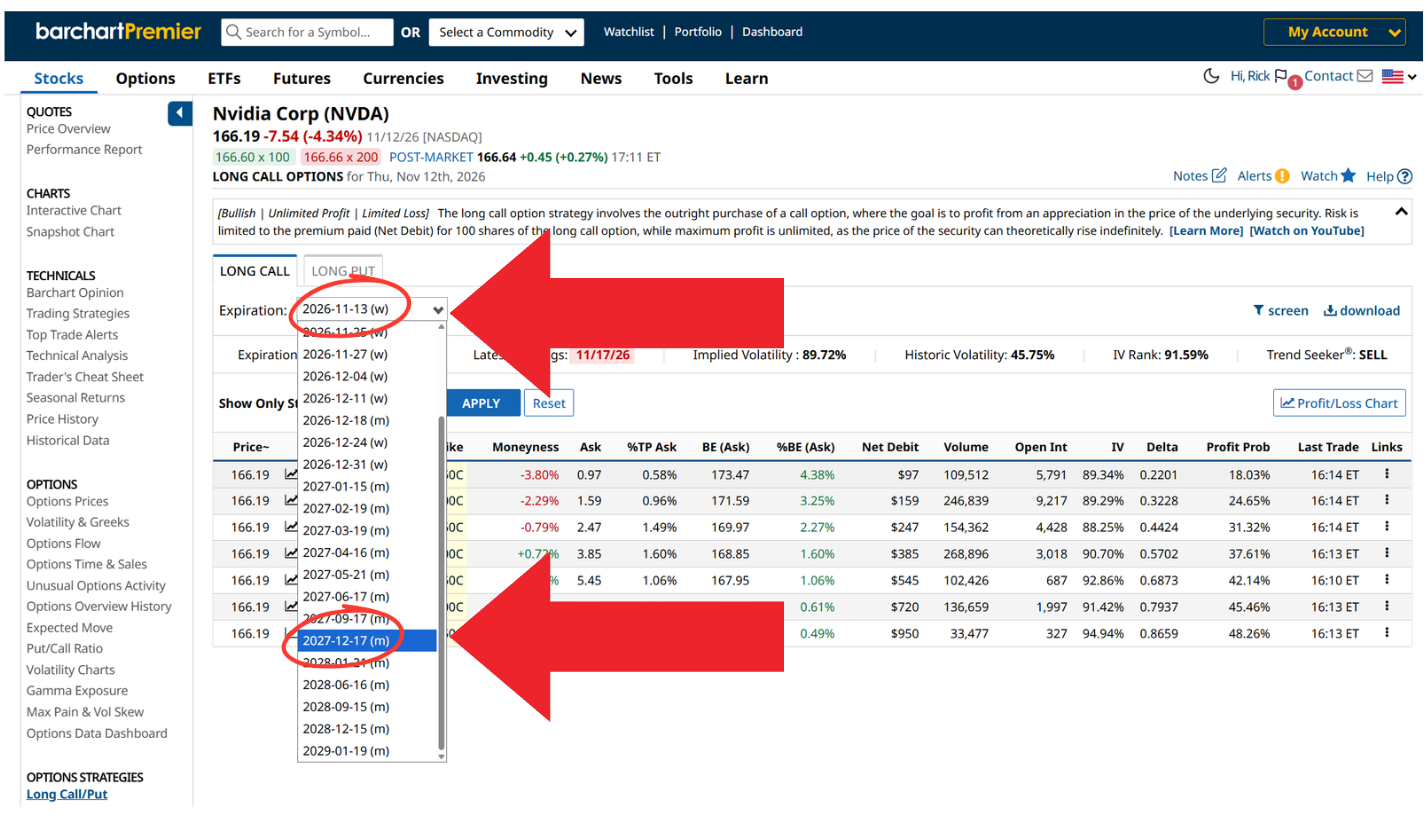
You’ll be taken to the Long Call results page, which shows trades for the nearest expiration date. Change the date to your preferred one. In this example, I’ll use December 17, 2027, 400 days away from the time of the scan.
Then, I’ll arrange the scan from highest to lowest delta by clicking on the column header, and we have results:
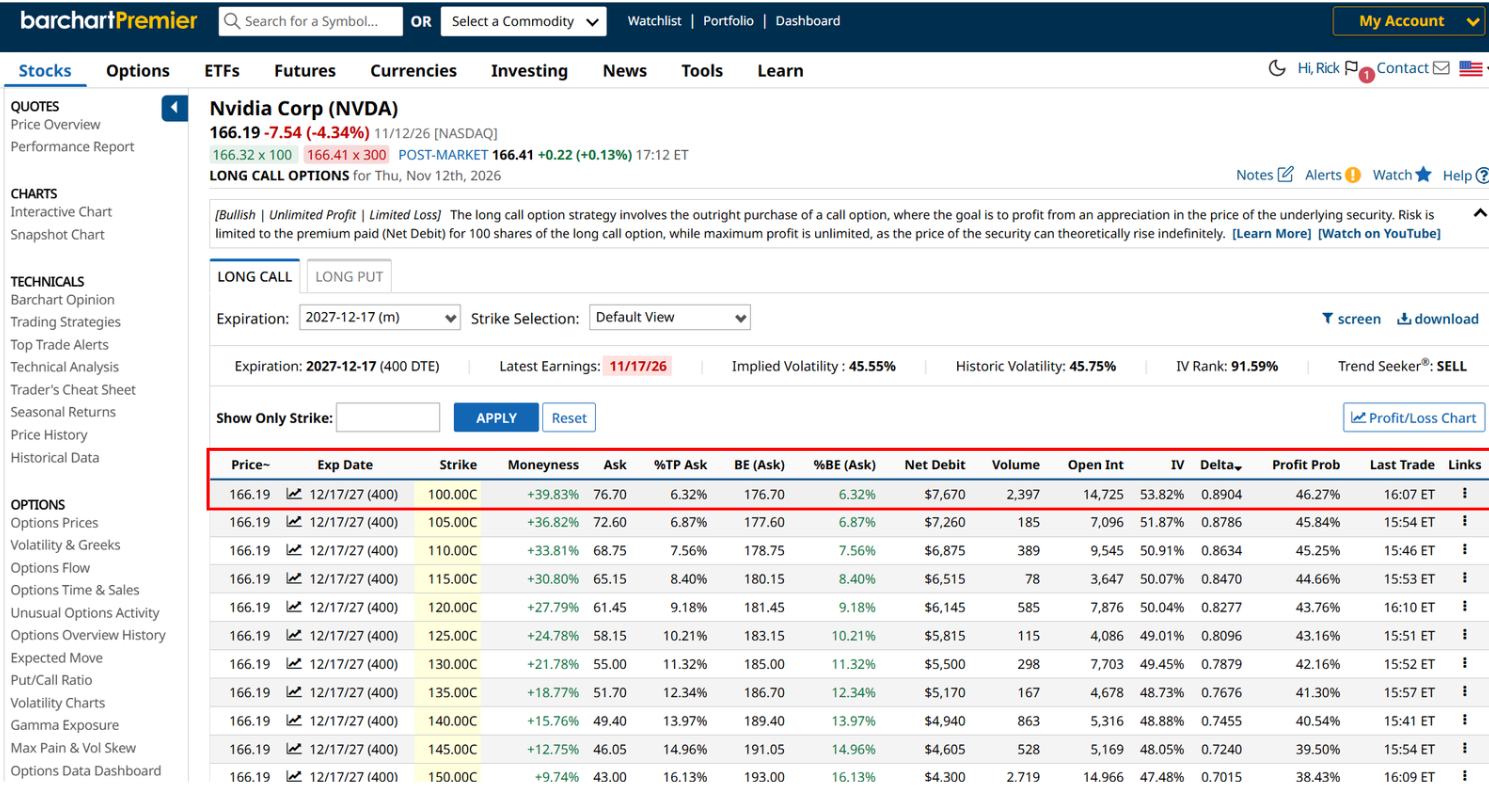
According to the screener, you can buy the NVDA 100-strike call expiring December 17, 2027, at an ask price of $76.70 per share, or $7,670 total for one contract. With Nvidia trading at $166.19, this call is deep in the money by roughly 40%, and it carries a delta of 0.89. This means for every one-dollar move in NVDA, the option will move approximately $0.89.
The intrinsic value is $66.19, and the remaining $10.51 is time value, which is the time value for for having about 400 days until expiration. Because of that, the breakeven sits at $176.70, roughly 6% above today’s price, which means the trade becomes profitable as long as Nvidia stock stays above $176.70 before expiration. From there, the upside is unlimited. The higher the stock goes, the more this trade earns, while the most you can lose is the premium you paid. Compare that to spending more than $16,000 buying 100 shares at $166.19, and you're getting the ability to control 100 shares of Nvidia- at a 54% discount.
What the Call Is Worth if Nvidia Trades Between $150 and $400
So what could this call actually be worth? Here’s a look at one contract at expiration across a range of Nvidia prices. Keep in mind that time value is gone by then, so what’s left is just intrinsic value: the stock price minus the $100 strike.
| NVDA at expiration | Call value | Profit or loss | Return |
|---|---|---|---|
| $150 | $5,000 | -$2,670 | -35% |
| $175 | $7,500 | -$170 | -2% |
| $200 | $10,000 | +$2,330 | +30% |
| $250 | $15,000 | +$7,330 | +96% |
| $300 | $20,000 | +$12,330 | +161% |
| $350 | $25,000 | +$17,330 | +226% |
| $400 | $30,000 | +$22,330 | +291% |
If Nvidia is at $150, the call is worth $5,000, which means a loss of $2,670 on the $7,670 you paid. At $175, you’re just under breakeven, down only $170. From there, every $1 move in the stock adds about $100 to the contract. At $200, the call is worth $10,000, and you’re up roughly 30%. At $300, it’s worth $20,000, a gain of about 161%. And if Nvidia gets to $400, the call is worth $30,000, a gain of roughly 291%. Compare that to owning the shares, where a move from $166 to $400 would be a gain of about 141%.
The Risks Investors Shouldn’t Ignore Before Buying This Nvidia Call
No matter how good that sounds, deep ITM LEAPS calls are not risk-free.
The biggest risk is that you can still lose the entire $7,670 premium if NVDA falls below the $100 strike by expiration; even though that’s a long way down from $166.19, the loss is 100% of what you paid.
Another problem with the setup is implied volatility, or IV, which is the market’s forecast of how much a stock could swing in the future, and it’s baked right into the option’s price.
Right now, Nvidia is trading with around 46% implied volatility, which might not look like much. However, IV rank, the measure that shows where current IV sits compared to its range over the past year, says that NVDA is trading at 91%, near the top of its yearly range. The fact that earnings are a few days away contributes to that value.
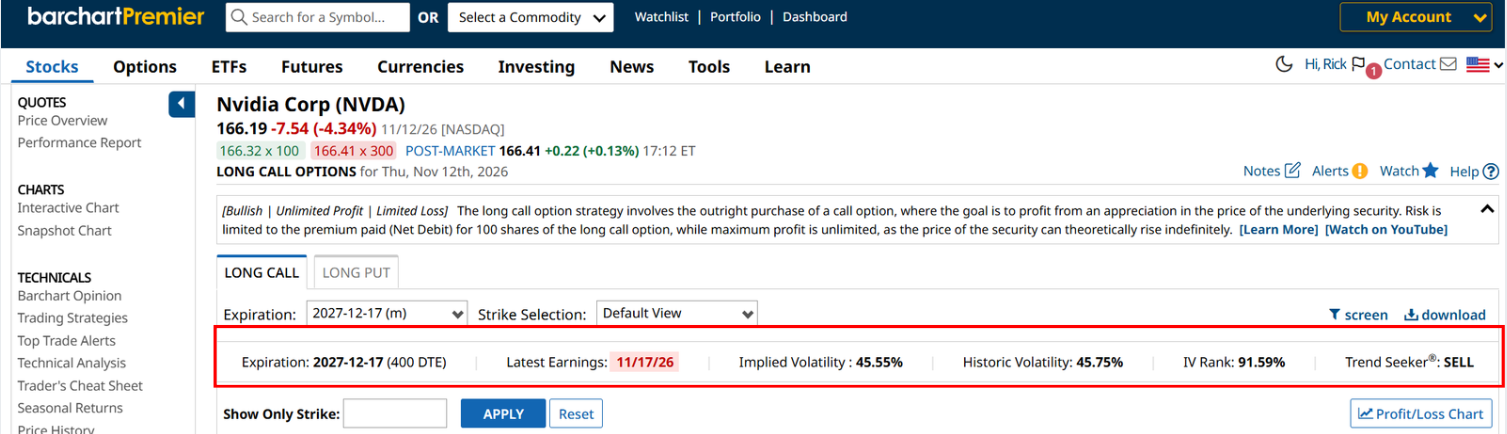
That means, despite the apparent “discount,” you’re paying a higher premium than usual to get into a long call right now.
Lastly, since LEAPS tend to be less liquid than shorter-dated options, you may face wider bid-ask spreads, which could eat into your profit just getting in and out of the trade.
Some traders might prefer to wait until after earnings to get into position. Volatility would deflate, and options would be relatively cheaper. But that would mean the stock could have likely risen. If the earnings report and Kress’s first remarks as interim CEO calm investors, NVDA would likely gap higher and leave you buying the same call at a higher stock price. After all, the underlying business itself is still rock-solid; Huang’s departure is more of a headline problem than anything else.
And that’s the real risk of sitting on the sidelines: the same relief that deflates implied volatility can also lift the stock, so you might get a cheaper option but a higher share price.
At the end of the day, your risk appetite will decide.
The Bottom Line on This Nvidia LEAPS Call Rebound Play
So here’s where that leaves investors.
For roughly $7,670, one deep in-the-money LEAPS call gives exposure to 100 Nvidia shares that would otherwise take more than $16,000. If Nvidia recovers to $300, that call is worth $20,000, and at $400 it’s worth $30,000. That’s the upside. But the other side is just as clear: the stock has to climb above $176.70 by December 2027 just to break even, and if it ends below $100, the entire $7,670 is gone.
On top of that, implied volatility sits near the top of its yearly range with earnings days away, so the premium is rich right now. Waiting until after earnings could make the option cheaper, but it could also mean buying the same call on a higher share price if the news calms the market.
At the end of the day, this comes down to conviction and position size. Huang’s exit looks more like a headline problem than a business problem, so for investors who believe Nvidia will bounce back, this call lets them play the rebound without tying up $16,000. Just keep the bet to money you can afford to lose.
On the date of publication, Rick Orford did not directly have a position in any of the securities mentioned in this article. All information and data in this article is solely for informational purposes. For more information please view the Barchart Disclosure Policy here.