EN
Omdia: Global AI software revenue is expected to exceed $200 billion in 2026
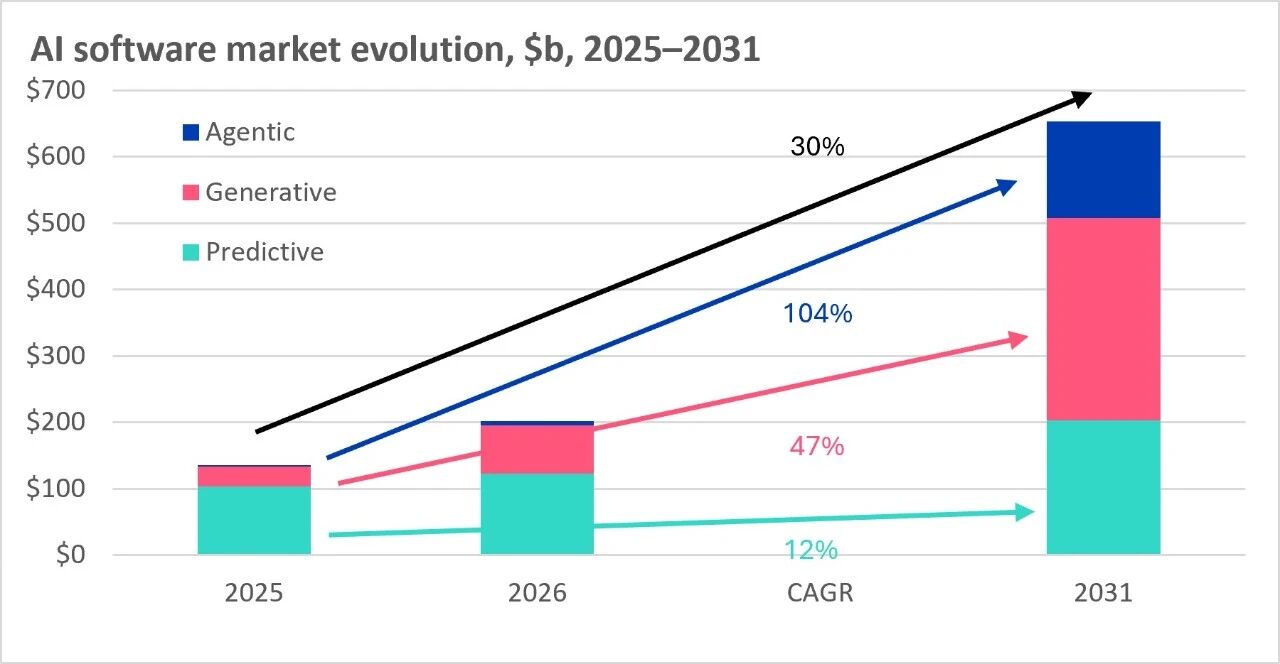
Zhitong Finance App learned that according to Omdia's latest “AI Software Market Forecast” report, global AI software revenue in 2026 will exceed 200 billion US dollars, double the 2024 level. Omdia predicts that demand for both generative AI and proxy AI is growing at an accelerated pace, driving Omdia to raise its semi-annual market outlook by the biggest margin since the COVID-19 pandemic.
As enterprises continue to expand the deployment of AI assistants, coding tools, and embedded AI functions in various business applications, generative AI revenue is expected to grow 139% in 2026, far exceeding previous forecasts. Although proxy AI is still in its early stages of application, it has a small revenue base and is growing faster.
As technology applications become more mature, the annual growth rate of the technology market usually slows down. However, in 2026, generative AI and proxy AI are driving an extraordinary acceleration in growth. This increase reflects rapid growth across all segments of the AI value chain, including a 3x to 10-fold year-on-year increase in revenue from leading basic model providers, triple-digit growth of top cloud service providers (Hyperscalers) in the AI cloud business, and competition among enterprise software vendors to launch AI-enhanced and native AI products.
Omdia predicts that as the market matures and returns to a more typical application trajectory, and the revenue base expands dramatically, the abnormally high growth rate seen in 2026 will stabilize in the next few years. AI software will continue to grow for a long time. The market is expected to grow at a compound annual growth rate (CAGR) of 30% between 2025 and 2031. Among them, proxy AI is expected to be the fastest growing segment, with a compound annual growth rate of 104% during this period.
The latest forecasts also highlight longer-term structural shifts. It is expected that by 2028, generative AI will surpass predictive AI and become the largest segment of AI software revenue. At the same time, AI assistants are gaining more autonomy and increasingly performing multi-step tasks on behalf of users, thus blurring the line between generative AI and proxy AI.
Neil Dunay, chief market forecasting analyst at Omdia, said, “As generative assistants become agentable and automated workflows increasingly replace human-guided prompts, the difference between generative AI and proxy AI may become less important. Instead, the market may be divided according to different levels of autonomy.”