


EN
Workday (WDAY) Adds New Partnerships, Is The Stock Cheap Or Fully Valued?
Why Workday’s New Partnerships Matter For Investors
Workday (WDAY) has been busy on the product side, striking partnerships with The Josh Bersin Company, Zuora, Avalara, and PayPal that integrate new AI, billing, compliance, and payroll capabilities directly into its cloud platform.
These agreements do not change the basic profile of Workday overnight, but they give investors more concrete detail on how the business is attempting to deepen its role in HR, finance, and employee-facing workflows.
Workday’s recent product headlines land against a softer tape, with the share price down 4.8% over the past week and 7.4% year to date, while the 1-year total shareholder return has declined 14.7% and the 5-year total shareholder return is down 36.3%. This suggests momentum has been fading even as investors weigh upcoming earnings and these new partnerships as potential catalysts for shifting sentiment.
Spot opportunities beyond Workday by scanning a curated set of AI focused platforms and tools through our 41 profitable AI stocks that aren't just burning cash.Workday shares have lost ground over 1, 3, and 5 years, even as new partnerships and earnings expectations build a different narrative. For investors, is this a reasonable entry now, or a stock to keep on the watchlist for later?
Most Popular Narrative: 13% Undervalued
On Simply Wall St, the most followed narrative pegs Workday’s fair value at $218.02 per share, compared with the recent closing price of $190.64. According to John_Eric, a Simply Wall St Community investor who built that model, the gap comes down to how much of Workday’s cash flow truly belongs to shareholders rather than employees.
My revised central estimated fair value is approximately $218 per share. Not $554. That’s a substantial correction. And the revised estimate isn’t immune to uncertainty. If stock compensation remains at 14% of revenue in year ten, rather than the 10% assumed in my central case, fair value falls toward $183. If it declines to 8%, the model rises toward $235. The lesson isn’t that one percentage point always produces a predictable stock-price movement. It’s that ownership costs matter. Workday could continue reporting growing revenue, expanding AI adoption, and attractive free cash flow while delivering considerably less economic value to existing shareholders than those headline numbers suggest. And the opposite is possible. If compensation becomes less dilutive and operating margins improve, the business could become more valuable without needing extraordinary revenue growth. I hadn’t needed a more complicated model. I needed a better economic definition of the cash I was valuing.
See why 19 investors see Workday as 13% undervalued.
Result: Fair Value of $218.02 (UNDERVALUED)
Still, Workday’s story can weaken if stock-based compensation stays elevated or if AI agents drive usage without clearly improving long term owner cash flow.
Find out about the key risks to this Workday narrative.
Another View: What Market Pricing Says About Workday
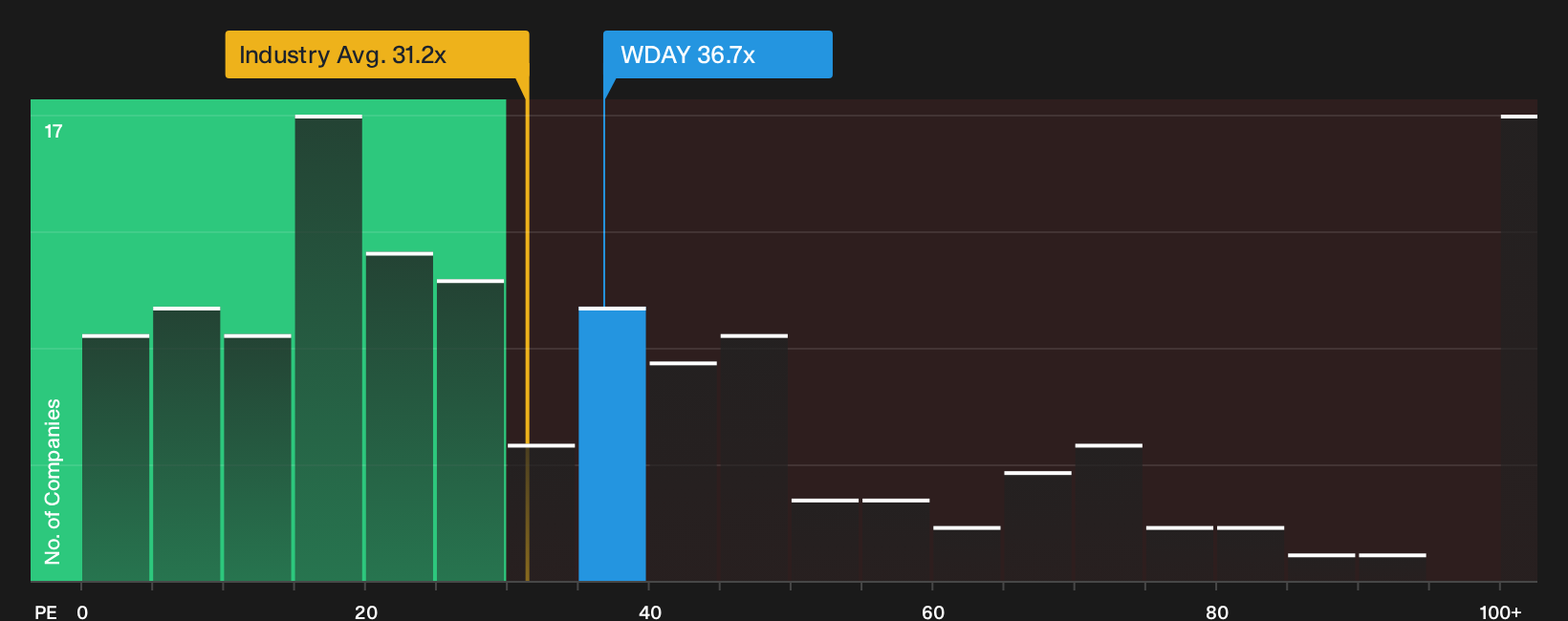
While the Simply Wall St narrative points to Workday trading below a modeled fair value, current pricing looks less generous when earnings multiples are used. The stock changes hands at a P/E of 36.7x, higher than the US Software sector on 31.2x and its peer group on 34.4x.
Yet that same P/E compares closely with an estimated fair ratio of 38.6x, which implies the market already prices in a lot of expectation but not outright euphoria. For investors, the puzzle is whether to focus on that apparent earnings premium, or on the cash flow based view that still flags room for upside.
See what the numbers say about this price — find out in our valuation breakdown.
Next Steps
The mixed signals on Workday can feel confusing. Treat this as your prompt to move quickly, stress test the numbers yourself, and then weigh those positives by digging into the 3 key rewards.
Looking For More Investment Ideas Beyond Workday?
If Workday has sharpened your focus, do not stop here. Broaden your watchlist now so you are not playing catch up when the next opportunity hits.
- Target resilience by scanning a 29 resilient stocks with low risk scores that may hold up better when sentiment turns.
- Hunt for mispriced quality using our 32 high quality undervalued stocks that filters for fundamentals first.
- Spot potential future standouts early by reviewing a 20 high quality undiscovered gems before wider attention arrives.
Have feedback on this article? Concerned about the content? Get in touch with us directly. Alternatively, email editorial-team@simplywallst.com