


EN
How AI Asset Management Launch Will Impact Halliburton (HAL) Stock
- Halliburton recently introduced its Agile Asset Management platform, an artificial intelligence powered, cloud-based Landmark solution that links subsurface, wells, facilities and economic workflows so energy operators can compare development options and reach investment decisions faster.
- The launch underscores Halliburton's push to embed proprietary AI and open-architecture software into client planning processes, which can deepen customer integration and potentially support higher value digital work across the asset lifecycle.
- This article examines how Halliburton's investment narrative is affected by the Agile Asset Management launch and its AI driven workflow integration.
Halliburton Investment Narrative Recap
To own Halliburton, you need to be comfortable with a business still anchored to upstream oil and gas activity, while leaning harder into technology and international work. The analyst consensus narrative on Simply Wall St rests on multi year investment by producers, modest revenue growth forecasts of 4.3% a year and earnings expected to grow 11.5% annually, with execution on high value contracts as a key swing factor.
In the short term, the biggest catalyst is how effectively Halliburton converts its differentiated services and digital tools into recurring, higher margin work as energy security keeps capital flowing into projects. The key risk remains structural, that faster decarbonization and renewables adoption pull capital away from upstream spending, alongside elevated regional conflict risk that can hit utilization and costs in places like the Middle East.
The dividend affirmation for the 2026 fourth quarter at US$0.17 a share ties directly into that cash generation story. It signals the board’s willingness to keep returning capital after a period where earnings grew 52.9% over the past year and net profit margins sit at 8.9%, even as analysts flag an unstable dividend track record historically and a relatively high level of debt.
For you as a shareholder, this payout decision sits next to the AI driven Agile Asset Management launch as a tangible test of discipline. On one side, Halliburton is investing roughly US$1.1b of 2026 capex into growth engines and digital offerings. On the other side, it continues regular cash distributions, which can constrain how quickly the balance sheet de gears if activity softens or if geopolitical disruptions persist.
Halliburton's narrative projects US$25.1b revenue and US$2.7b earnings by 2029. That profile lines up with analysts factoring in 3.9% yearly revenue growth and an earnings increase of about US$1.1b from US$1.6b today.
Discover how Halliburton's fair value indicates a 33% potential upside to its current price that may not last much longer.
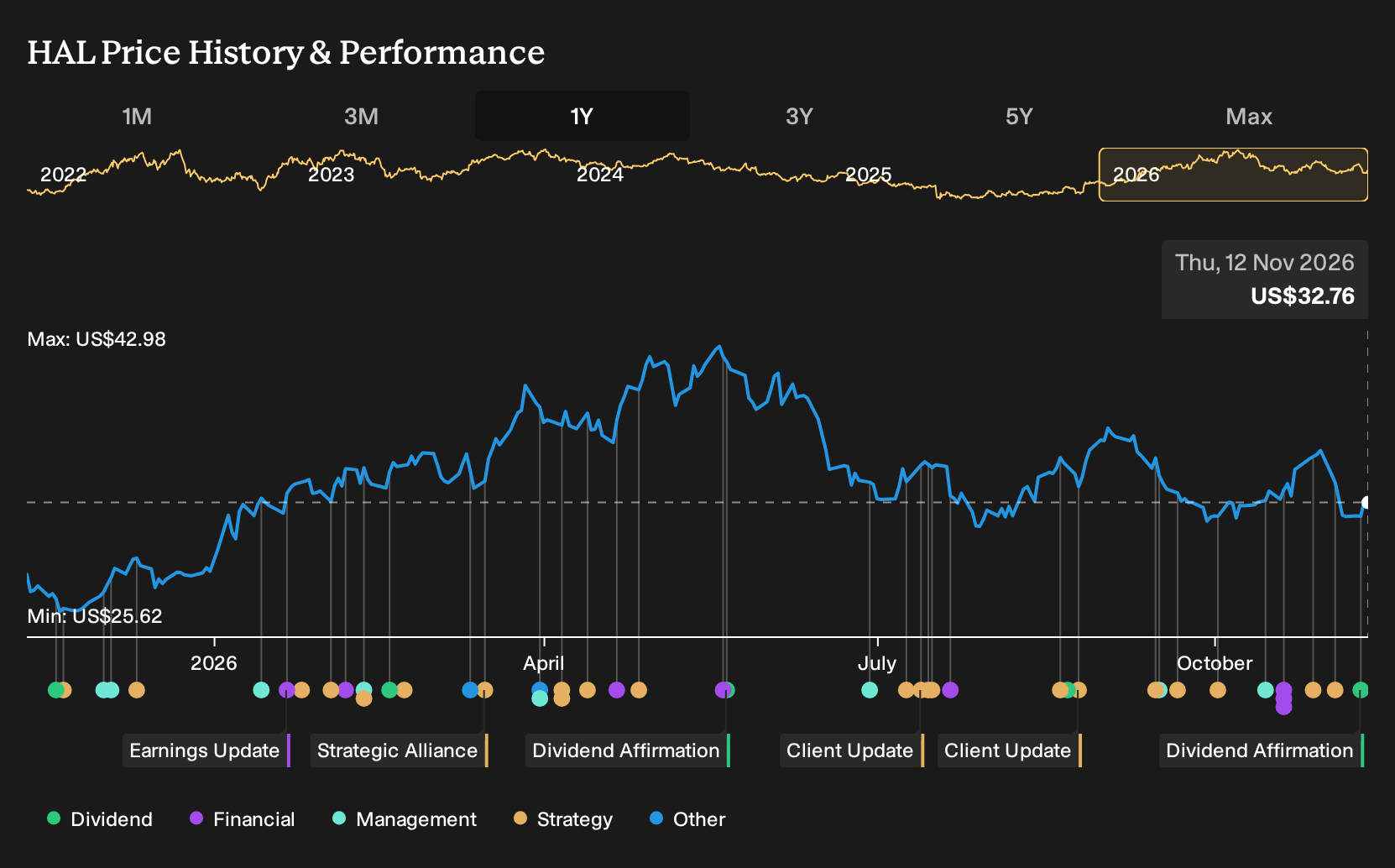
Exploring Other Perspectives
One alternate view puts the Middle East conflict risk front and center for Halliburton. The most cautious analysts, who saw revenue only reaching about US$23.2b and earnings around US$2.8b by 2029 before this AI and dividend news, argue that geopolitical setbacks could cap upside. That is a far more restrained story than consensus, and it shows how sharply opinions can differ. Use that spread as a prompt to compare several scenarios and decide which assumptions you find most reasonable.
Explore 4 other Halliburton fair value estimates, including one that suggests it could be worth just $34.03.
Decide For Yourself
Disagree with existing narratives? Extraordinary investment returns rarely come from following the herd, so trust your own analysis and judgment.
- A great starting point for your Halliburton research is our analysis highlighting 5 key rewards and 2 important warning signs that could impact your investment decision.
- See our latest analysis for Halliburton. The report includes a comprehensive fundamental analysis summarized in a single visual, the Snowflake, making it easy to evaluate Halliburton's overall financial health at a glance.
Looking For More Ideas Beyond Halliburton?
If the Halliburton story has sharpened your thinking on risk, return and cash generation, it can be useful to line it up against other opportunities using the Simply Wall St Screener.
- Want potential mispricing with solid fundamentals? Start with a focused set of 31 high quality undervalued stocks that may offer a better balance between quality and price.
- If resilience matters most to you, filter for 29 resilient stocks with low risk scores and see which companies score well on stability and financial strength.
- Prefer businesses with strong finances doing the heavy lifting? Run through a list of solid balance sheet and fundamentals (23 results) to compare alternatives that might complement or substitute Halliburton in your portfolio.
Have feedback on this article? Concerned about the content? Get in touch with us directly. Alternatively, email editorial-team@simplywallst.com