


EN
The launch of Anthropic led to a sharp rise! Concerns about regulatory stagnation are suspended, and professional investors take a U-turn to “go long” on Bitcoin in the short term
The Zhitong Finance App learned that Bitcoin's current pricing is no longer determined by the crypto market itself. Over the past 48 hours, three clues have played against each other: one of the most famous crypto traders made a U-turn to increase positions before Anthropic's listing, a well-known TV institutional investor said stablecoin adoption had stalled, and on-chain data companies counted $142 billion in stablecoins leaving the market within 30 days.
Bitcoin is currently trading at around $73,470, down 0.3% in 24 hours. On the Stocktwits platform, retail sentiment surrounding Bitcoin was in an “extremely bearish” range, and the number of followers dropped by more than 21% within a week.
Hayes' shift: judging that Anthropic's listing “will skyrocket” and take the opportunity to prolong crypto assets in the “short term”
Arthur Hayes — founder of BitMEX and current CEO of Flop Labs — said on X late Wednesday that he has “slightly turned more” on crypto assets and increased his risk exposure before Anthropic lands on the NASDAQ next week. His judgment was straightforward: this IPO would “skyrocket.”
His position discipline explains the nature of this statement: Relying on this optimism, positions are kept on a medium to medium scale, with the reason that “you can exit quickly if needed” — this is a short-term trade around specific events, not a reoptimism about the crypto cycle.
What is more telling is his old judgment this month: Anthropic's IPO investors will face an 83% dilution by June 2027, and it is “mathematically almost impossible” for the stock to rise until then. There is no contradiction between the two statements — one talks about the share capital structure in mid-2027 and the other about next week's pricing sentiment — but they exist at the same time, which shows just how short the period for this round of “turning more” is.
Followed down 91% and followed up 58%: Bitcoin is no longer like a risky asset, but more like a high beta short
The background of Hayes' bet is the increasingly unequal relationship between Bitcoin and US stocks.
Bitfinex gave a set of numbers in the weekly Bitfinex Alpha report: Since the Nasdaq 100 index peaked on October 6, Bitcoin has continued to fall 91% during the trading day when the NASDAQ fell; while during the trading day when the NASDAQ rose, Bitcoin only kept up with 58% of the increase. By contrast, before peaking on October 6, the two figures were 129% and 23%, respectively — at that time, Bitcoin rose more sharply than technology stocks and fell less than technology stocks.
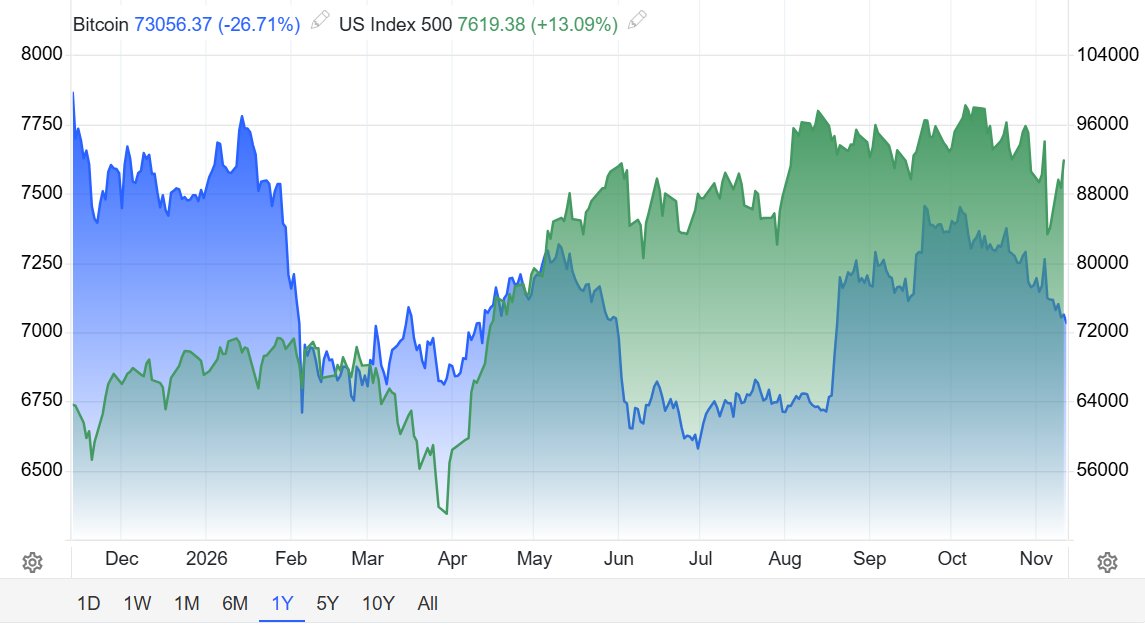
This set of comparisons shows that “the direction of beta has changed”, not “how much it has dropped”: previously it was a high beta amplifier of the NASDAQ index, but now it has taken all of the decline, but only half of the increase has been realized.
Bitfinex attributed the reason to the demand side: ETF and corporate treasury purchases “have completely stopped,” so no stable buyer base can turn a rise in the stock market into a rise in crypto. In contrast to this, leveraged long futures — they are almost unaffected when crossing the stock market decline, because leveraged positions do not require new money to enter the market; they just need to be unbalanced.
The breaking point in the transmission chain is that purchases on the stock side come from passive capital and corporate cash, while purchases on the crypto side come from ETF purchases and exchanges of positions with listed companies. Both have stopped at the same time.
How does Anthropic's IPO affect Bitcoin?
According to Bitfinex's analysis, the Anthropic listing has three transmission paths to Bitcoin, and the direction is not the same.
The first is a capital competition for retail quotas. About one-fifth of this offering is reserved for retail investors. Bitfinex believes that this money is “the same buyer pool” that supports crypto — the risk budget is fixed for a short period of time, so if you buy an IPO, you buy less coins.
The second is mobility. New capital is locked in on the pricing date. After listing, breakouts may leave the market at a loss, and profits may be settled and then refunded after a sharp rise, but in the short term, they are all net outflows.
The third one is the direct channel, which is also the most notable this time. Bitfinex said that during Anthropic's pre-IPO phase, traders had deposited more than $260 million in open positions in Anthropic contracts on the crypto derivatives platform, and the transaction price was about 23% above the upper limit of the IPO range. In other words, the crypto market is already pricing an unlisted AI company in its own way, and this price is more than 20% more expensive than the primary market.
Putting the three paths together, “IPO is Bitcoin's catalyst” is only half right: it pumps water first, then releases water, removes retail investors' risk budgets and new funds before pricing, and whether it can be returned after listing depends on whether this stock rises or falls. Hayes was betting that the amount of water released was greater than the yield, and he himself said the term of this bet — to be able to quit soon.
The other side: money is leaving the market and is leaving faster than at any time since 2022
Glassnode's weekly report gave the opposite reading. The first group is stablecoins: The supply of major stablecoins has declined by $142 billion over the past 30 days, the biggest monthly contraction since the 2022 crypto bear market. As a result, the total supply of stablecoins fell to just under $280 billion, the lowest level since September 2025. Glassnode explained, “A contraction in supply means that holders are redeeming stablecoins for dollars and taking cash out of the market, which leaves less fuel for a rebound.”
The 30-day decline in June 2022 was close to $30 billion, and Bitcoin hit a bear low of $15,500 about five months later; this time it was only half of what it was at the time, and the direction was the same.
Second, CryptoQuant claims that USDT's market capitalization declined by $6.6 billion in the 60 days to November 7, more than double the $3.2 billion drop in the same period after the FTX crash in December 2022. USDT accounts for approximately 62.8% of the stablecoin supply, and USDC accounts for 25.1%.
The third group is ETFs and premiums: US spot Bitcoin ETFs had a net outflow of $1.6 billion over 20 trading days, and the Coinbase premium continued to be negative — the latter is an immediate indicator of the strength or weakness of local US buying.
The price also fell below the cost line: Bitcoin is below $75,600, which is the recent average buying cost for buyers; Glassnode claims that only about 35% of the short-term holders' tokens were profitable, and the remaining 65% constituted selling pressure during the rise.
“Stagnation of adoption”: it is an institutional problem, not an emotional issue
If Glassnode describes results, Kevin O'Leary describes why. The investor, known as “Mr Wonderful,” wrote on X on Wednesday: “The crypto sell-off isn't just about Bitcoin.” He further explained in the TV program: the adoption of stablecoins and blockchain at the institutional level has stalled because companies “are still awaiting regulatory clarification”; “So you see that the crypto market is selling off and underperforming because adoption has stalled, and it's not just Bitcoin and other blockchains.”
O'Leary is a user himself: he already uses Circle's USDC for treasury management and cross-border payments, but “a lot of people won't move until their compliance team knows what the rules are.” The bottleneck in institutional adoption is not yield or technology, and compliance departments are unable to sign when rules are missing.
Circle fell 2% overnight, retail sentiment was “bearish” and discussions were “low.” The total crypto market value fell 0.5% to about $2.54 trillion during the same period, and turnover fell 22.7% to about $63.7 billion.
CLARITY Act: 10 votes short, 50 days left
The rule O'Leary and others is the CLARITY Act (H.R. 3633, Digital Asset Market Clarification Act). Its current state is worth addressing, as its outcome determines the crypto regulatory framework until 2027.
The bill passed by 294 votes to 134 in the House of Representatives on July 17, 2025. On September 15, 2026, the Senate voted on a procedural motion to advance the full house debate. The result was 49 votes to 50, 10 votes short of the required 60 votes. The 49 votes were all from the Republican Party. Four Republicans (Collins, Hawley, Moran, and Tillis) voted against; Coons did not vote. Tillis voted against in order to preserve the right to submit a motion for reconsideration — this leaves a door, but that does not mean that the votes have already been counted.
There are three card points. The hardest part is stablecoin earnings: regional and community banks worry that once exchanges pay interest on stablecoin balances, deposits will flow away from low-interest savings accounts. The Tillis—Alsobrooks compromise text of May 1, 2026 attempted to draw a line — profits “like bank deposits” are not permitted, and rewards linked to actual activity are still legal—but there is still no consensus on where the line is. The other two are the moral provisions for officials to hold coins, and the registration requirements imposed on controllers of “not truly decentralized” agreements in the Senate's September 10 draft.
The schedule is tight. If the bill is still pending when the new National Assembly takes office on January 3, 2027, it will expire. At that time, it will have to be re-introduced and reintroduced to the committee process. After the midterm elections on November 3, the Democratic Party won both houses, and the probability of passing was drastically reduced — Polymarket priced “becoming law by the end of 2026” at about 3% on November 1.
An alternative path has already been cleared. The SEC proposed the draft “Crypto Asset Regulations” on August 18 to provide exemptions for fundraising of up to $75 million within 12 months. The call for comments ended on October 20; the CFTC sent the pre-rules to the White House Review Office on September 17, but the binding rules are not expected to be before the end of 2027. The rules can give the exchange a set of operation manuals, but they don't give the legal division of labor between the SEC and CFTC that the bill should have provided; the rules can be rewritten by the next committee, but the bill cannot.
Technical analysis
According to the data, put February-April 2023 side by side with July-November 2026:2023 was a deep pit ($15,000—$18,000), rebounded to $21,800—$27,800, and continued to rise; 2026 bottomed out, rebounded to $84,000—$92,000, and fell back to around $74,000, which is exactly the same position (below the grey moving average and above the red moving average). Bitcoin price held the 200-day SMA and the rebound is now beginning, according to analysts.
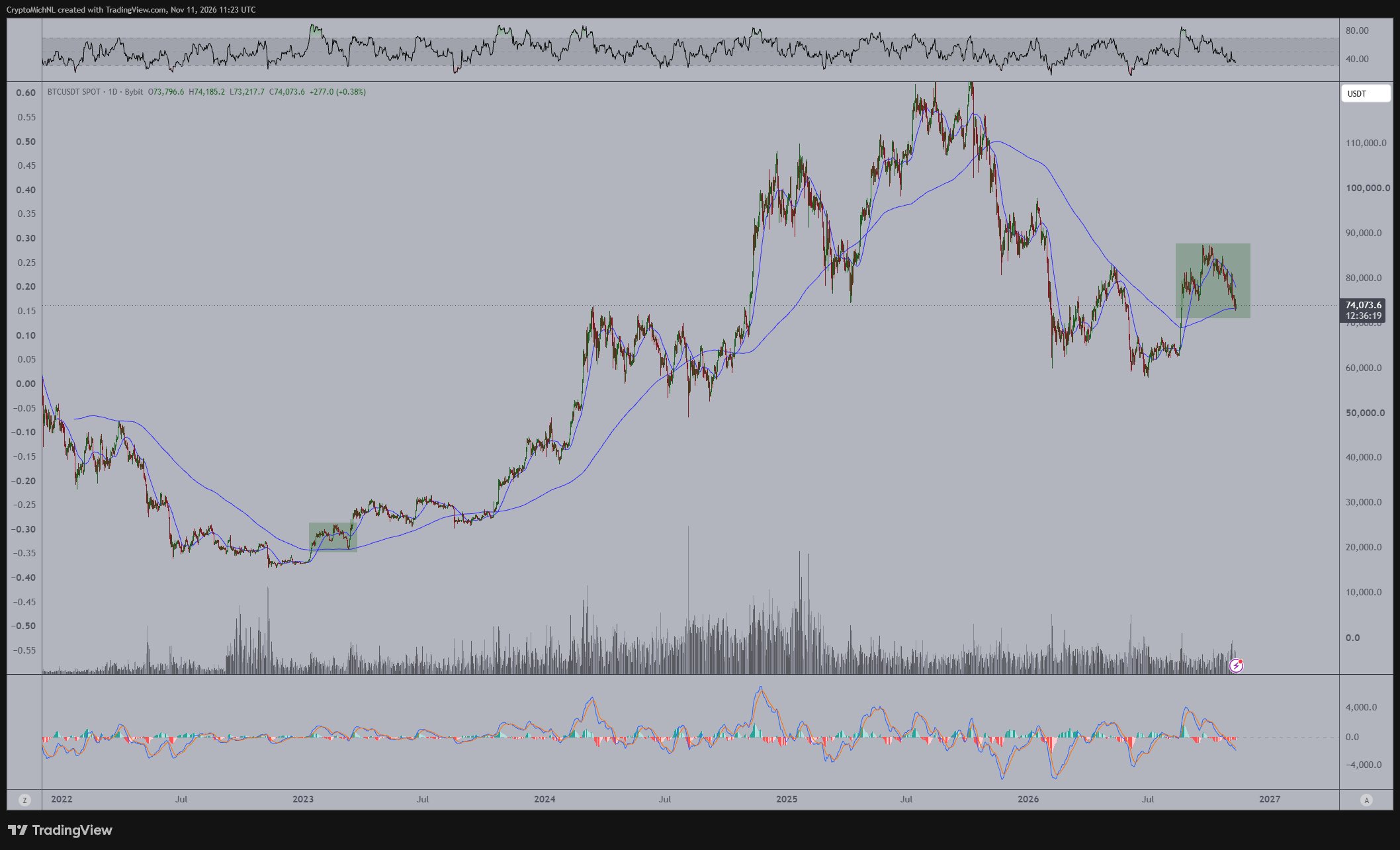
This chart proves that “the same position” is not “the same result”: there are no confirmed breakthroughs on this side in 2026; the arrow points to the starting point; it is not a market that has already started.
Glassnode also gave two positive observations: two types of high-value wallets holding 100 to 10,000 BTC have begun to be bought; as long as Bitcoin holds the June low of $58,500, the trend change that has formed since August will hold true.
Conclusion: The three lines are closed - the catalyst is in front and the pump is in the back
Bitcoin currently has a likely upward event (Anthropic listing), a potentially upward system (CLARITY or alternative rules), and a working pump (stablecoin loss, ETF outflow, 65% short-term chip loss).
The time of the incident is ahead: Anthropic pricing November 18, code ANT, see next week. The system is behind: Even if it goes well, it will be in 2027. According to current odds, the probability of landing within 2026 is only a single digit.
The pump is in the middle and is spinning faster than any time since 2022. This determines the asymmetry between the two scenarios. The upside requires two things to happen at the same time: capital flows back after the IPO is priced, and stablecoin supply stops falling. Glassnode gave the judging criteria — the resumption of growth in stablecoin supply is “the first sign of new money entering the market”; CryptoQuant is more relaxed, believing that a partial bottom may occur before the USDT supply rectifies.
The downside only requires one thing: the recent buyer cost line of $75,600 was not maintained, 65% of the floating loss chip turned into selling pressure, and 73,000, 68,400, and 67,800 were tested in sequence. $82,000 was the first resistance to the rally, and the $87,400 100-week EMA was the reversal confirmation level.
Hayes' “mini-bulled up” is notable not because he was right, but because he made his position smaller. In a market that is falling 91% and rising 58%, the most famous choice for bulls is a position size that “can be quickly withdrawn” — this itself is a judgment on current odds.