


EN
Salesforce (CRM) Stock Could Be Undervalued Following Its Cresta AI Deal
Salesforce has seen its share price slide in 2024, while management leans harder into AI acquisitions and new products. That mix of weaker recent returns and higher ambition raises a straightforward question about whether the current valuation is adequately backed by its earnings power.
- Over the past 5 years, Salesforce shares are down 27.9%. This puts more focus on whether the earnings profile now justifies holding or adding exposure at this stage.
- The planned purchase of voice AI specialist Cresta and a debt funded US$25b buyback program can reshape expectations for future profit growth, capital allocation, and balance sheet risk. All of these factors feed directly into what investors might be willing to pay for the company’s earnings.
- The analysts covering Salesforce have run their own numbers. See what analysts think Salesforce's shares could be worth.
The stock's next move may depend on whether Salesforce's current earnings, and what investors expect them to deliver over time, are strong enough to support the price you see today.
If you want a wider set of ideas while you assess Salesforce's recent pullback and AI push, a focused stock screen built around 42 profitable AI stocks that aren't just burning cash can be a useful next step.
Does Salesforce Look Undervalued on Earnings?
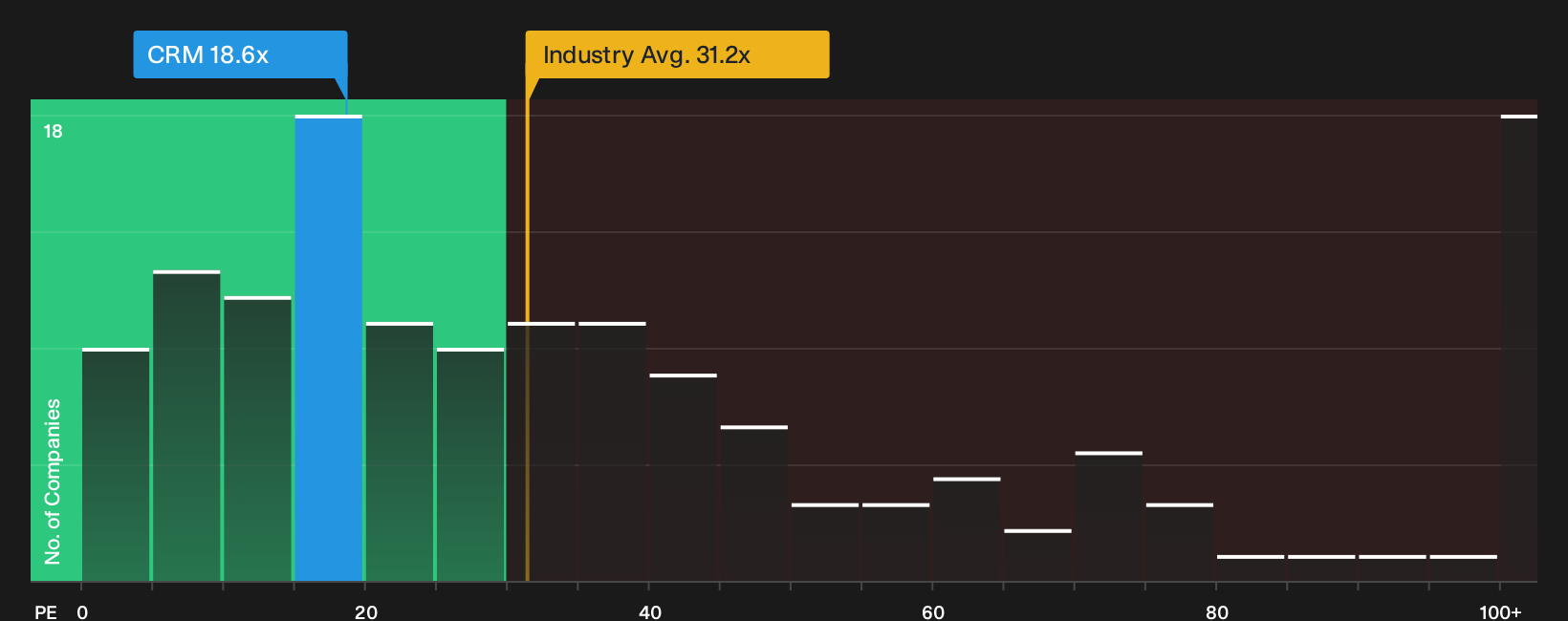
The P/E ratio fits Salesforce because earnings now play a bigger role in how investors judge mature software platforms that still invest heavily in new products and AI. At roughly 18.6x earnings, Salesforce trades at a clear discount to the wider Software industry average of 31.2x and an even larger gap to the peer group around 45.1x. For a reader, that means the market is currently putting a lower price on each dollar of Salesforce profit than it does on many comparable software stocks.
The fair value model suggests a P/E multiple that already adjusts for Salesforce's profitability profile, scale, sector and risk, and the present 18.6x level sits below that implied figure. Despite the recent Cresta acquisition headlines and the credit rating downgrade linked to higher planned leverage, the earnings multiple still prices Salesforce at a discount to both the industry and its direct peer set, which points to sentiment that has not fully followed the AI narrative. You would need to decide whether that gap reflects conservatism about the pipeline or an opening for exposure at a lower earnings price tag than many software alternatives. Explore the numbers behind Salesforce's P/E valuation.
The Salesforce Narrative: What Would Justify Today's Price?
Narratives on Salesforce sit between the current P/E gap and the question of what kind of future the market is quietly pricing in. They spell out the earnings, margin and growth path that would need to hold for the stock to be worth meaningfully more or less than today. Each storyline ties a fair value to a specific mix of potential catalysts and risks, so you can track which version seems closest to reality over time.
Two credible views on Salesforce line up on opposite sides of the value line: one seeing a discount, the other arguing expectations already run hot.
Bull case: 26% undervalued
According to HedgeY, an investor in the Simply Wall St Community, Salesforce’s AI shift reframes what the business is really selling.
"The new thesis is more interesting, Salesforce may sell governed work, that means trusted data, permissions, workflows, audit trails, agent actions, and enterprise context…"
Discover why this Narrative puts Salesforce at 26% undervalued.
Bear case: 12% overvalued
The bearish analyst Narrative on Simply Wall St argues that AI agents could also drag on economics and heighten scrutiny.
"The current numbers around revenue guidance, free cash flow, AI adoption, and long term targets imply that Salesforce's share price already reflects a successful AI agent platform…"
Explore why this Narrative puts Salesforce at 12% overvalued.
One more angle on Salesforce before you make a move
Valuation only tells part of the story, since the analyst view of where Salesforce could be a few years from now offers a separate reference point to compare with today's pricing. Explore where analysts expect Salesforce to be in a few years.
Have feedback on this article? Concerned about the content? Get in touch with us directly. Alternatively, email editorial-team@simplywallst.com