


EN
Nvidia's “Black Swan” stirs up AI beliefs! Hwang In-hoon's turmoil brought about buying US bonds, and long-term US bonds bucked the trend
The Zhitong Finance App learned that after a short holiday, the US bond market resumed trading, and the price of long-term US bonds rose slightly. The Nvidia (NVDA.US) crisis caused the market to have doubts about the main line of AI transactions, and safe-haven purchases poured into US debt.
The 30-year US Treasury yield declined by 2 basis points to 5.34%. Thursday will usher in the same period treasury bond tender; the 10-year US Treasury yield stabilized at 4.99% after a brief decline. The cash treasury bond market is closed on Wednesday for US Veterans Day.
Earlier, it was reported that Nvidia's board of directors is considering dismissing CEO Wong In-hoon. Related accusations point to his multiple extramarital affairs, and the news is impacting the market's risk appetite. This chip giant is the core pillar of the AI market. Any negative turmoil could damage market confidence far beyond the company's own scope.
Commonwealth Bank of Australia strategist Carol Kong said, “The series of news surrounding Wong In-hoon further shook the market's confidence in the AI narrative and led to small safe-haven purchases on US bonds. Nvidia is critical to the AI investment boom and the global economy, and there is no doubt that all market participants are closely monitoring developments.”
Other sovereign bonds were also bought during the Asian session, and Australian and New Zealand treasury bond yields declined by at least 1 basis point.
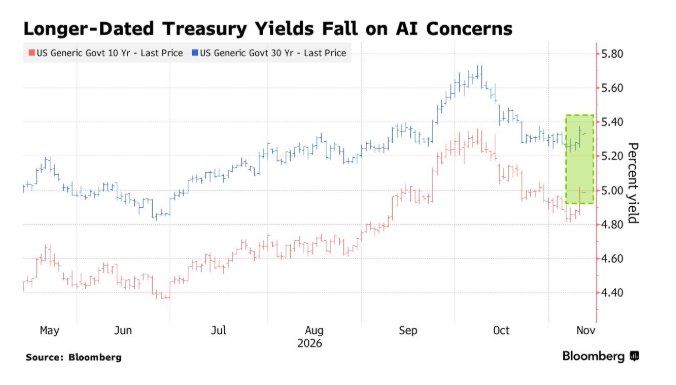
Strategist Mark Cranfield said, “Aggressive traders are likely to see a slight rebound in the NASDAQ as a window to rebuild macro-hedging positions. This may also give a fresh boost to bond purchases — US bonds have been weakening under pressure this week.”
However, short-term US bond yields rose slightly, as traders continued to bet that the Federal Reserve would raise interest rates further, and the US bond yield curve flattened. The 2-year US Treasury yield rose 3 basis points to 4.77%, and the 5-year yield rose 1 basis point to 4.83%.
The swap market shows that traders are setting expectations for a 25 basis point rate hike at the December meeting of the Federal Reserve after the key indicators of US consumer prices once again strengthened beyond expectations in October. The data prompted Federal Reserve officials to open the door for more aggressive rate hikes in the coming months. Governor Christopher Waller said a 50 basis point rate hike may be needed in December.
Andrew Ticehurst, senior interest rate strategist at Nomura Holdings in Sydney, said, “The short-term yield in the US rose this morning. Essentially, after the inflation data broke out, the market continued to reprice the hawkish US Federal Reserve policy, which was compounded by the outspoken hawkish statements of many officials since then. Currently, the market's pricing of the December rate hike is close to 30 basis points, indicating that the market is carefully evaluating the risk of raising interest rates by 50 basis points in December. This signal is worth paying attention to.”