


EN
After $3.3 Billion in Insider Selling, CoreWeave CEO Says His Stock Sale Plan is 'Silenced' on Beat-and-Raise Quarter
CoreWeave (CRWV) CEO Michael Intrator executed a dramatic reversal on Wednesday, cancelling his prearranged schedule for insider stock sales and pledging that any further selling will be limited to routine tax-related dispositions tied to restricted stock units for now.
“I cancelled my 10b-5,” Intrator told CNBC earlier today. “It is done… Until there is a material change in our equity pricing, my 10b-5 has been silenced.”
The move directly answers a persistent bear argument, as Intrator and his co-founders had sold roughly $3.3 billion of stock since the IPO, including about $2.4 billion this year, while shares fell more than 50% from mid-year levels.
That selling had become a lightning rod for skeptics, who questioned why founders were cashing out so aggressively while the share price slid.
The timing amplified the signal, with the announcement landing directly after a beat-and-raise third quarter that sent the stock up more than 25% intraday in its best session since April 2025, after it had lost more than 40% in the preceding month.
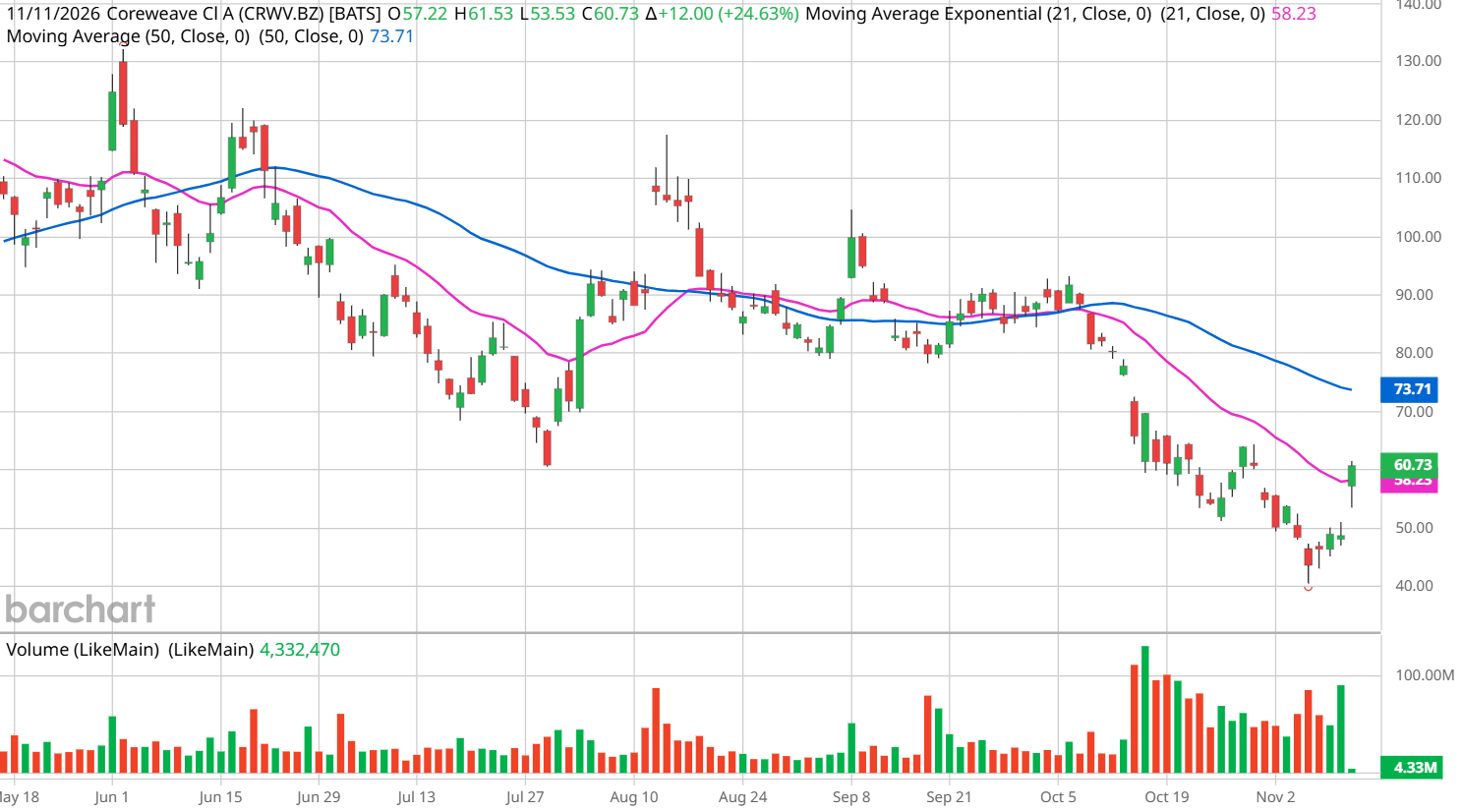
CoreWeave Just Crushed Q3 Earnings
Third-quarter revenue surged 168% to $3.66 billion, while adjusted operating income of $379 million came in well above guidance and the backlog ballooned to a staggering $132.5 billion.
Management also lifted 2026 revenue guidance to $13.0 billion to $13.3 billion, giving bulls fresh ammunition after a bruising month for the stock.
Those figures arrived as a counterweight to months of worry over the company's financing, and the market rushed to price in its relief.
The Financing Reset Is the Real Story
The insider-sale reversal matters most alongside a notable but underappreciated financing reset, as management pledged to avoid unsecured debt at current yields through 2027.
Instead, CoreWeave will lean on about $9 billion in expected customer prepayments and deposits, plus an investment-grade asset-backed deal expected to price around 7% to 7.5%, far below the roughly 15% to 17% that its unsecured bonds recently yielded.
That gap of roughly 7.5 to 10 percentage points represents meaningful potential relief on borrowing costs for a company carrying this much debt.
Intrator also declined to buy back discounted bonds, arguing that internal returns are higher, even with the company's own debt trading below face value.
Executive Selling Isn't Corporate Dilution
Investors should distinguish between the two, because the at-the-market program for up to 35 million shares, which lets the company sell new stock directly into the market, remains available for opportunistic use.
In other words, the founders may have stopped selling, but the company itself has kept the door open to issuing stock if prices cooperate.
Can CRWV Outrun Its Interest Bill?
However, the fundamental hurdle remains, with fourth-quarter interest expense of $1.05 billion to $1.15 billion set to exceed adjusted operating income, debt standing near $47 billion, and adjusted profitability not targeted until the first half of 2028. That means the company is still spending more to service its debt than its operations generate on an adjusted basis.
Skeptics also cite thin returns on capital and tight liquidity, and they expect another equity raise despite the confidence gesture from the corner office.
Intrator’s decision to halt personal sales is a credible signal that removes a sentiment overhang, but it does not change the balance sheet, and $47 billion in debt will not shrink simply because insiders stopped selling.
The Next Catalyst to Watch
The decisive tests are timely collection of the roughly $9 billion in prepayments and successful pricing of the secured debt in that 7% to 7.5% range.
Peer results, notably from Nebius (NBIS) on Thursday, will also show whether today’s neocloud stock rally can hold amid a hawkish Federal Reserve.
NBIS is up 17% today, with the stock’s weekly November 13 options pricing in a 10.9% price swing after Thursday’s earnings announcement.
This article was created with the support of automated content tools from our partners at Sigma.AI. Together, our financial data and AI solutions help us to deliver more informed market headline analysis to readers faster than ever.
On the date of publication, Sarah Holzmann did not directly have a position in any of the securities mentioned in this article. All information and data in this article is solely for informational purposes. For more information please view the Barchart Disclosure Policy here.