


EN
Alphabet Edged Higher After Revealing a Pair of New TPUs for Agentic AI. A Bigger Challenge for GOOGL Stock Is Its Cash Flow.
Alphabet (GOOGL) caught investors’ attention on November 9 as Google unveiled two new Tensor Processing Unit (TPU) systems targeting agentic AI and enterprise computing. Alphabet’s Class A shares jumped to $296.33 during the session before easing to $288.15, still up 1.18% from the previous close.
The announcement puts Google’s chip ambitions back in focus, but the investment question goes beyond the initial stock reaction. Can these new systems deliver meaningful business gains, and do Alphabet’s fundamentals and valuation support the enthusiasm? Let's find out.
What the New TPUs Could Change
Google’s new systems, TPU 8i Max and TPU 8tx, deserve a cautiously positive reception because they broaden the AI workloads its infrastructure can support. The TPU 8i Max targets large context windows, high compute density, and agentic AI applications requiring substantial memory. These capabilities could strengthen Google’s appeal to customers running complex AI tasks, although the announcement does not establish a measurable performance or cost advantage.
The TPU 8tx addresses a separate enterprise concern, that is confidential inference and computing while preserving data sovereignty. That focus could help Google compete for workloads where control over sensitive information influences purchasing decisions.
Alphabet is also using AMD’s (AMD) fifth-generation EPYC processors to power the host infrastructure for its cloud TPU 8tx, according to an expanded partnership announced on November 9. Together, the additions bring Google’s lineup to four distinct TPU systems introduced within one year, demonstrating how quickly it is expanding its hardware offering.
The sensible takeaway is that the launch strengthens Alphabet’s competitive toolkit, but does not independently justify a more bullish valuation. Evidence of customer commitments, attractive pricing, and profitable demand would provide a firmer basis for treating this technical progress as an earnings catalyst.
Alphabet’s Recent Financial Performance
Alphabet released its third-quarter 2026 results on October 28, reporting revenue growth of 24.7% to $127.6 billion, broadly matching the $127.9 billion consensus. The GAAP profit of $2.12 per share missed the $3.01 estimate by 29.5%, partly reflecting an $8.7 billion equity securities loss versus a $10.7 billion gain a year earlier.
This investment swing weighed on reported earnings even as operating margin expanded to 31.8% from 30.5%. The improvement did not extend to cash generation, however, with free cash flow margin falling to negative 7.1% from positive 23.9%.
GOOGL stood at $288.15 as of November 10, down 7.94% this year but up 3.34% over 52 weeks, giving Alphabet a market capitalization of approximately $3.483 trillion.
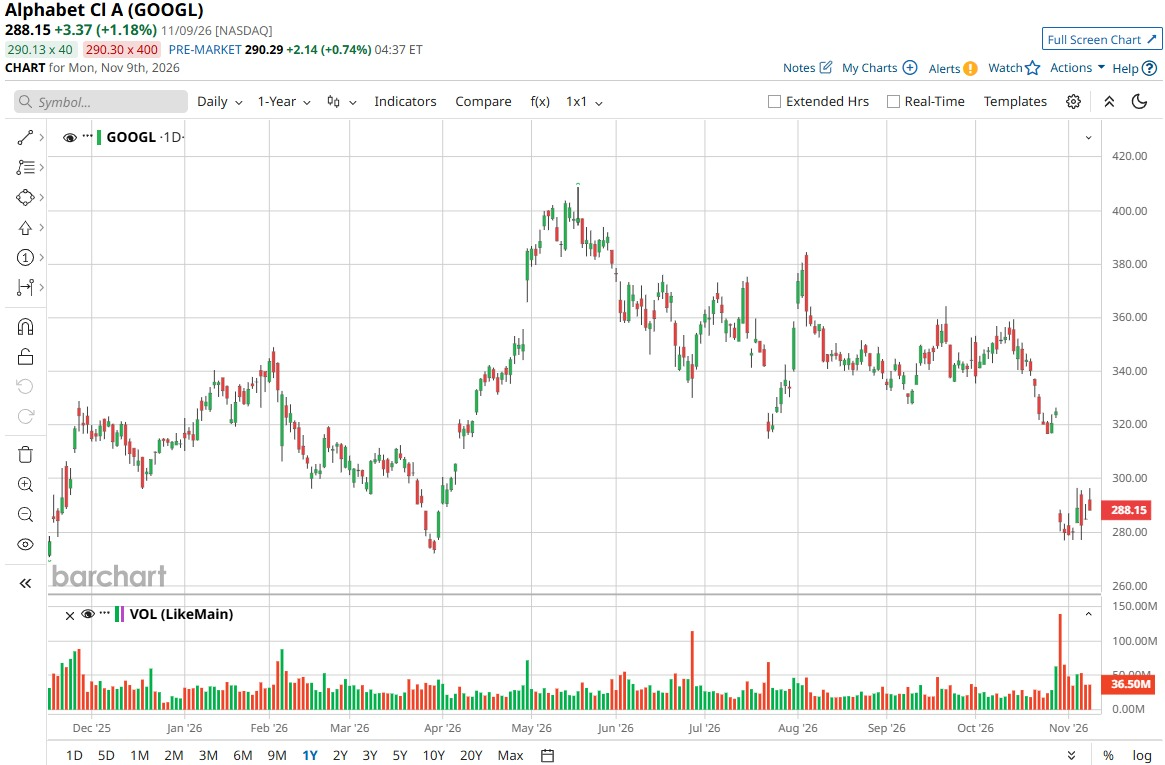
The longer revenue trend provides some support for its growth prospects, with annual sales increasing from $239.2 billion five years ago to $471.1 billion over the latest 12 months, representing 14.5% annualized growth. Alphabet derives 53.1% of revenue from Google Search, whose annualized growth accelerated to 14.1% over two years from 12.1% over five years.
This established business remains more relevant to current earnings than emerging opportunities such as quantum computing. Alphabet’s October 15 Willow processor demonstration reduced specific quantum state errors approximately 40-fold, but the result applies to a particular technique, with commercial scaling still years away.
The distinction between technical progress and commercial delivery also matters when assessing execution risk. Alphabet faces a securities lawsuit alleging misleading disclosures about Gemini 3.5 Pro training results and launch timing. The November 5 notice identifies December 1 as the lead plaintiff deadline, although the allegations remain unproven.
Where Analysts See Alphabet Heading
Alphabet’s next earnings release is expected on February 3, 2027, with analysts forecasting earnings of $3.14 per share for the quarter ending December 2026. That compares with $2.82 a year earlier, representing expected growth of 11.35%.
This reassessment also appeared in JPMorgan Chase analyst Douglas Anmuth’s updated outlook. The analyst lowered his price target to $375 from $425 while maintaining an “Overweight” rating, implying 30.14% upside. That $50 reduction indicates more restrained expectations, even as his recommendation remains positive.
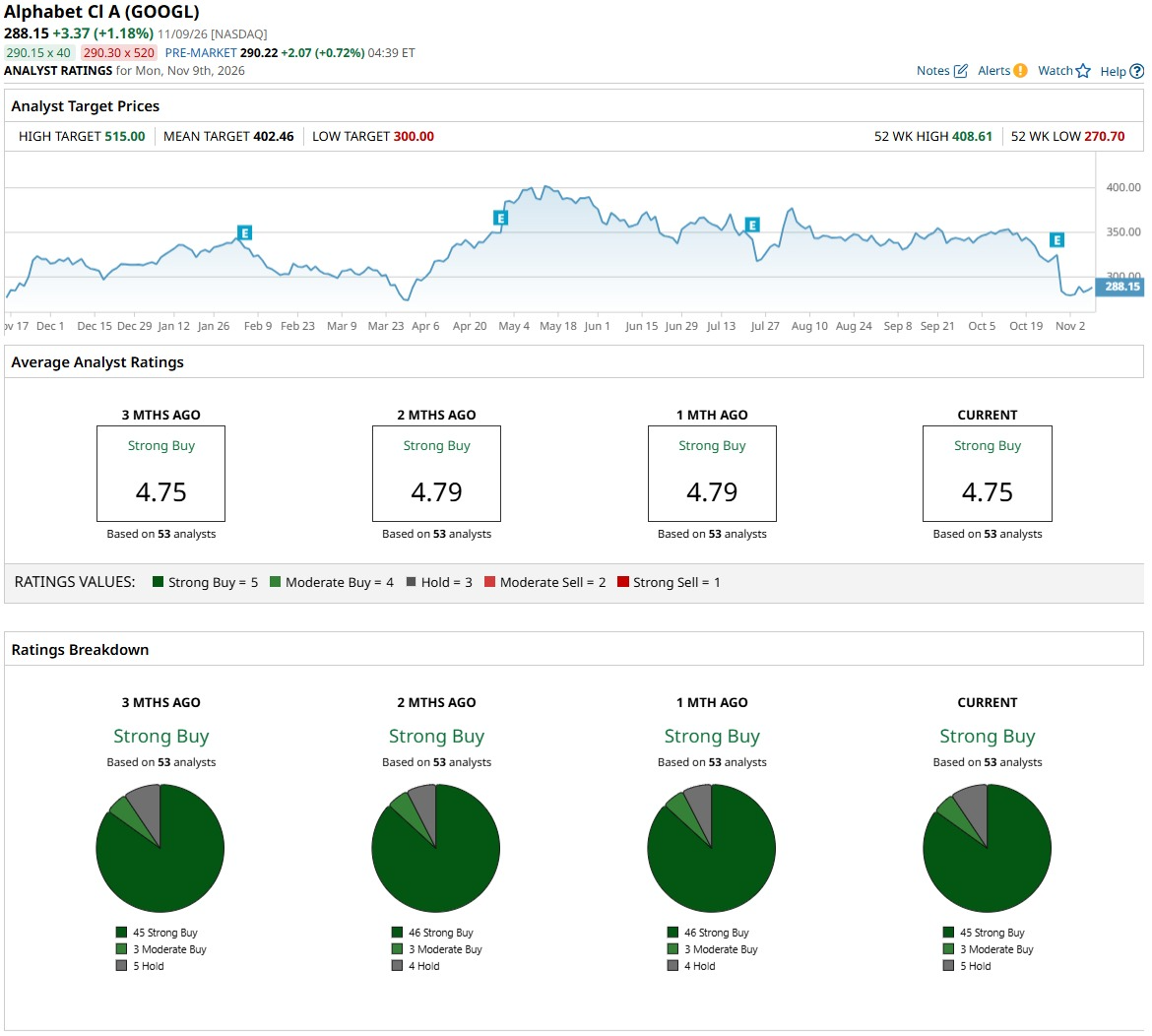
Wall Street’s overall view remains more constructive. GOOGL holds a “Strong Buy” consensus across 53 surveyed analysts, with an average price target of $402.46, implying approximately 39.67% upside from the November 10 share price of $288.15.
Conclusion
Alphabet’s new TPUs give Google more ways to serve demanding AI workloads and businesses handling sensitive data. That strengthens the investment case, but negative free cash flow makes profitable adoption the priority. Gradual customer uptake looks more likely than an immediate earnings windfall. With analysts projecting 39.67% upside, the opportunity is worth watching, though recent downgrades argue against chasing the initial rally. The sensible stance is cautiously bullish, with cash generation carrying more weight than another expansion of Google’s chip lineup.
On the date of publication, Ebube Jones did not directly have a position in any of the securities mentioned in this article. All information and data in this article is solely for informational purposes. For more information please view the Barchart Disclosure Policy here.