


EN
Hospital Transformation Update Might Change The Case For Investing In Ramsay Health Care (ASX:RHC)
- Ramsay Health Care released its Q1 2027 results on 5 November 2026, followed by an earnings call on 6 November that updated investors on its hospital portfolio and transformation progress.
- Management discussion around the multiyear Australian hospital transformation program and its impact on underlying EBIT and margins brought fresh focus to how Ramsay Health Care is handling cost pressures and funding arrangements.
- We now look at how Ramsay Health Care's Q1 2027 earnings update might reshape its investment narrative around hospital transformation.
Ramsay Health Care Investment Narrative Recap
To own Ramsay Health Care, you need to be comfortable that the Australian hospital transformation can keep offsetting stubborn wage and funding pressure. The analyst consensus Narrative on Simply Wall St already ties the investment case to EBIT efficiency, digital tools and higher acuity services. The Q1 2027 update reinforces that the near term swing factor is execution on those operational changes rather than new growth engines.
The biggest short term catalyst remains whether transformation benefits can consistently support margins while enterprise bargaining, French tariff settings and higher interest costs bite. The key risk sits in the same place. If wage inflation, regulatory decisions or funding indexation move against Ramsay Health Care, cost discipline and capital returns could come under more strain.
The Q1 2027 earnings call on 6 November is the clearest recent lens on that trade off. Management commentary linked the Australian transformation program directly to underlying EBIT and margin trends, and investors received more detail on theatre utilisation, case mix, and the cost to run digital and technology upgrades across the hospital portfolio.
For anyone tracking catalysts, that matters more than short term share price moves. The call ties together several themes already flagged in earlier guidance, including higher ROCE at the Funding Group, capital allocation toward Australian hospitals and the ongoing burden of interest costs. Your own view on Ramsay Health Care probably comes down to how durable you think these operational gains are against wage, tariff and funding risks.
What The Current Forecasts Assume For Ramsay Health Care
Ramsay Health Care's current analyst narrative bundles the hospital transformation story into some very specific numbers. Consensus assumptions point to revenue expanding by 4.0% a year, and profit margins moving from 1.7% to 2.6% over roughly three years. On earnings, the group is projected to move from A$313.5 million today to A$551.7 million by 2029, with the most optimistic forecasts closer to A$630.3 million. Those projections also bake in only a small lift in the share count of about 0.06% annually, which keeps most of the earnings change flowing through to each share rather than being heavily diluted.
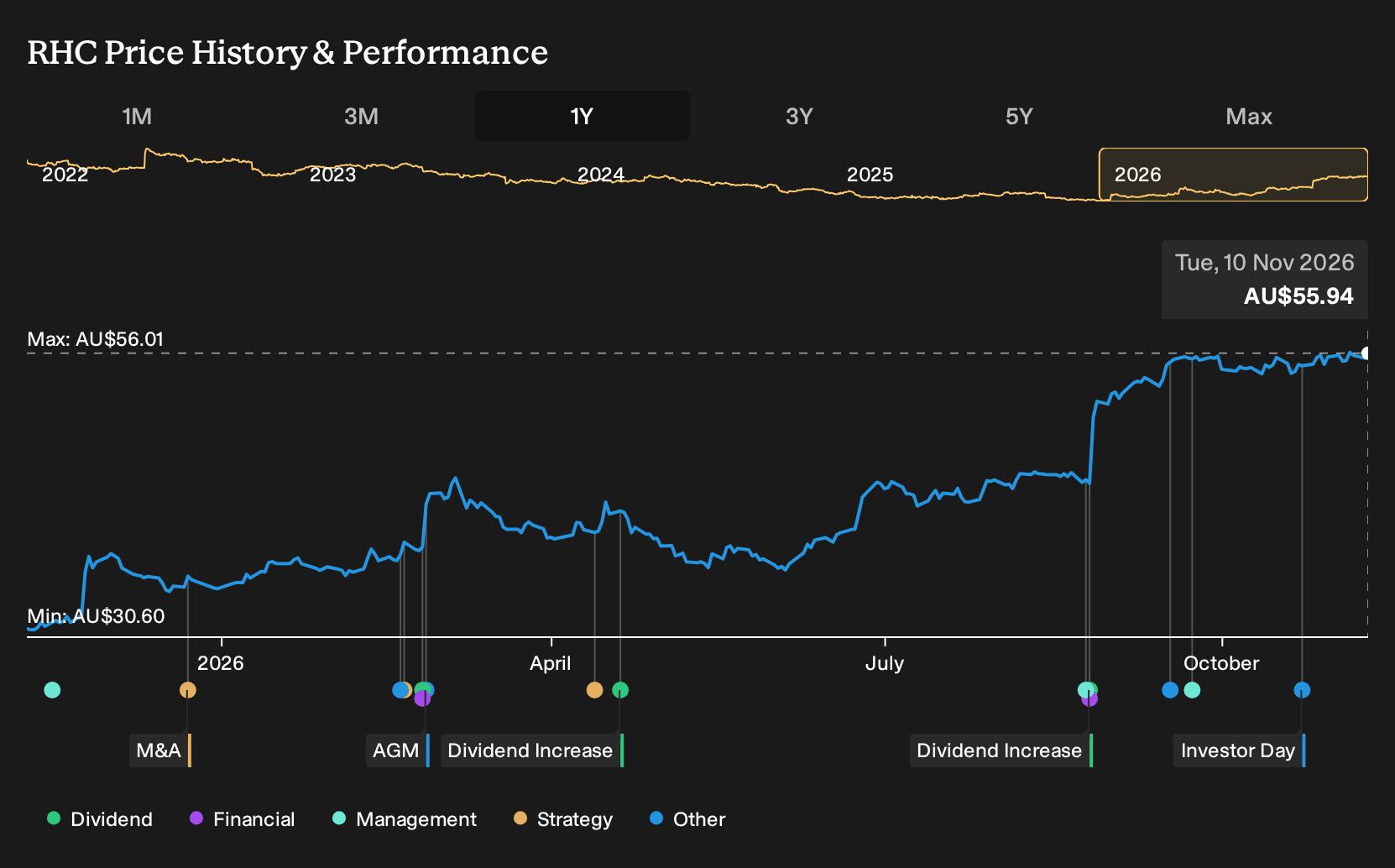
Valuation work in the analyst reports lines those operating forecasts up with Ramsay Health Care's share price. The consensus view uses 2029 assumptions of A$21.0b in revenue and A$551.7 million in earnings alongside a future P/E multiple of 27.2x, compared with 40.4x today and 35.8x for the wider Australian healthcare peer group. That framework underpins a consensus price target of A$52.02, sitting slightly below the current A$55.0 share price, with a fairly wide spread between the A$41.9 low and A$66.0 high target that reflects different views on how confidently the business can convert its cost and funding challenges into better margins.
Ramsay Health Care's narrative projects A$21.0b revenue and A$551.7 million earnings by 2029. This is built on 4.0% yearly revenue growth and an earnings increase of about A$238 million from A$313.5 million today.
Uncover why Ramsay Health Care's fair value indicates a 7% potential downside to its current price, leaving little room for error.
Exploring Other Perspectives
One alternate view on Ramsay Health Care focuses on weaker patient demand and funding pressure. The most cautious analysts had pencilled in A$20.3b revenue and A$500.9 million earnings by 2029 before this Q1 2027 update. That is a meaningfully softer story. Use this earnings release to test which narrative you find more convincing.
Explore 3 other Ramsay Health Care fair value estimates, including one that suggests there could be as much as 25% downside from the current price.
Form Your Own Verdict
Disagree with existing narratives? Extraordinary investment returns rarely come from following the herd, so consider conducting your own research and analysis.
- A great starting point for your Ramsay Health Care research is our analysis highlighting 2 key rewards and 2 important warning signs that could impact your investment decision.
- See our latest analysis for Ramsay Health Care. The report includes a comprehensive fundamental analysis summarized in a single visual, the Snowflake, making it easier to evaluate Ramsay Health Care's overall financial health at a glance.
Looking For More Investment Ideas Beyond Ramsay Health Care?
If Ramsay Health Care has sharpened your focus on cost pressure, funding mix, and capital allocation, it can help to widen your watchlist with companies that approach those same problems from different angles. The Simply Wall St Screener lets you filter for the traits you care about most and then compare fundamentals side by side before you commit more time to deeper research.
- If you are hunting for value backed by resilient finances, scan a curated set of companies through the 2 high quality undervalued stocks that pair stronger balance sheets with more conservative valuations.
- If capital protection matters as much as upside, narrow your field to businesses that score well on stability metrics by starting with the 6 resilient stocks with low risk scores that filters for lower overall risk profiles.
- If you want to balance income needs with financial resilience, focus on firms with higher yields and sturdier fundamentals by reviewing a targeted 5 dividend fortresses that emphasises dependable payouts.
Have feedback on this article? Concerned about the content? Get in touch with us directly. Alternatively, email editorial-team@simplywallst.com