


EN
Will Lower Oil Prices Change Delta Air Lines' (DAL) Narrative
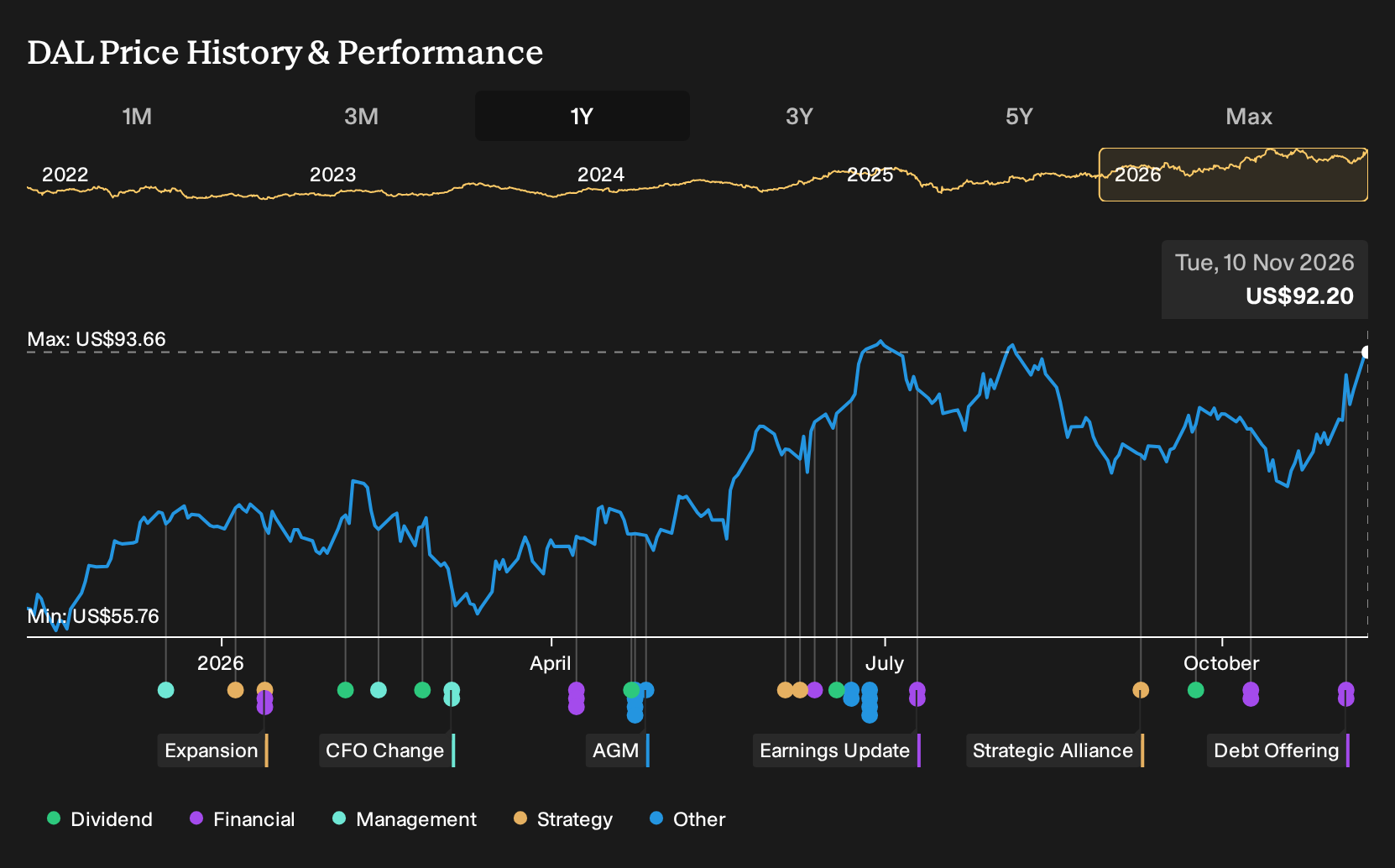
- Delta Air Lines completed a US$499.275 million fixed income offering of 5.5% senior unsecured notes due November 6, 2029, alongside an additional fixed rate callable senior unsecured issuance.
- The combination of new fixed rate debt and recent record profitability gives Delta Air Lines additional flexibility to manage fuel costs, capital spending and balance sheet pressure in a fuel sensitive, thin margin business.
- The focus now shifts to how Delta Air Lines' earlier margin story aligns with this new fixed rate funding in a period of softer fuel prices.
Scan other airlines and capital intensive businesses reacting to similar fuel and funding shifts with our curated list of list of solid balance sheet and fundamentals (25 results)
Delta Air Lines Investment Narrative Recap
For shareholders in Delta Air Lines, the core belief is that a fuel sensitive carrier with thin margins can still compound value through careful capacity discipline, yield management and cost control. According to PittTheYounger, an investor in the Simply Wall St Community, Delta has been protecting load factors by holding back on aggressive expansion. Softer crude and jet fuel prices improve breathing room, but the short term catalyst still rests on Delta converting that fuel relief into stable profit margins rather than one off trading days in the stock.
The biggest operational risk today remains the combination of high leverage and exposure to external shocks when profit margins are already below last year. PittTheYounger highlights the balance sheet as vulnerable to events such as trade conflict or a sharp demand slowdown. Recent fuel relief helps near term earnings pressure but does not change those underlying sensitivities, so the credit profile still needs close watching.
The recent US$499.275 million fixed income deal, with 5.5% senior unsecured notes due 2029, matters most in this context. A callable, unsecured structure extends Delta Air Lines’ funding runway at a known coupon, which can help management plan fleet, maintenance and refinery spending with a bit more confidence while fuel prices sit below recent peaks.
That extra term funding sits alongside a history of high debt and profit margins that are currently below the prior year, so execution on cash generation becomes the key catalyst. If Delta uses this liquidity to keep operations running smoothly and protect service quality while avoiding further margin compression, the bond issuance could support the equity story rather than adding to investor concerns about leverage.
PittTheYounger’s fair value of US$63.21 for Delta Air Lines comes from a narrative that assumes revenue rising at 2.0% a year and future profit margin settling at 8.0%, followed by applying a P/E multiple that reflects what they see as a resilient but fuel sensitive carrier.
Uncover why Delta Air Lines' fair value indicates a 31% potential downside to its current price, which leaves little room for error.
Exploring Other Perspectives
Some of the most optimistic analysts frame the new bonds very differently for Delta Air Lines. You might worry about leverage; they focus on earnings power. Before this funding, the bullish camp was pencilling in revenue of about US$84.7b and earnings of roughly US$7.6b by 2029. That more upbeat script may now shift again, so it is worth exploring a few contrasting viewpoints for yourself.
Explore 7 other Delta Air Lines fair value estimates, including one that suggests as much as 152% upside from the current price.
Form Your Own Verdict
Don't just follow the ticker. Dig into the data and build a conviction that's truly your own.
- A great starting point for your Delta Air Lines research is our analysis highlighting 2 key rewards and 3 important warning signs that could impact your investment decision.
- See our latest analysis for Delta Air Lines. The report includes a comprehensive fundamental analysis summarized in a single visual, the Snowflake, making it easy to evaluate Delta Air Lines' overall financial health at a glance.
Looking for more investment ideas beyond Delta Air Lines?
Once you have a view on Delta Air Lines, it often helps to widen the lens and test your thesis against other businesses with different balance sheets, cash flows and risk profiles. The Simply Wall St Screener lets you shift from one stock to a whole watchlist of candidates in a few clicks.
- If you want potential mispricing paired with quality fundamentals, start with a curated pool of 33 high quality undervalued stocks that already clear basic balance sheet and cash flow hurdles.
- If resilience matters more than excitement right now, narrow your search to 30 resilient stocks with low risk scores that score well on financial strength and business stability metrics.
- If you prefer to fish where fewer investors are looking, focus on 19 high quality undiscovered gems that combine solid fundamentals with relatively low market attention.
Have feedback on this article? Concerned about the content? Get in touch with us directly. Alternatively, email editorial-team@simplywallst.com