


EN
What Manulife Financial (TSX:MFC)'s Quarterly Earnings Update Means For Shareholders
- Manulife Financial reported third quarter 2026 net income of C$1,488 million compared with C$1,789 million a year earlier, while nine month net income reached C$4,862 million versus C$4,220 million, alongside ongoing common and preferred dividends and completion of 24,000,000 share repurchases for C$1,313 million under its 2026 buyback.
- The mix of lower quarterly earnings, higher year to date profit and continued capital returns through dividends and buybacks gives investors a clearer view of how Manulife Financial is balancing current profitability with long term capital deployment priorities.
- Investors can now evaluate how Manulife Financial's third quarter earnings dip, together with maintained dividends, may shape its longer term investment narrative.
Scan how Manulife Financial's latest mix of buybacks and dividends compares with other companies returning capital through 3 dividend fortresses in the current market.
Manulife Financial Investment Narrative Recap
To stay invested in Manulife Financial, you need to believe the business can keep shifting its earnings mix toward Asia, fee based wealth and more stable protection lines while managing pressure in areas like alternative long duration assets and Canadian group disability. The third quarter dip in net income and earnings per share highlights that volatility. The bigger near term swing factor still looks like how investment income and morbidity trends evolve rather than this single set of results.
The analyst consensus narrative on Simply Wall St leans on Asia demand, AI driven efficiency and excess capital as key supports for earnings over time. The recent quarter, with higher year to date profit but softer three month numbers, does not radically change that setup. The main practical risk around the story remains continued strains in Global WAM flows and disability claims, which could make the path to steadier earnings less smooth, even with strong capital levels.
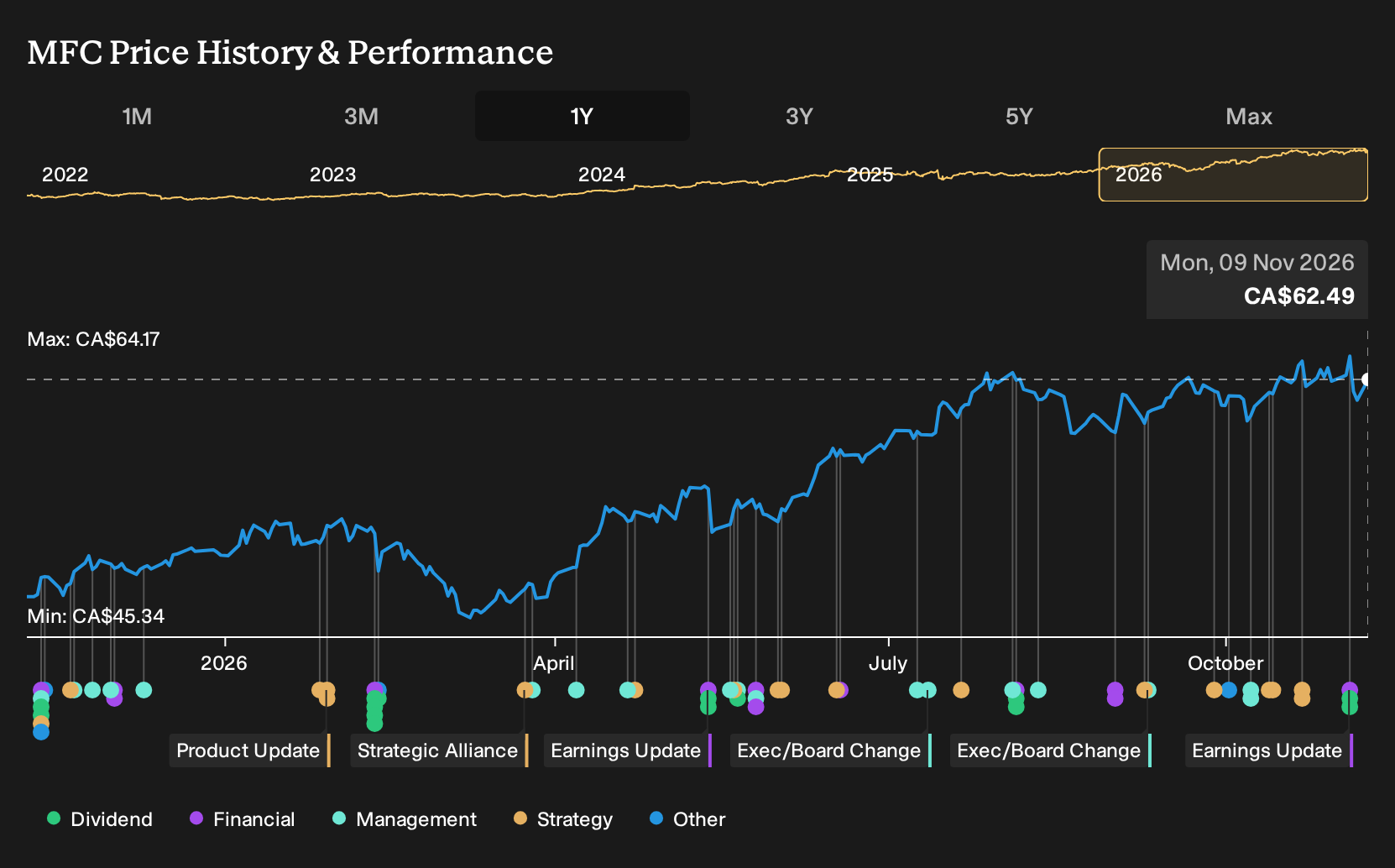
The most relevant recent announcement for that story is the completion of Manulife Financial's C$1,313 million buyback covering 24,000,000 shares, including C$501.4 million spent on 8,300,000 shares in the latest quarter. That capital return happens alongside a quarter where net income was C$1,488 million and year to date profit reached C$4,862 million, so you can see management running both profitability and balance sheet decisions in parallel.
For you as a shareholder, the interesting link to catalysts is how this buyback interacts with ongoing common and preferred dividends and the excess capital highlighted in the analyst consensus narrative on Simply Wall St. If execution in Asia, long term care risk transfer and AI driven cost work stays on track, then using that surplus for repurchases can shape per share earnings. If pressures in alternative assets, Global WAM outflows or morbidity linger, the same capital deployment could feel more conservative than aggressive, with the business still working through its operational risks.
Manulife Financial's current earnings are CA$6.2b, with analysts forecasting CA$8.5b of earnings on CA$61.5b of revenue by 2029. This implies revenue growth of 22.9% per year and an earnings increase of about CA$2.3b from today.
Uncover how Manulife Financial's fair value indicates a 5% potential upside to its current price before a closing discount resets the risk reward balance.
Exploring Other Perspectives
The Simply Wall St Community currently supplies three fair value views for Manulife Financial, ranging from a low estimate of 65.4 to a high of 128.07. Private investors are broadly divided on the potential upside. Consider these differing views alongside ongoing alternative asset and disability risks, and decide which perspective best aligns with your expectations.
Explore 2 other Manulife Financial fair value estimates, including one that suggests as much as 105% potential upside from the current price.
Reach Your Own Conclusion
Disagree with existing narratives? Extraordinary investment returns rarely come from following the herd, so go with your instincts.
- A great starting point for your Manulife Financial research is our analysis highlighting 4 key rewards that could impact your investment decision.
- See our latest analysis for Manulife Financial. The report includes a comprehensive fundamental analysis summarized in a single visual, the Snowflake, making it easy to evaluate Manulife Financial's overall financial health at a glance.
Looking For More Investment Ideas Beyond Manulife Financial?
Once you are comfortable with where Manulife Financial fits in your portfolio, it can help to scan a wider set of candidates that match different risk and income profiles using the Simply Wall St Screener.
- For investors who care most about balance sheet strength and resilient fundamentals, review our list of solid balance sheet and fundamentals (5 results) to see which businesses meet that test.
- If you want potential opportunity with less emphasis on price momentum and more on quality, cast a wider net across our 7 high quality undiscovered gems that might not be widely followed yet.
- Income focused readers who prioritise reliability of payouts can compare Manulife Financial's yield profile with other 9 resilient stocks with low risk scores that score well on stability.
Have feedback on this article? Concerned about the content? Get in touch with us directly. Alternatively, email editorial-team@simplywallst.com