


EN
Where Are Crude Oil Prices Heading?
Markets reflect the economic and geopolitical landscape, making crude oil the main focus of markets in late 2026. I asked if crude oil prices would remain volatile for the rest of 2026 in a September 24, 2026, Barchart article, where I concluded with the following:
We should expect continued volatility in crude oil prices. Iran is likely to continue its aggressive posture. It will try to stall negotiations until after the U.S. midterm elections, which could shift support for the current U.S. military posture. The U.S. administration would like to de-escalate and lower oil prices before the November 3 election. I expect oil prices to remain volatile for the rest of 2026 and into 2027.
Nearby NYMEX crude oil futures and ICE Brent futures settled at $94.61 and $100.22 per barrel, respectively, on September 24, 2026, and were lower on November 9 after the U.S. midterm elections reshaped the U.S. government for the next two years.
NYMEX WTI crude oil futures remain choppy
While NYMEX crude oil futures have remained below the March 9, 2026, high of $119.48 per barrel, price action was bullish from a low of $67.04 on July 2, 2026, through the end of October.
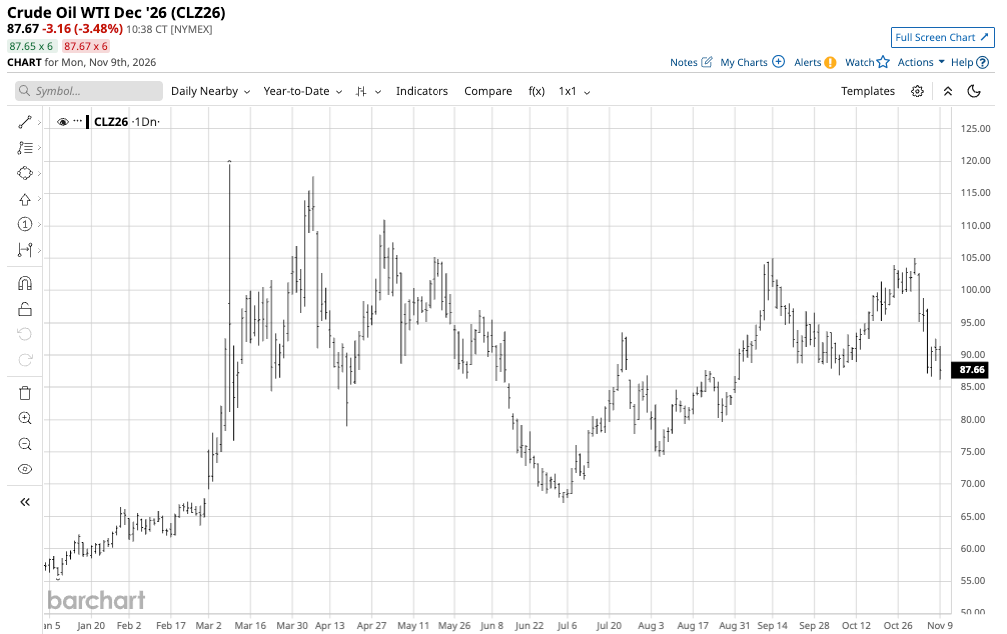
The daily continuous contract year-to-date chart shows WTI futures moving into a bullish trend, with the price reaching a high of $104.99 on October 30 before running out of steam and falling below $88 per barrel on November 9.
ICE Brent futures have also been choppy
ICE Brent crude oil futures have followed the same path.
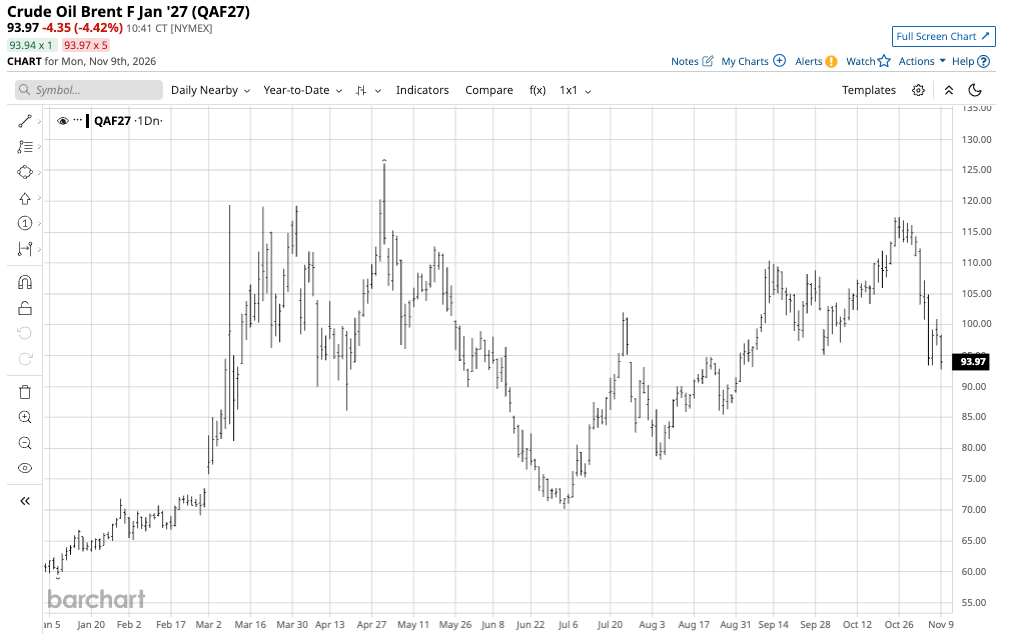
The daily continuous contract year-to-date chart shows Brent North Sea crude oil futures rose to $117.43 on October 26 before falling below $94 per barrel on November 9.
The bullish case for the rest of 2026
The ongoing war between Russia and Ukraine has escalated with increasing Russian attacks on Kyiv and other Ukrainian cities, and Ukrainian attacks on Russian oil production and refining infrastructure. Continued attacks and sanctions on Russian energy exports will increase supply concerns, pushing oil prices higher over the coming weeks and months.
While the war in Eastern Europe is critical, the most significant factor for the path of least resistance of crude oil prices is the hostilities between the U.S. and Iran. While U.S. sanctions and a blockade of Iranian exports are choking Iran’s economy, crude oil flows through the Strait of Hormuz remain a leading factor for crude oil prices. Moreover, Iranian attacks on neighboring countries’ oil infrastructure and Iranian proxy attacks on Saudi Arabia add fuel to the fire. The Houthis have stepped up attacks on Saudi oil production and refining, and the Bab al-Mandeb Strait is another critical logistical chokepoint. The results of the U.S. midterm elections have likely empowered the Iranians, as the election results show that U.S. voters do not support an ongoing war.
The bottom line is that wars in Eastern Europe and the Middle East remain the most bullish factors that could send crude oil prices higher over the coming weeks and months. Meanwhile, the U.S. Strategic Petroleum Reserve has declined to 282.2 million barrels as of the week ending on October 30, which is 432 million barrels below maximum capacity. The U.S. SPR can only decline to 150-250 million barrels before it becomes challenging to withdraw additional barrels to address supply concerns. Therefore, the SPR is only 32.2 million barrels above the top end of the minimum range.
Oil product markets remain tight. In October 2025, the gasoline crack spread peaked at $19.67 per barrel. At over $25, the refining spread reflects tightness driven by supply concerns and attacks on Russian and Middle Eastern refineries. Moreover, in October 2025, the distillate crack spread peaked at $40.89 per barrel. At over $88 per barrel, distillate prices reflect the supply concerns.
The bearish case until the end of this year
Just as the bullish case relies on the conflicts in Eastern Europe and the Middle East, the bearish case would be an end to the hostilities or ceasefires that lead to meaningful negotiations. The results of the U.S. midterm elections, with opposition party majorities controlling both the House and Senate, increase the odds of ending the conflict with Iran.
The U.S., Russia, and China, the world’s nuclear powers, have discussed the increasing potential of a trilateral summit between Presidents Trump, Xi, and Putin to discuss “denuclearization,” which could lead to pressure and compromises regarding Ukraine and Tehran to end the conflicts. Oil and gas prices would likely fall, perhaps dramatically, if a trilateral summit leads to solutions. Any agreements will depend on all sides’ willingness to walk away from the negotiating table with a great compromise.
Meanwhile, the UAE’s departure from OPEC and increased U.S. oil and gas production have reduced the oil cartel’s pricing power, which could be bearish for crude oil and gas prices. The U.S. energy policy could hit a roadblock if the opposition party thwarts the administration’s “drill-baby-drill” and “frack-baby-frack” policies in favor of a green energy agenda that inhibits fossil fuel production and consumption. The U.S. government now must walk a tightrope between affordability and a green agenda.
Go with the flow, as the trends are our best friends until they bend
Crude oil remains the energy commodity that powers the world. The U.S. and Russia are leading producers, while China is a leading consumer. Crude oil prices will affect markets across all asset classes because they are a critical input in the cost of goods sold for most products and services. Higher oil prices will increase inflationary pressures and interest rates, while lower oil prices could push inflation back toward the Fed’s 2% target and cause long bond prices to rebound, pushing long-term interest rates lower.
Given the volatile geopolitical landscape, forecasting oil prices over the coming months is impossible. However, prices are likely to be highly volatile. Crude oil prices can trend for months. The latest bullish trend began in early July and is faltering in November. The last significant bearish trend began at the March 2022 high and ran through the December 2025 low. The optimal approach to crude oil and oil-related assets is to follow the trend until it bends. In November 2026, the trend has turned lower, so the odds favor a choppy market better suited to trading short- to medium-term trends until they bend.
On the date of publication, Andrew Hecht did not directly have a position in any of the securities mentioned in this article. All information and data in this article is solely for informational purposes. For more information please view the Barchart Disclosure Policy here.