


EN
Warby Parker Stock Could Get a Big Boost From Warby’s Smart Glasses
Warby Parker's (WRBY) smart glasses, which are expected to be launched before the end of the year, could boost WRBY stock significantly. Given the success of Meta's (META) smart glasses and Warby's partnership with Samsung and Alphabet's (GOOG) (GOOGL) Google on its offering, there's a good chance that Warby's undertaking will boost the company's bottom line meaningfully beyond analysts' average estimates in 2027. And when companies' financial results surpass analysts' mean estimates by significant amounts, their stocks often rise more quickly than the overall market.
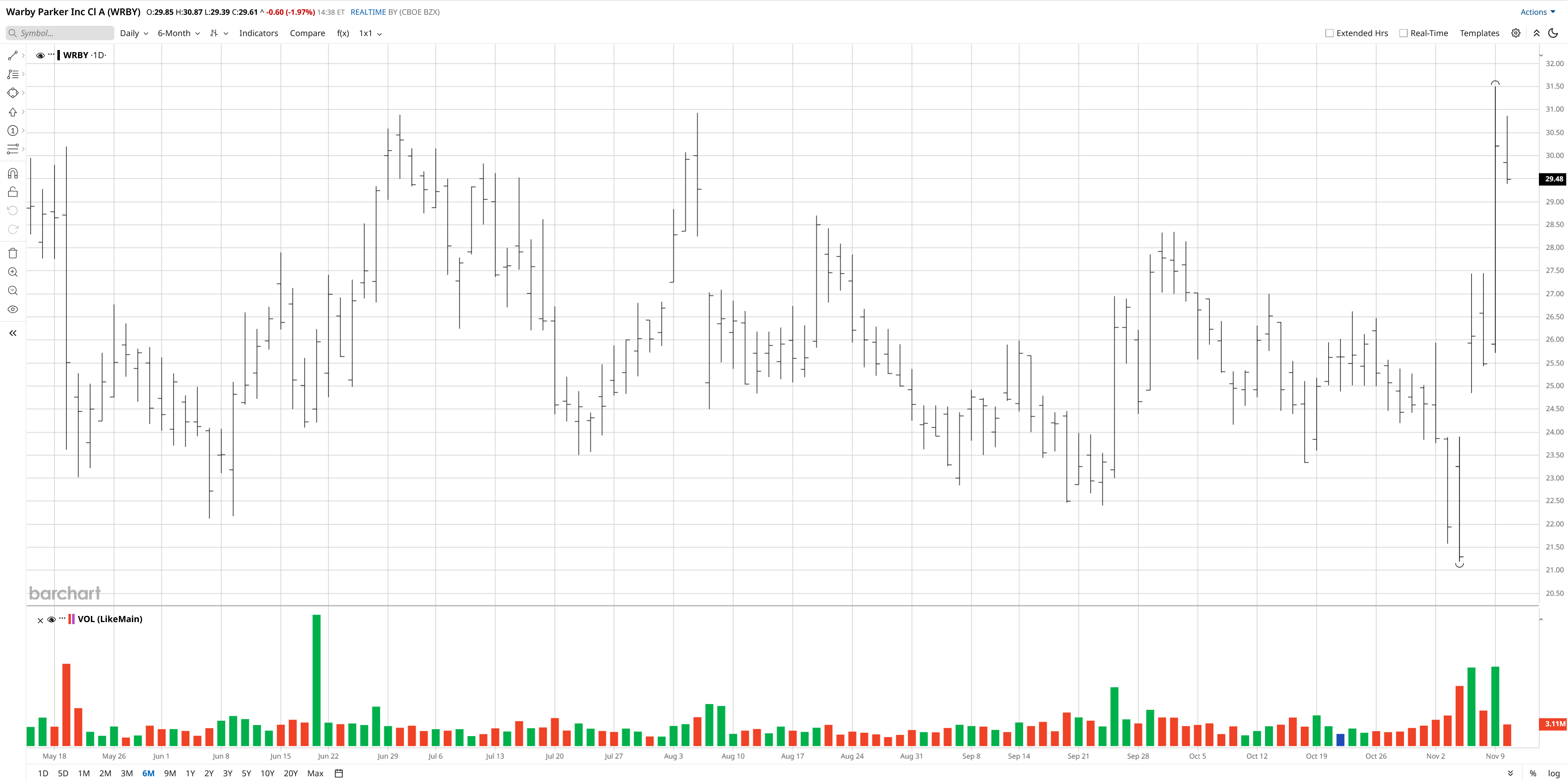
Also importantly, Warby's overall business appears to be quite solid, while the valuation of WRBY stock is fairly attractive in light of its expected growth and the pending launch of its smart glasses.
Nevertheless, while the shares look like a buy for risk-tolerant investors, more cautious individuals may want to wait for signs that Warby's “intelligent eyewear” (as the company calls the products) will be a hit before purchasing WRBY stock.
Reasons Why Warby's Smart Glasses Are Likely to Be Successful
By combining their expertise, Google, Samsung, and Warby Parker probably developed a product that will at least be competitive with Meta's offerings. Google has developed very successful software, including the Android operating system and Gmail, while Samsung's smartphones have generally been very well-received. And of course, Warby Parker knows a thing or two about eyeglasses.
Demonstrating that there is a significant market for smart glasses, European retailer EssilorLuxottica (ESLOY) reported that it sold over 7 million of Meta's AI glasses in 2025.
Finally, just as EssilorLuxottica markets the smart glasses that it developed with Meta in its brick-and-mortar stores (it also distributes them to other retailers), Warby will market its own AI glasses in its stores. Being able to market AI glasses face-to-face to potential customers likely makes it easier to sell them.
Estimating How Much Warby's Intelligent Eyewear Can Boost Its Bottom Line in 2027
Meta Ray bans, one of the brand names that Meta and EssilorLuxottica use for their glasses, reportedly cost between $390 and “almost $500.” Let's say that Warby can sell 300,000 AI glasses for $400 each (it had 2.7 million active customers last quarter) and that 10% of the revenue flows to its bottom line, after all the production and marketing costs and after compensating Google and Samsung. That works out to a $12 million increase in its profits.
In the nine months that ended in September, the firm's net income came in at $13.4 million. That works out to an annualized total of $16.75 million. So an additional $12 million of profits would increase the firm's bottom line by almost 75%. Conversely, analysts on average predict that Warby's earnings per share will increase by a total of only about 50% in 2027.
Healthy Fundamentals and a Reasonably Attractive Valuation
In Q3, Warby's revenue climbed 10.4% versus the same period a year earlier, while its EBITDA, excluding some items, rose 9.5% year-over-year to $28.6 million. These numbers indicate that the company's fundamentals are strong and that it is growing fairly quickly.
Meanwhile, WRBY stock is changing hands at a forward price-earnings ratio of 44. Since analysts expect the company's EPS to advance 50% in 2027 and they may be tremendously underestimating the firm's EPS growth, its valuation is reasonably attractive.
On the date of publication, Larry Ramer did not directly have a position in any of the securities mentioned in this article. All information and data in this article is solely for informational purposes. For more information please view the Barchart Disclosure Policy here.