


EN
How Saudi Expansion At Barclays (LSE:BARC) Has Changed Its Investment Story
- Barclays has opened a new office in Riyadh’s King Abdullah Financial District after receiving a Capital Market Authority licence, and has appointed Majed Al Hassoun as CEO and Head of Investment Banking for Barclays Capital Saudi alongside a broader senior local leadership team.
- This build out of a Saudi franchise gives Barclays on the ground access to a deepening capital market and fee pool that can complement its existing investment banking and global markets operations.
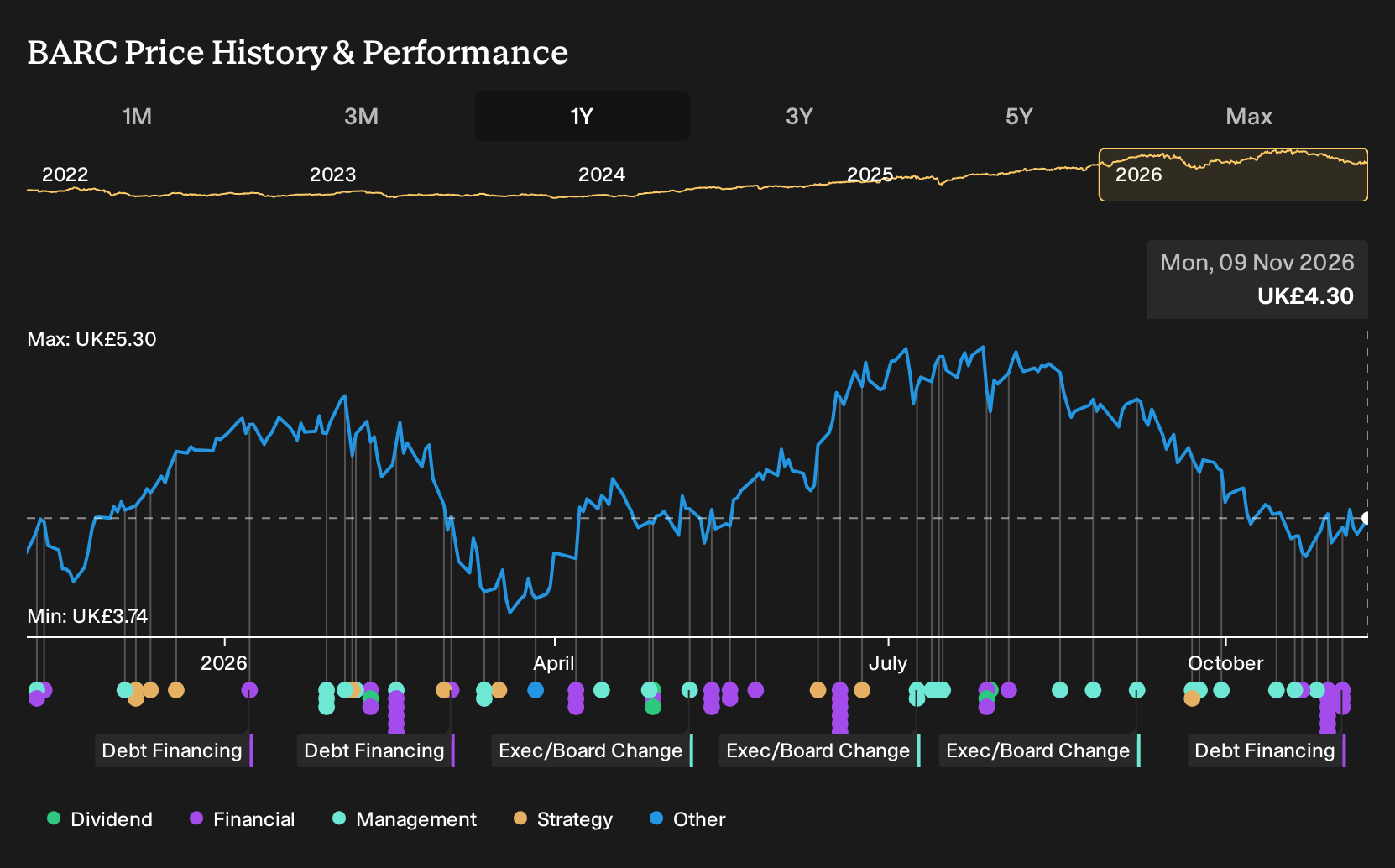
- With Barclays trading around 0.8x P/B, the build out of a licensed Saudi office and leadership bench could influence how investors view its long term earnings mix.
Scan how Barclays’ Saudi push compares with other globally focused banks by lining up institutions that currently screen as 16 high quality undervalued stocks on Simply Wall St.
Barclays Investment Narrative Recap
To own Barclays, you need to believe the diversified mix of UK retail, US cards and global investment banking can keep turning current earnings growth into durable returns, even with a relatively low 10.4% return on equity and a 0.8x P/B multiple. Robbo, a Simply Wall St Community investor who wrote the Narrative, argues the valuation still reflects a deep confidence gap.
Right now, the key short term swing factor is delivery on operational efficiency and credit quality, given the high bad loan level at 2% and low 69% allowance. The Saudi expansion looks additive rather than transformational and does not materially change the core risk around higher risk wholesale funding at 64% of liabilities.
The most relevant move alongside the Saudi build out is Barclays’ decision to redeem the outstanding US$1.75b 2.279% senior callable notes due 2027 and cancel their NYSE listing. This sits alongside new fixed to floating offerings in dollars and sterling, including US$1.75b notes due 2037 and £750m perpetual contingent convertible securities.
For you as a shareholder, these actions highlight an active approach to reshaping the liability stack while investing in new fee pools such as Saudi investment banking. Execution risk cuts both ways. Refinancing with callable, variable rate and subordinated instruments can influence funding costs and regulatory capital, which then feeds back into how investors judge Barclays’ ability to close the gap between book value and market value.
Robbo’s narrative reaches its own fair value of £5.64 for Barclays by applying a discounted cash flow style framework that assumes revenue grows at 8.7% a year and that the business settles at a future profit margin of 23.0%.
Uncover why Barclays' fair value indicates a 31% potential upside to its current price that could narrow quickly.
Exploring Other Perspectives
One big swing factor the bullish analysts focus on is operating leverage. Before this Saudi move, the most optimistic forecasts already had Barclays revenue reaching £36.5b and earnings of £10.8b by around 2029, versus £6.8b today. That is a far brighter story than Robbo’s. Use this Riyadh news as a prompt to compare both views.
Explore 8 other Barclays fair value estimates, including one that suggests as much as 129% upside from the current price!
Form Your Own Verdict
Don't just follow the ticker. Dig into the data and build a conviction that's truly your own.
- A great starting point for your Barclays research is our analysis highlighting 5 key rewards and 3 important warning signs that could impact your investment decision.
- See our latest analysis for Barclays. The report includes a comprehensive fundamental analysis summarized in a single visual, the Snowflake, making it easy to evaluate Barclays' overall financial health at a glance.
Looking For More Investment Ideas Beyond Barclays?
Once you have formed a view on Barclays, it can help to widen the lens and compare it with other opportunities that share some of the traits you care most about, whether that is value, balance sheet strength, or a focus on resilient businesses.
- If you are hunting for companies that pair quality fundamentals with what currently screens as attractive pricing, use the 16 high quality undervalued stocks to see which stocks fit that brief.
- If balance sheet strength is non negotiable for you, filter for businesses that currently pass strict financial health checks with the list of solid balance sheet and fundamentals (9 results) and see how they stack up against Barclays.
- If you prefer ideas that the market has not fully crowded into yet, run a search using the 5 high quality undiscovered gems and compare those under the radar candidates with your view on Barclays.
Have feedback on this article? Concerned about the content? Get in touch with us directly. Alternatively, email editorial-team@simplywallst.com