


EN
Why UBER Stock Option Sellers May Be Setting Up Their Own Trap
Let’s get right down to business. Despite a rather disappointing year in the charts for Uber Technologies (UBER), the equity itself might still be underpriced. No, I don’t necessarily mean in the wholesale sense, where you’re looking to collect a bag off one big move. Indeed, UBER stock may have already started its recovery, having gained 4.54% in the trailing five sessions.
Still, there could be additional upside to be extracted. In order to maximize the possible northbound move, I’d look into a vertical spread strategy called the bull call spread. In exchange for a capped total gain, the speculator benefits from a lower net debit (cash outlay). Since we’re targeting a relatively small uptick, a spread arguably makes more sense than a naked call option.
This is also where circumstances get very interesting because one spread in particular — the 72.50/75 bull call spread expiring Dec. 18 — is currently being offered at a rate potentially favorable to the bettor. In exchange for a relatively low net debit of $106, the maximum payout stands at 135.85%.
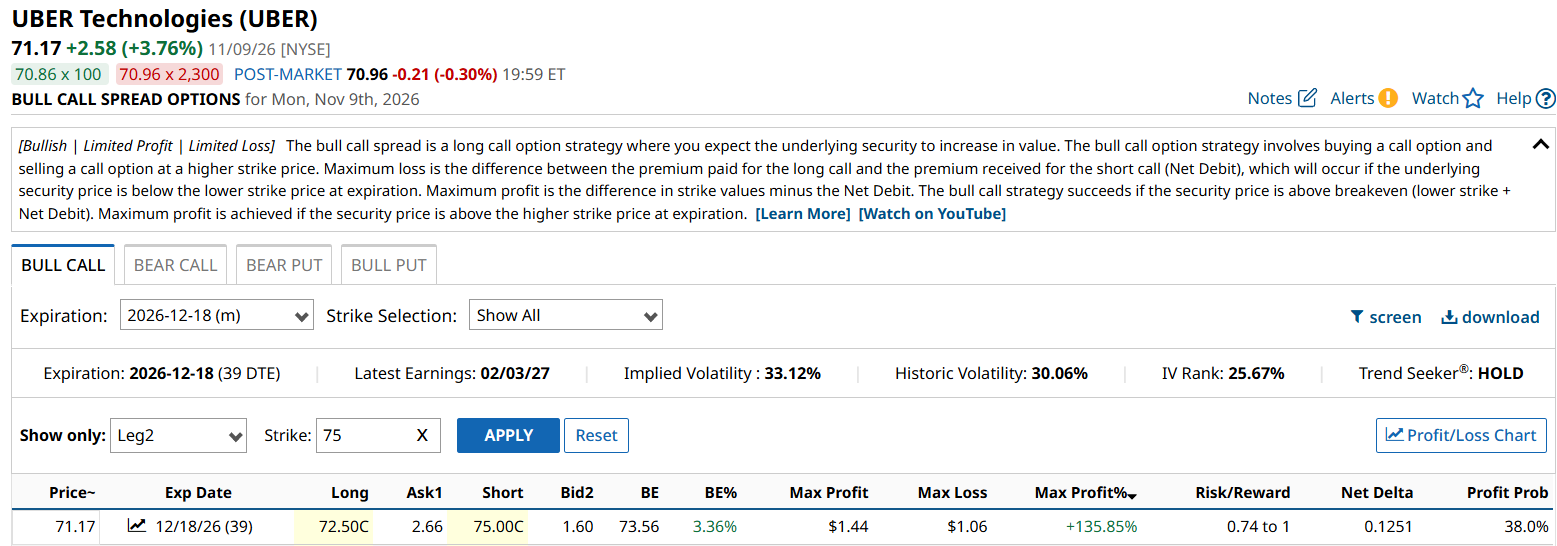
It’s a tempting proposition, which somewhat implies that the credit seller is egging on the debit buyer. On that note, it looks like your standard trap designed to ensnare naïve speculators. However, a hidden opportunity lies in the math.
Laying Out the Conceptual Framework for UBER Stock
In order for the aforementioned bull spread to be economically rational, there has to be some realistic chance of UBER stock triggering the $75 strike price at expiration. Otherwise, because it’s a debit-based trade, you’re not going to be rewarded if the security doesn’t cross the profitability threshold.
Of course, this dilemma backs us into a corner. As with anything related to the future, we don’t have any certainty about where UBER stock will actually end up on expiration — that’s why it’s a speculative trade. However, we do know the basics: the current spot price, the threshold that we need to hit, the time remaining to expiration and the current implied volatility (IV).
In order to make a more educated guess regarding whether the UBER stock spread is worth our money, though, we must assume a framework or model to calculate a baseline probability of success. For this exercise, we assume that UBER will undergo a random walk between now and the expiration date. Further, the IV is then integrated into the model, which would metaphorically represent the speed of our walking steps.
This analysis is the broad view of the Expected Move calculator. For the projected event of UBER stock hitting $75 on the Dec. 18 expiration date, the estimated probability is 29.55%.
Now, let me address the elephant in the room. With only a 29.55% probability, an expected value (EV) calculation for the $75 bull spread would come out to $32.12 below zero or an expected return on capital (ROC) of -32.12%. Over the long run, this trade would be problematic for the debit side (but obviously very profitable for the credit side).
So, what’s the deal about this spread being underpriced?
A Difference Between Journalistic and Editorial Probability
To put it simply, the 29.55% probability is the journalistic standard. Because the concept of the random walk is mathematically clinical or sanitary, it enjoys de facto consensus as the gold standard for forecasting equity price movements. You can think of it as the control group.
However, I’m writing this article from the perspective of the debit-side trader. It is YOUR money that you are putting at risk. By that logic, it is also YOUR choice what model to use to estimate the probability of UBER stock being profitable (or not). In that sense, I believe that a nonrandom walk may provide further insights.
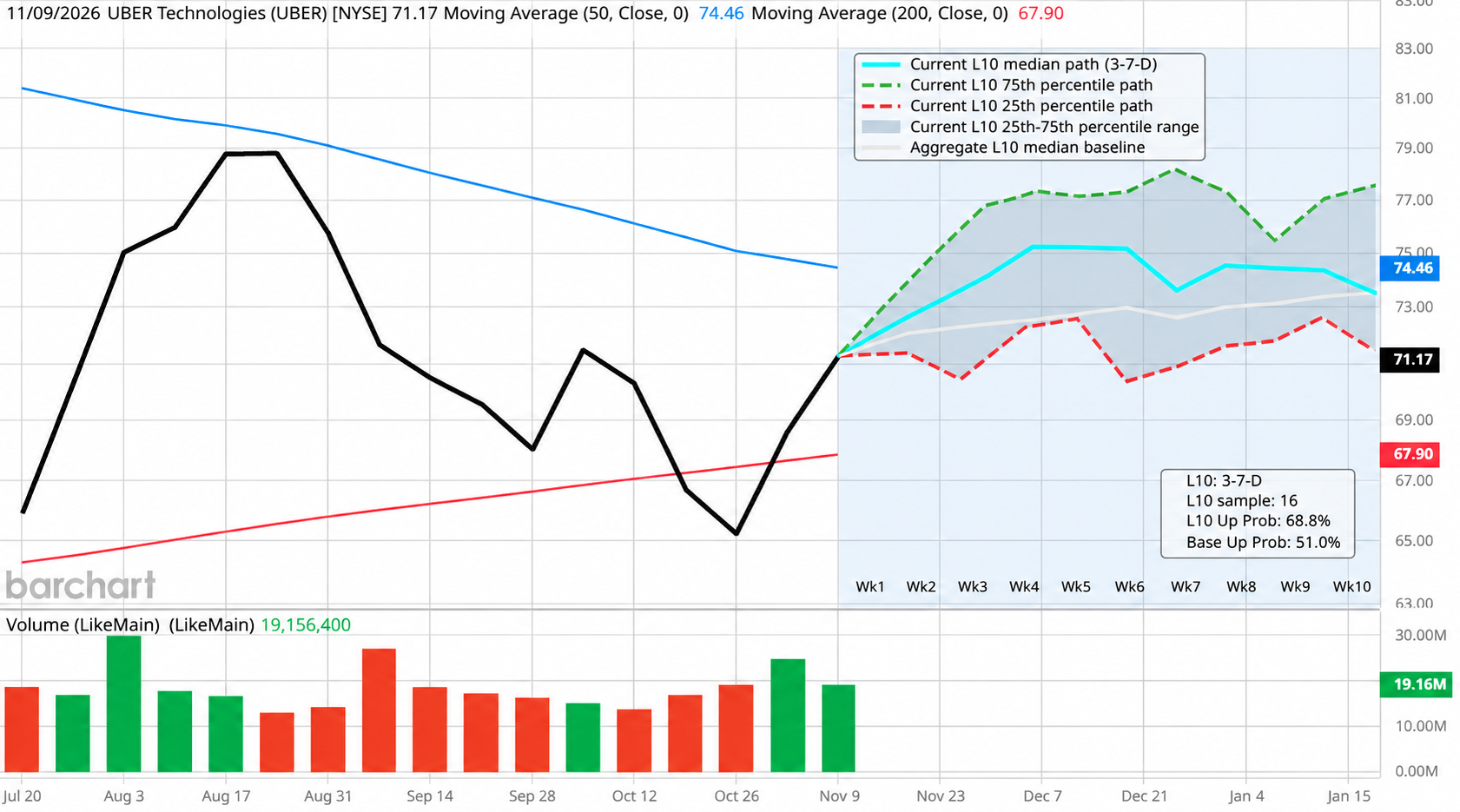
Specifically, we may observe through historical data that when the balance of weekly candlesticks is heavily biased toward negative sessions over a rolling 10-week period, the general tendency over the subsequent 10-week period shifts positively.
It’s not a guaranteed inference, of course, but this pattern implies a probabilistic range of between 37.5% and 50% that UBER stock may trigger the $75 strike between Dec. 11 and Dec. 18. At the most optimistic end, the $75 bull spread would feature an EV of $75 or an expected ROC of +17.92%.
Therefore, if we use the “editorial probability” of 50%, the aforementioned trade is underpriced.
It’s a Duel Out There
Since this is the internet, I want to make crystal clear that this article is not about “my model is better than your model.” It may be an interesting debate topic but it’s completely irrelevant to this discussion.
In the options market, we have two opposing sides: you’re either buying the deal or selling the deal. My job is to provide my opinion on whether it’s a good deal for the buyer. In this case, I think it is.
To summarize, the UBER stock spread is being offered at a price reflecting a very low journalistic probability. Theoretically, that’s great for the seller and disadvantageous for the buyer. However, the editorial probability suggests that the chance of success may be much higher than advertised. If so, that puts the buyer in a favorable position.
On the date of publication, Josh Enomoto did not directly have a position in any of the securities mentioned in this article. All information and data in this article is solely for informational purposes. For more information please view the Barchart Disclosure Policy here.