


EN
How Investors Are Reacting To Autoliv (ALV) Dividend Hike
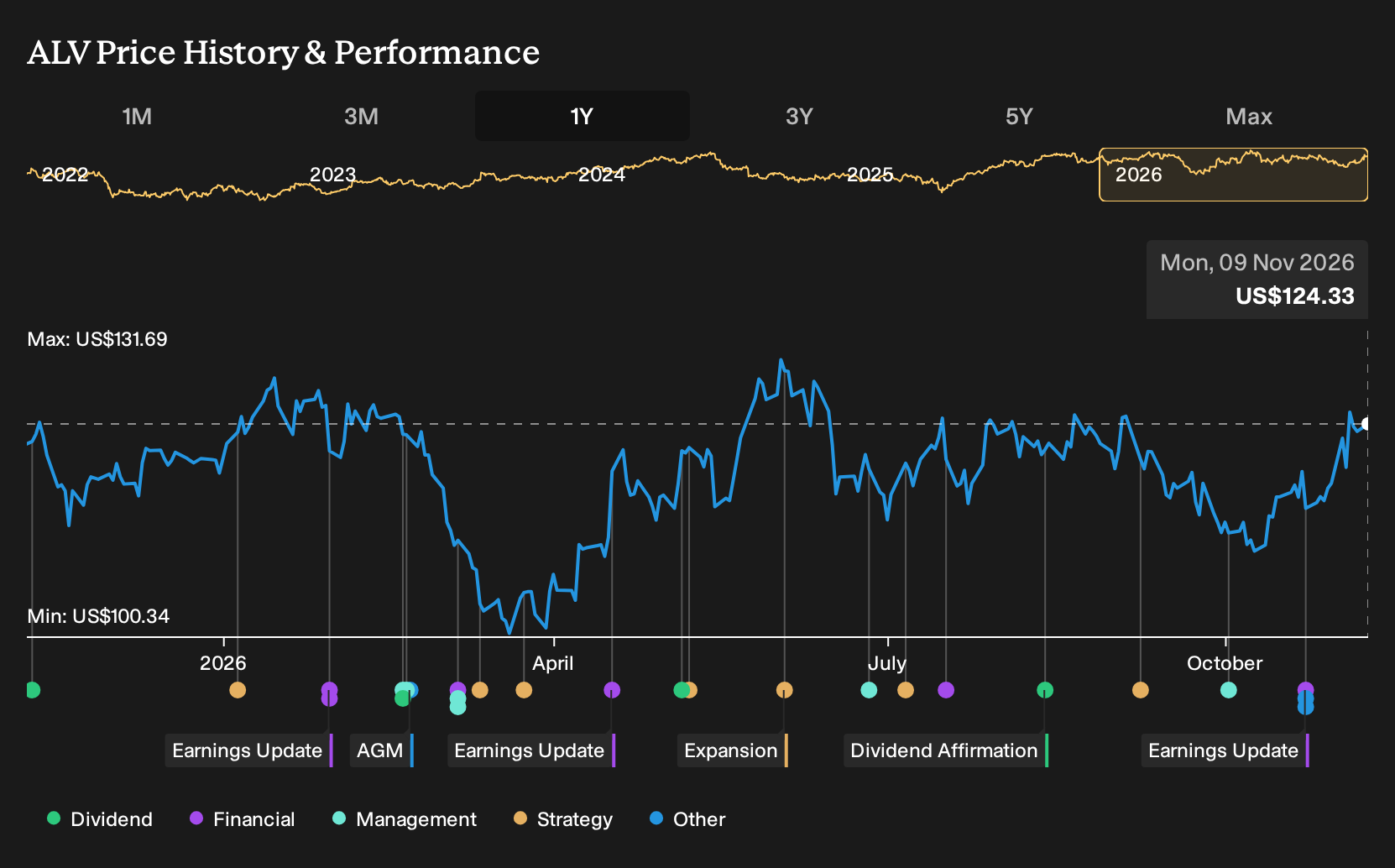
- Autoliv has already raised its fourth quarter 2026 quarterly dividend by 15% to US$1.00 per share. Payments are scheduled in December to holders of NYSE listed common stock and Swedish Depository Receipts on Nasdaq Stockholm.
- The richer payout indicates that Autoliv's board sees room to return more cash to investors while still funding safety content growth, cost efficiency programs, and new mobility safety projects outlined in the existing investment case.
- We will now look at how Autoliv's higher quarterly dividend could reshape the existing investment narrative around cash generation and returns.
Scan how Autoliv's richer dividend fits alongside other income-focused opportunities by reviewing our curated list of 6 dividend fortresses.
Autoliv Investment Narrative Recap
Owning Autoliv means believing that stricter global safety rules, higher content per vehicle in China and India, and new mobility safety products can offset raw material headwinds and swings in auto production. The analyst consensus narrative on Simply Wall St focuses on Autoliv sustaining efficiency gains and high quality earnings while absorbing about US$110 million of expected 2026 input cost pressure.
The richer dividend and board appointment do not change the near term swing factors. The main potential upside driver remains execution on cost programs and safety content wins in Asia. The key near term risk remains that raw material costs or weaker cash generation limit funds for dividends, buybacks, and growth projects.
The appointment of Joachim Rosenberg as an independent director is the announcement that connects most directly with this context. Autoliv already had an experienced board with an average tenure of 8.4 years, and 90% of directors classified as independent. Adding another industry veteran expands that pool of operational and regional expertise around the table.
This matters for investors whose main thesis rests on tight execution in China and India, timely product launches, and disciplined handling of leverage and raw material costs. Board refreshment after a period with no new directors for three years can support oversight of those catalysts and risks, especially as Autoliv balances higher dividends against a high level of debt.
Autoliv's current analyst narrative points to revenues of US$11.9b and earnings of US$1.0b by 2029, based on 2.4% yearly revenue growth and an earnings increase of about US$357m from US$643.0m today.
Uncover why Autoliv's fair value indicates an 8% potential upside to its current price that could narrow quickly.
Exploring Other Perspectives
Four fair value estimates from the Simply Wall St Community span roughly US$103 to about US$228, so retail opinions on Autoliv's worth already cover a wide band. When you also consider the higher dividend, raw material cost risk, and execution reliance in China and India, it becomes clear why viewpoints differ. Explore those alternatives before deciding where you stand.
Explore 3 other Autoliv fair value estimates, including one that suggests as much as 84% potential price increase from the current level.
Decide For Yourself
Disagree with existing narratives? Extraordinary investment returns rarely come from following the herd, so go with your instincts.
- A great starting point for your Autoliv research is our analysis highlighting 2 key rewards and 2 important warning signs that could impact your investment decision.
- See our latest analysis for Autoliv. The report includes a comprehensive fundamental analysis summarized in a single visual, the Snowflake, making it easy to evaluate Autoliv's overall financial health at a glance.
Looking For More Ideas Beyond Autoliv?
If Autoliv has sharpened your focus on income, quality, and risk, it can help to line it up against other options that target similar goals in different ways. Use the Simply Wall St Screener to scan for other listed businesses that match your preferences and compare how their fundamentals stack up.
- If capital preservation is high on your list, start with a set of companies that score well on stability and financial resilience by reviewing our 30 resilient stocks with low risk scores.
- For those hunting for quality at a sensible price, broaden your watchlist with our hand picked group of 33 high quality undervalued stocks.
- If you want a mix of strength and staying power, check the list of solid balance sheet and fundamentals (25 results) to see which companies combine robust finances with sound fundamentals.
Have feedback on this article? Concerned about the content? Get in touch with us directly. Alternatively, email editorial-team@simplywallst.com