


EN
Bloom Energy’s AI Growth Story Isn’t Over. The 15% Dip Could Be Your Chance to Buy.
Wall Street has spent much of 2026 rewarding companies that can help solve artificial intelligence's growing power problem, and one of those has been Bloom Energy (BE), which is up 100% on the year and an amazing 442% over the last five years.
But investors suddenly seem worried that Bloom may be too dependent on AI, and shares of the energy company fell roughly 15% Thursday as part of a larger market sell-off, triggered by Democrats taking control of Congress in the midterm elections. The concern is that tougher oversight of data center construction could slow the massive infrastructure expansion supporting AI development.
That's a legitimate risk for Bloom, which makes fuel cell systems that generate electricity directly at customer sites. But there's an interesting contradiction in Thursday's sell-off. On the very same day, Bloom announced the largest international project in its history — an agreement to provide power for data centers around the world.
So, is the sell-off an opportunity for investors, or a warning that Bloom's remarkable growth could be running into trouble?
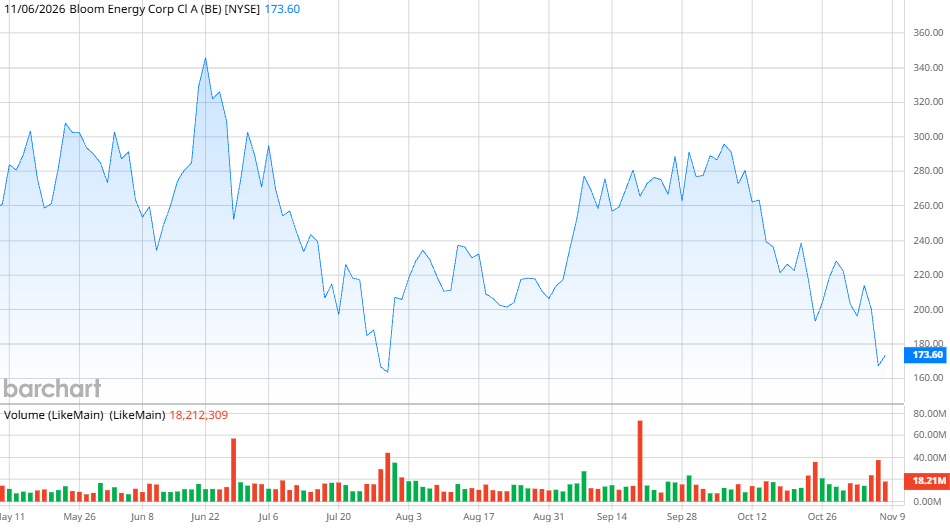
Why Bloom Energy Stock is Falling
The political concern is relatively straightforward. Data centers require a lot of electricity, and more communities are questioning how they will affect power prices, water supplies, and local infrastructure. And those questions are becoming significant obstacles — there were 41 local ballot measures across the country on Tuesday, and in 40 of them, voters favored limiting data center development.
Democratic control of Congress could bring additional scrutiny to an industry that has enjoyed substantial investment and rapid expansion.
Reuters reported Thursday that UBS analysts estimate approximately 30% of expected U.S. data center capacity additions in 2028 could be at risk from potential construction pauses. That would create problems for companies supplying equipment to those facilities, including Bloom.
But Bloom's technology addresses one of the very problems contributing to opposition against data center construction. Bloom generates electricity on-site using solid oxide fuel cells and an electrochemical process rather than combustion. Customers, in turn, can reduce their dependence on the utility grid. The systems also use relatively little water and produce low local air emissions.
For data center developers facing power shortages and community opposition, those characteristics could become increasingly valuable.
A 900-Megawatt Deal Makes the Bullish Case
On Thursday, Bloom announced an agreement with NTT DATA to deploy 900 megawatts of on-site power generation across multiple data center projects worldwide. The agreement is Bloom's largest international project to date, with initial shipments expected in 2027. The companies also indicated that their relationship could eventually expand to gigawatt scale.
That's a substantial commitment.
NTT Global Data Centers plans to use Bloom's fuel cells as a primary power source, allowing facilities to begin operating without depending entirely on traditional electrical grids. The agreement also demonstrates that Bloom's opportunity extends well beyond the United States. Even if American policymakers slow domestic data center development, international demand for AI infrastructure could provide another avenue for growth.
Of course, the announcement doesn't establish how much revenue Bloom will recognize from the agreement or how quickly the full 900 megawatts will be deployed. Still, it's difficult to reconcile fears of collapsing demand with a major customer announcing plans for hundreds of megawatts of additional generating capacity.
Bloom's Financial Results are Catching Up With the Excitement
Bloom's recent earnings provide another reason to take the company's growth seriously.
Revenue in the third quarter was $1.24 billion — a quarterly record and up 138% from a year ago. Product revenue climbed 179.4% to $1.07 billion.
Importantly, Bloom is turning that growth into profits. GAAP operating income was $225.4 million, versus $7.8 million a year ago. Its gross margin expanded from 29.2% to 33.8%. Management also raised its full-year revenue guidance to between $4.4 billion and $4.6 billion, representing approximately 122% annual growth at the midpoint.
Those aren't the financial results of a company experiencing a sudden collapse in demand. But rapid growth creates its own challenges. Bloom must expand manufacturing capacity, manage working capital, and deliver increasingly large projects without sacrificing profitability.
How Should Investors Play Bloom's Decline?
Analysts are generally positive about Bloom stock, with 27 analysts having a consensus “Moderate Buy” rating. Only one suggests selling the stock, while 14 have “Buy” recommendations. The mean price target of $283 represents potential upside of 62%.
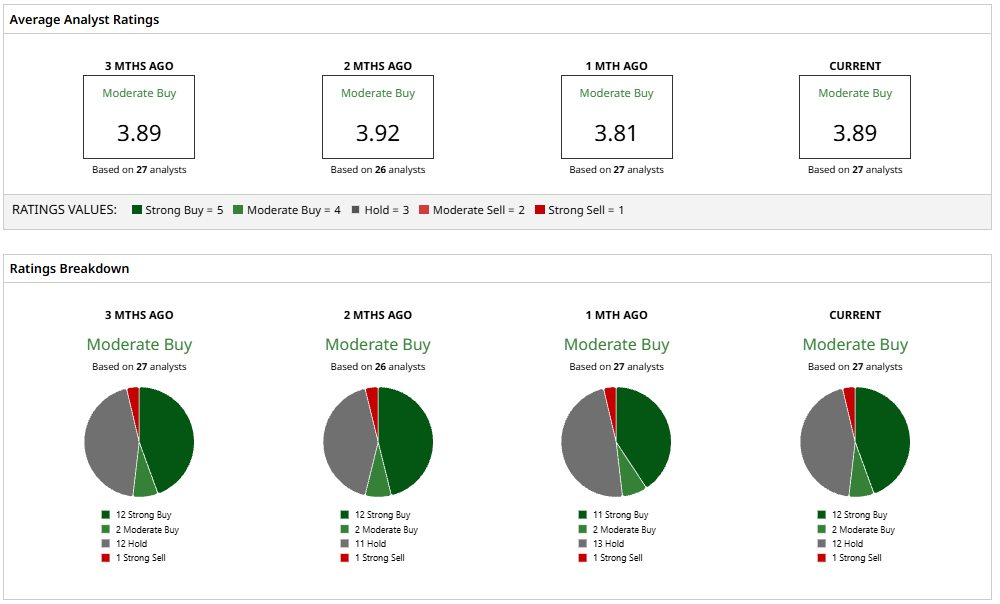
Thursday's sell-off appears to reflect concerns about future government policy rather than evidence that Bloom's customers are abandoning their projects.
But the NTT DATA agreement and Bloom's latest earnings suggest that demand for onsite power remains strong. And political scrutiny of data centers could actually increase interest in technologies that reduce pressure on electrical grids.
For long-term investors who believe AI infrastructure spending will continue expanding, Bloom remains an interesting way to participate in growing electricity demand.
On the date of publication, Patrick Sanders did not directly have a position in any of the securities mentioned in this article. All information and data in this article is solely for informational purposes. For more information please view the Barchart Disclosure Policy here.