


EN
Will tonight's earnings report fall no matter how strong it is? Headwinds continue to pressure market sentiment, making it difficult for “AI New Cloud Leader” CoreWeave (CRWV.US) to bail out
The Zhitong Finance App learned that after a rough week for AI stocks, CoreWeave (CRWV.US) faced a difficult threshold to overcome: when US stocks released their third-quarter earnings report after the market on Tuesday, it had to convince Wall Street that AI transactions were still in place. But the real test was not the performance itself, but how management said “next” — because the midterm election results showed that quite a few voters opposed building data centers close to their own communities.
“The outlook for AI spending is 100% more important than the results, because people are worried about whether the midterm elections will mean a slowdown in AI construction.” Michael Monaghan, founder ETFs portfolio manager who holds the shares, said.
CoreWeave isn't alone in this test. Nebius Group (NBIS.US), also a manufacturer that has set up a business around leasing AI computing power, will follow up with the earnings report before Thursday. The market expects a loss of 0.69 US dollars per share and revenue of about 906 million US dollars — only 146 million US dollars in the same period last year; based on a market value of about 32 billion US dollars, the earnings fluctuation of 20.45%, corresponding to a market value fluctuation of about 6.56 billion US dollars. Two new clouds handed in documents one after another, which is tantamount to spreading the bets in this sector all at once on the table.
Emotions already precede performance
CoreWeave shares fell 15% last week, down 65% from a six-month high. Other new clouds, such as Nebius and IREN, have also fallen sharply since election day. According to options data, the market expects CoreWeave's stock price to fluctuate about 18% after the earnings report — far higher than the average fluctuation after the S&P 500 earnings report (its average fluctuation after the past four financial reports was 16.38%; in terms of about US$26 billion, this margin corresponds to a market capitalization fluctuation of more than US$5 billion).
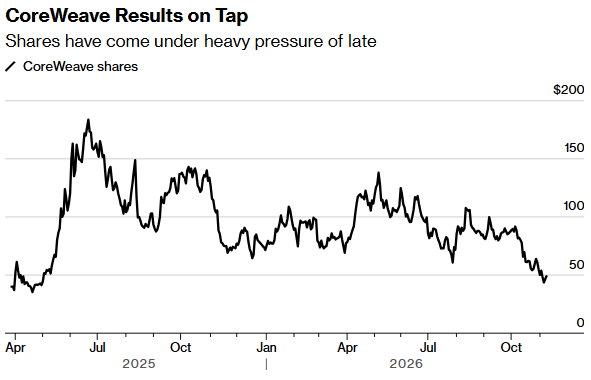
Money is also voting with feet. According to TipRanks, ARK Invest, owned by Cathie Wood, sold 412,700 shares of CoreWeave last Thursday, worth around $18 million.
Voters are dissatisfied, Microsoft is quitting
The immediate headwind facing Xinyun is politics. They are about to face state and local governments controlled by the Democratic Party, which are far less willing to release AI infrastructure projects than before. In Texas, for example, governor-elect Gina Hinojosa has called for an immediate suspension of the data center project; CoreWeave has written to Hinojosa seeking cooperation on development.
“Americans have voted to say they don't want data centers.” Adam Sarhan, CEO of 50 Park Investments, said, “This will mean new clouds will have to find their way in a more difficult environment because they have no revenue streams that can fill the AI revenue gap.”
Another signal comes from Microsoft. It was this company that spawned the new cloud boom with tens of billions of dollars in contracts, but according to media reports, it is tightening supervision of some projects and withdrawing some that it believes are too risky. The reason why the marginal change in Microsoft's attitude is fatal is the nature of the new cloud business: unlike hyperscale vendors that allocate computing power on top of the virtual machine layer, CoreWeave runs the customer's AI load directly on bare metal servers, with no virtualization layer in the middle. This allows its GPU utilization rate to reach 95% to 98% of the theoretical peak, and provides a lower unit price for large long-term customers — the cost is much heavier upfront capital investment. The more focused and powerful the customer, the thinner the model.
Nvidia is a backer, and it is difficult to protect itself
There's also CoreWeave's relationship with NVDA.US (NVDA.US) — the latter is both a key supplier and its investor, and its CEO, Wong In-hoon, is now unable to insure himself. Last month, when CoreWeave's stock price plummeted due to debt concerns, Hwang In-hoon also publicly defended it. Now, Nvidia's board of directors is launching an independent investigation into matters involving Wong In-hoon's personal actions, and his leadership position is at risk. Nvidia closed down 4.27% to $178.67 on Monday — for a new cloud that is deeply tied to Nvidia's supply chain and credit, backbone fluctuation itself is the second most important risk other than liquidity.
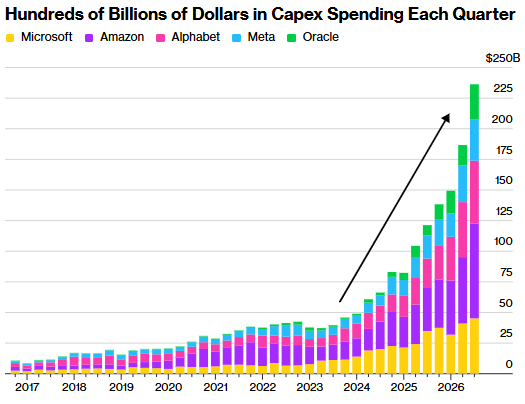
In fact, AI stocks were already struggling before the election, and investors questioned the capital expenditure prospects for developing the technology — especially when the spending has yet to be exchanged for a clear return. There have been a number of high-profile sell-offs this earnings season: Alphabet, Meta, Amazon, and Intel have all been sold due to earnings reports, and Microsoft and SanDisk have experienced sales even when they handed over strong results.
One business, two destinies
This explains a seemingly contradictory phenomenon: after the election, the stock prices of hyperscalers (hyperscalers) such as Microsoft, Amazon, and Alphabet rose, but Xinyun was being sold off. Both do similar businesses — both rent out computing power, and are in short supply due to AI demand — but the two groups of companies mean the opposite in terms of the prospect of “AI spending less.”
For hyperscale manufacturers, a fall in capital expenditure may mean a restoration of free cash flow, and investors are increasingly clearly demanding that this be seen. For the new cloud, what threatens the slowdown in AI spending and construction is its core business model.
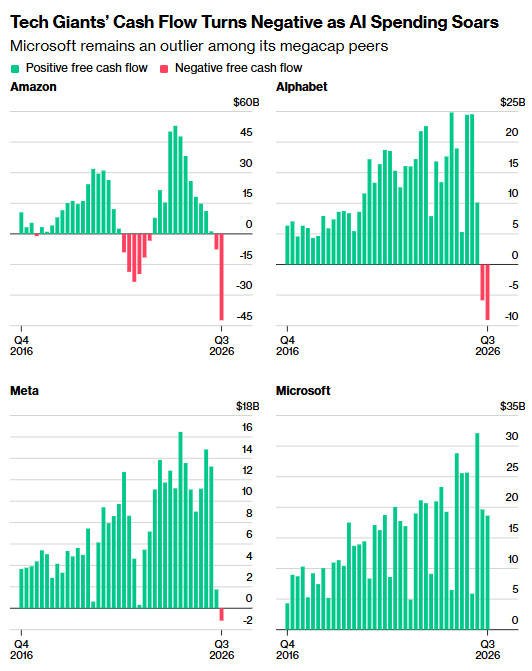
CoreWeave is already considered a riskier target in AI transactions: it relies on loans to finance data center construction, so it needs continued strong growth to pay its debts. After the election, the price of corporate bonds fell, and the yield on some bonds exceeded 15%, which is generally regarded by the market as a “difficult” level; according to Barchart, the yield on its bonds once exceeded 16% last weekend.
“If AI revenue were to dry up, then fair value would almost certainly fall below current prices.” Sarhan said, “If it doesn't come from AI, where else can growth come from? If you can't grow, how can you pay back your debts?”
A set of numbers can quantify this vulnerability: According to company guidelines, CoreWeave's interest expenses for the quarter were between $860 million and $940 million, while adjusted operating profit was only $200 million to $260 million — more than three times what the operation earned. Hedging this weakness is the demand side: the company has a revenue backlog of over $104 billion, annual capital expenditure guidance of $35 billion to $39 billion, and an active electricity capacity target of over 1.85 GW at the end of the year (1.5 GW at the end of the second quarter). However, to fulfill the revenue consensus for the third quarter, the company needed to jump from $2.58 billion in the second quarter to about $3.54 billion. This requires active production capacity to rise significantly during this quarter — whether the construction progress revealed in the financial report can keep up is no less important than revenue itself. As for how much and at what pace the $104 billion backlog order can be fulfilled, it is still a subject that the market will scrutinize one by one.
Digital outlook: high growth and longer losses
As far as the financial report itself is concerned, market consensus predicts that CoreWeave's third-quarter revenue will increase by more than 160% year over year to about US$3.54 billion, but the net loss will be significantly larger than a year ago; the company does not expect to achieve annual profit until 2029, and the revenue growth rate will slow year by year until then. The growth rate is declining year by year, but the interest burden is still rising — Radke's move to raise interest cost forecasts by 22% shows the direction of this combination curve — this makes the “2029 profit” threshold seem farther and farther away in an environment where capital costs are rising.
Sellers' differences are so large that they are rare. Citibank analyst Tyler Radke reiterated the “buy” but lowered the target price from $159 to $128; UBS Karl Keirstead repeated the “buy” and lowered the target price from $120 to $105; Bank of America maintained a “buy” and target price of $140, and estimated that the company would still need about $20 billion in additional financing to reach the construction target; Cantor Fitzgerald gave a “gain” of $176; while HSBC's rating was “reduced holdings” and the target price At $39, Morgan Stanley is “neutral,” $70. The rating distribution itself explains the differences: TipRanks statistics show 21 “buys,” 5 “holds,” and 3 “sells,” with an average target price of $128.83. This figure is less optimistic than evidence that the market is unable to converge even within a “fair range.”
The lack of profit makes CoreWeave seem expensive under most valuation metrics, even though its current expected sell-through rate is only about 1 times — which is close to its all-time low, about a quarter of the average since its March 2025 IPO.
Repairs take time
Optimists bet on demand and ability to pass it on. Radke believes the earnings report will reflect a “background of continued strong demand,” with strong pricing and profit margins, while rising memory, GPU, and capital costs will be passed on to customers like rising costs — he raised his 2027-2030 revenue forecast by 12%, while raising his interest expense forecast by 22%. Keirstead's judgment is calmer: investors are shifting to a more defensive attitude to allocate AI infrastructure exposure. He agreed with this shift and reminded confidence that repair “will take more than a quarter.” Another reminder from the market comes from Jim Cramer: This financial report will determine how the “disrupted AI data center deal” goes next, and management must answer “how to finance growth and how to manage borrowing costs.”
Sarhan's summary is probably the closest to the real mentality of the market: “In the short term, the newcomers are oversold. But with so much uncertainty, it's hard to imagine that they can still trade the way they used to.”