


EN
One hand multiplies computing power, the other hand steals spectrum! Barclays is optimistic about SpaceX (SPCX.US)'s acquisition of T-Mobile: Terrestrial networks complement Starlink's advantages
The Zhitong Finance App learned that after the “AI+ Space Exploration” supergiant SpaceX (SPCX.US), founded by Musk, experienced a sharp rebound of 14.92% in two days, Wall Street financial giant Barclays Bank listed T-Mobile (TMUS.US), one of the three traditional US operators, as the preferred telecom acquisition target for SpaceX to enter the US mobile communications market.
In terms of the latest stock price trend, by the close of the US stock market in the US East on November 9, SpaceX's stock price had risen sharply by 5.81% to 142.07 US dollars, recovering from last Thursday's decline. T-Mobile rose 4.14% to $168.71 on Monday, and can be described as bucking the trend when tech stocks plummeted last Thursday. In the same period, although the Nasdaq 100 and the Philadelphia Semiconductor Index rebounded sharply on Monday, they were still below the closing level before the sell-off.
Barclays Bank's main judgment is that if SpaceX wants to speed up the establishment of an all-American consumer-side mobile communication service, it can acquire spectrum, terrestrial networks, and customer service systems at once, while T-Mobile's terrestrial network and Starlink's remote area coverage are the most complementary. The construction action that has been clarified so far is that SpaceX has selected the Qualcomm plan and plans to deploy the US terrestrial 5G network starting in 2027.
Barclays listed T-Mobile (TMUS.US) as SpaceX's preferred acquisition target, mainly focusing on comprehensive coverage and complementarity and rapid entry into the consumer market. T-Mobile's share of the rural US market is relatively low. Starlink under SpaceX can supplement coverage in remote areas, while T-Mobile's mature terrestrial 5G network can provide SpaceX with the required network capacity in cities and indoors. The two sides have already cooperated with T-Satellite, but T-mobile management is negative about SpaceX using its terrestrial network to sell its own mobile services. If T-Mobile can be acquired, SpaceX will be able to simultaneously obtain spectrum, base stations, customer base, and retail and customer service systems, greatly shortening the time it takes to move from satellite blindness repair services to the national consumer mobile communications market.
As SpaceX's stock price has been rising for two consecutive days, Barclays raised a takeover conjecture: T-Mobile is the best fit
Barclays believes that Verizon is a variable. AT&T has long regarded Starlink, which focuses on satellite internet communication systems, as a rival, so AT&T has the lowest degree of strategic alignment.
SpaceX shares rose 6% on Monday, rising for the second consecutive trading day. Barclays said that if Elon Musk were to seek a major wireless communications acquisition, T-Mobile US (TMUS) would probably be the best strategic target. SpaceX is preparing to launch the deployment of its own nationwide terrestrial 5G network in 2027. Barclays believes the acquisition of an established operator can speed up this process.
SpaceX shares jumped to $142.07 on Monday, closing higher for the second consecutive trading day. Barclays said US operators are facing trade-offs. Selling idle network capacity to SpaceX could increase revenue while also potentially helping a future competitor.
Barclays said, “This is the prisoner plight we pointed out in our previous report. For every existing operator, wholesale of idle network capacity can be profitable. It is in their common interest to prevent SpaceX from connecting to terrestrial networks.”
For SpaceX, buying an operator may enter the consumer wireless communications market faster than negotiating to secure network access and build a business from scratch.
Barclays Bank said in a report, “Acquiring a major operator can solve spectrum, technical issues, roaming, retail and distribution, mobile phone vendor relationships, customer service, equipment financing, and most importantly, time issues all at once. If SpaceX's goal is indeed to establish a large-scale consumer mobile communications business, the acquisition will become more and more attractive.”
According to Barclays, T-Mobile is “the most strategically compatible combination of the three major operators” because its share of the rural market is relatively low, which naturally complements Starlink's advantages in these regions.
Meanwhile, Verizon Communications (VZ) may be attractive due to other factors. Barclays said, “In some ways, Verizon is a variable in this industry. Its customer base is quite mature, its balance sheet is constrained, and it also needs to change its growth trajectory through external means such as mergers and acquisitions.”
AT&T has valuable assets but the least strategic match. Despite the potential benefits of the acquisition, Barclays described the path to a deal as “quite tortuous.”
T-Mobile has partnered with SpaceX through T-satellite to allow compatible phones to connect to Starlink outside of traditional network coverage. However, T-Mobile CEO Srini Gopalan made it clear that the company would not allow SpaceX to sell its own services using T-Mobile's terrestrial network.
He said on the company's recent performance call, “So in this case, we really don't see room for satellite services or SpaceX to adopt a mobile virtual network operator model.” Gopalan believes that satellites are a complement to T-Mobile's network. He also denied the possibility of adopting similar arrangements in the field of physical AI and edge AI.
Any potential acquisition would require consideration of Deutsche Telekom's controlling position. Deutsche Telekom disclosed that as of September 30, after accounting for treasury stock, its shareholding ratio was 54.8%.
SpaceX has 80 MHz spectrum, while T-Mobile has nearly 400 MHz. Additionally, with over 11,000 satellites, Starlink serves over 13 million customers in over 170 countries.
SpaceX can be described as fully targeting the launch of terrestrial network deployment in 2027. Meanwhile, SpaceX is promoting its own nationwide terrestrial 5G network and has selected the Qualcomm (QCOM) Dragonwing platform for Starlink Mobile. The deployment is scheduled to begin in 2027, and tens of thousands of sites are expected to be built under a multi-year agreement.
Musk is also open to buying an established operator. Speaking with Ron Barron at the Barron Investment Conference on Friday, he said the potential acquisition could help SpaceX make more full use of the relevant spectrum.
Musk said, “I think SpaceX can go a long way with the spectrum it has already obtained. But if we can use spectrum more effectively than traditional telecom operators, we can totally buy this operator and increase spectrum utilization efficiency to 10 times the original.”
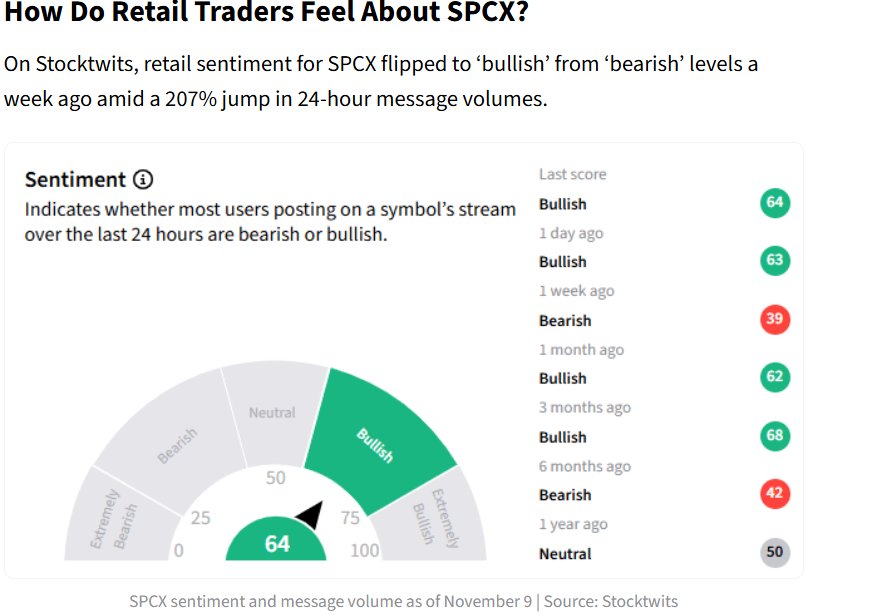
What do retail investors think of SpaceX? On the Stocktwits platform, where retail investors gather, retail sentiment about SpaceX changed from “bearish” to “bullish” a week ago, and the number of posts surged 207% in 24 hours. One user even wrote, “$SPCX, here it is! Sold at a high level! From $120 all the way up, it was so exciting. I couldn't help but stand on the roof and shout. I just wish I could buy more.” Another user wrote, “$SPCX, it's great to consolidate a little bit here, preparing for the next jump!”
From satellite blindness replacement to terrestrial 5G, how much time value can you buy if you swallow T-Mobile?
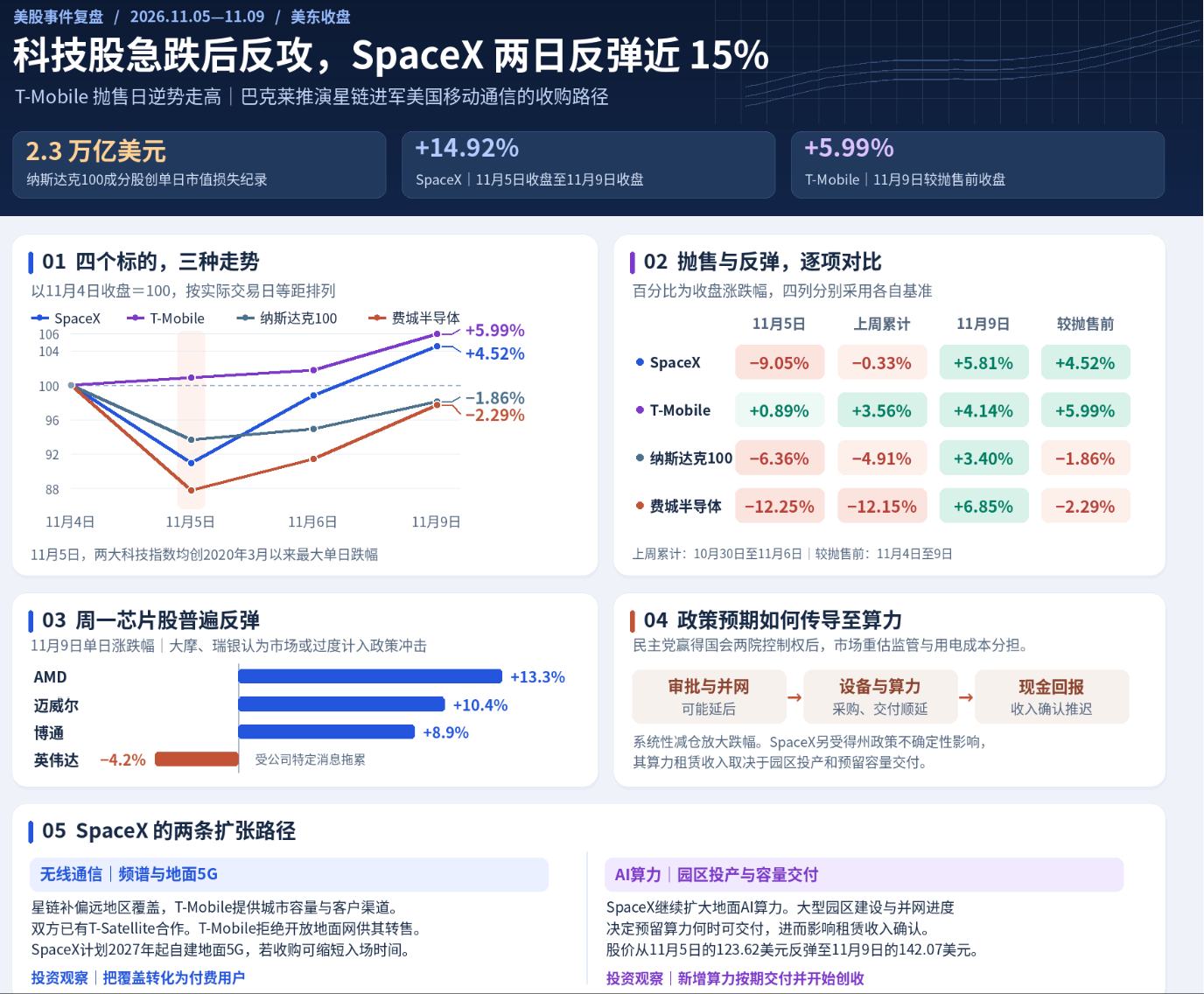
On November 5, the Nasdaq 100 fell sharply by 6.36%, and the Philadelphia Semiconductor Index plummeted by 12.25%, all of which were the biggest one-day declines since March 2020. According to statistics, the total amount of NASDAQ 100 constituent stocks evaporated about 2.3 trillion US dollars in a single day, setting a record for this index. After the Democratic Party gained control of both houses of Congress, investors re-evaluated AI supervision, data center approval, and the sharing of additional electricity costs.
Furthermore, more importantly, if project approval or connection to the grid is delayed, equipment procurement, computing power delivery, and cash returns may also be delayed. Changes in policy expectations have further amplified the decline due to systemic strategic position reductions such as congested positions and trend tracking. SpaceX is also facing additional uncertainty due to the Texas election. Since its computing power business is highly dependent on large-scale parks being put into operation on schedule, blocked ground expansion will directly affect when reserved computing power is delivered and when rental revenue is confirmed.
On November 5, SpaceX fell 9.05% on the same day, while T-Mobile (TMUS.US) bucked the trend and rose 0.89%. Looking at the overall weekly performance, SpaceX fell only 0.33%, and T-Mobile rose 3.56%, both outperforming the NASDAQ 100 and Philadelphia Semiconductor Index, which fell 4.91% and 12.15%, respectively, during the same period. On November 9, SpaceX rose 5.81%, T-Mobile rose 4.14%, and the Nasdaq 100 and Philadelphia Semiconductor Index rebounded 3.40% and 6.85%, respectively. Based on the November 4 closing before the sell-off, SpaceX is already 4.52% higher, T-Mobile is 5.99% higher, and the two major technology indices are still 1.86% and 2.29% lower, respectively. SpaceX recovered its losses by rebounding after a sharp decline, while T-Mobile recorded gains in both the sell-off and rebound stages.
The significant recovery in US stocks on Monday was mainly reflected in a general rebound in AI computing power and semiconductor-led technology stocks. AMD, Maywell, and Broadcom, the AI computing power leaders, rose by about 13.3%, 10.4%, and 8.9%, respectively, while Nvidia declined by about 4.2% due to company-specific news. Institutions such as Morgan Stanley and UBS believe that the market may have overtaken the impact of policy changes on AI capital expenditure. At the individual stock level, SpaceX rose from $123.62 on Thursday to $142.07 for two consecutive days, while T-Mobile recorded gains on the day of the sell-off and the subsequent rebound.
For the three major US operators, wholesale idle capacity can increase revenue and may also support a new rival for the same group of consumers. T-Mobile already allows compatible phones to connect to Starlink outside of terrestrial coverage through T-Satellite, but its CEO clearly stated that there is no room for SpaceX to use the T-Mobile terrestrial network to sell independent services as a mobile virtual network operator (MVNO).
If the acquisition path is changed, SpaceX can simultaneously obtain spectrum, base stations, roaming, terminal manufacturer relationships, retail distribution, customer service, and equipment financing systems. Barclays believes that T-Mobile's relatively low rural market share complements Starlink's advantages. Verizon has become a variable due to growth demands and balance sheet constraints, and AT&T's strategy is the least compatible.
Notably, Musk proposed a conditional takeover idea at the Barron Investment Conference over the weekend — he said that if SpaceX can utilize wireless spectrum far more efficiently than traditional operators, a direct acquisition of a major traditional US telecom operator is not ruled out. Furthermore, Deutsche Telekom holds 54.8% of T-Mobile after deducting treasury stock, and its attitude and regulatory review will affect the viability of any potential transaction.
SpaceX is building the two-tier network needed to compete with the three major operators. Direct-to-device (D2D) phones are suitable for filling remote areas and dead spots on the ground, while large-scale concurrency in cities and indoors relies more on intensive terrestrial base stations and spectrum multiplexing. Qualcomm's Dragonwing solution will provide Starlink with terrestrial 5G radio frequency and baseband capabilities. Construction is planned to begin in 2027, covering tens of thousands of sites over many years.
According to some media reports, about 80 MHz is more appropriate to be understood as the spectrum size arranged through the protocol, part of which is still to be delivered. What determines whether Starlink can become a national consumer mobile operator is how quickly it can convert spectrum into usable capacity and develop stable customer acquisition and service capabilities. The value of the acquisition is mainly to reduce this period of time.
AI computing power has become another asset heavy business for SpaceX. In the third quarter, SpaceX's “Super Intelligence” division focused on AI computing power leasing and AI application software. Revenue reached US$7.56 billion, accounting for about 52% of the group's revenue, covering businesses such as external computing power services, Grok, and Cursor. By the end of September, the rated power capacity of the company's computing power facilities was 1.7 gigawatts.
SpaceX has provided computing power or signed related agreements to customers such as Anthropic and Google, and announced that it has secured a financial lease commitment of approximately US$40 billion for the next generation Nvidia Vera Rubin and ancillary equipment. The return on wireless services depends on whether spectrum can be converted into coverage, capacity, and paid users, while the return on computing power services depends on whether electricity, GPUs, and networks can be delivered to customers on schedule. Both business lines can expand revenue, but whether the new revenue can cover construction and financing expenses is the key to whether SpaceX's valuation can continue to rise.
Wall Street financial giant Morgan Stanley (“Damo”) is still optimistic that the company's stock price is expected to rush to $300. Damo is optimistic not only about SpaceX's AI business; analysts in the bank's investment business department are also optimistic that the company's other businesses will have a synergy with the AI business. The team of analysts at Morgan Stanley explained, “We believe the company is one of the few platforms that can integrate orbital space resources, global connectivity services, and computing power into one infrastructure system.”
The growth outlook released by Musk at the Barron Investment Conference on November 6 provides a new basis for bulls: he expects SpaceX's revenue to increase by about 70% month-on-month in the fourth quarter, and reaffirms that the annualized revenue scale in December 2026 will exceed 100 billion US dollars, and that in December 2027 it may exceed 500 billion US dollars.