


EN
Is Equifax (EFX) Fully Valued As Its Dividend Signals Steady Confidence?
Equifax (EFX) reaffirmed its cash return policy, with the board declaring a quarterly dividend of $0.56 per share, payable on December 15, 2026, to holders of record on November 25.
That dividend decision comes after a volatile stretch for Equifax, where the share price is up about 29% over the past month but still down 12% year to date. Over a 1-year period, total shareholder return has declined 8.8%, and over 5 years it has fallen 30.6%. This suggests that recent momentum is rebuilding confidence rather than erasing a longer period of weaker overall returns.
Scan how Equifax’s recent rebound and steady dividend profile compare with other potential opportunities by reviewing our curated list of 33 high quality undervalued stocks.
Equifax looks like a solid data and analytics franchise, backed by more than a century of dividend payments and recent growth in revenue and earnings. After a sharp 1 month rebound, is that quality now on sale, or already fully reflected in the price?
Most Popular Narrative: 6% Undervalued
Equifax last closed at $188.33, while the analyst consensus Narrative on Simply Wall St anchors fair value at $200.35 using a 7.87% discount rate and detailed revenue and earnings forecasts. That gap frames the stock as modestly undervalued and sets the scene for a thesis driven by margins, data assets and product adoption.
Rapidly growing Work Number records, now at 217 million active records with 108 million unique Social Security numbers, along with high margin Workforce Solutions revenue and 52.1% segment EBITDA margins, are increasing the share of recurring verification income and supporting group level margin expansion.
See why 31 investors see Equifax as 6% undervalued.
Result: Fair Value of $200.35 (UNDERVALUED)
Still, Equifax’s narrative hinges on mortgage exposure and legal overhangs, where weaker mortgage volumes or higher litigation costs could quickly challenge the current upside case.
Find out about the key risks to this Equifax narrative.
Another View: What Equifax’s P/E Is Saying
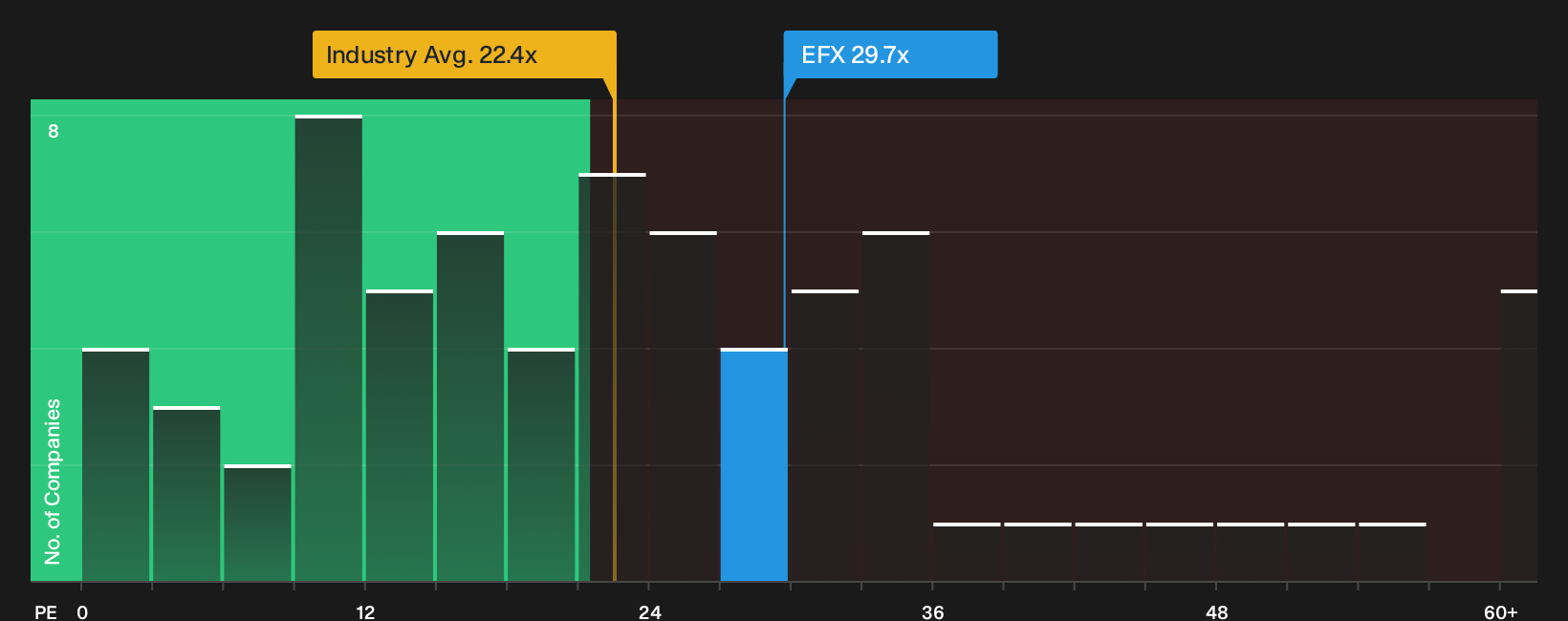
The equity story around Equifax being 6% below fair value on analyst models sends a very different message when compared with its current P/E. At 29.7x earnings, the stock trades above both the Professional Services industry on 22.7x and peers on 27.9x, and also above its own 27.4x fair ratio.
That gap indicates investors are already paying a premium for Equifax’s earnings profile, while the fair ratio suggests the multiple could drift lower or remain elevated. The question for you is straightforward: does the margin and growth narrative justify paying more than both sector averages and the level the fair ratio points to as reasonable?
See what the numbers say about this price — find out in our valuation breakdown.
Next Steps
Mixed signals on Equifax so far. If you want to move quickly and judge the trade off between its pressure points and bright spots yourself, start with 3 key rewards and 1 important warning sign.
Looking for more Equifax investment ideas beyond this stock?
If Equifax has your attention but you want fresh angles, you can use focused stock lists on Simply Wall St's screener to pressure test your next move.
- Target resilient income by reviewing companies that screen as potential 6 dividend fortresses for investors who care about yield backed by underlying business strength.
- Hunt for quality at a discount by scanning a curated 19 high quality undiscovered gems that many investors may not be watching yet.
- Dial down volatility in your portfolio by assessing a 30 resilient stocks with low risk scores that filters for businesses with more stable risk profiles.
Have feedback on this article? Concerned about the content? Get in touch with us directly. Alternatively, email editorial-team@simplywallst.com