


EN
TSM.US revenue surged 60% in October: AI demand is still strong, but market concerns about “regulation+financing costs” are unstoppable
The Zhitong Finance App learned that TSM.US's monthly sales increased 60% year over year, reflecting the company's central position in global artificial intelligence infrastructure construction.
This major chip agency for Nvidia (NVDA.US) and Apple (AAPL.US) announced that October revenue was NT$586.9 billion (approximately US$17.9 billion). This growth rate was further accelerated from about 51% in the September quarter. Analysts on average expect a 63% increase in the last three months of this year.
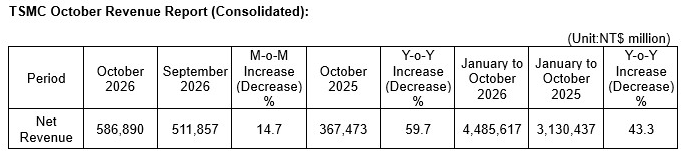
The revenue outlook given by TSMC last month was better than expected, and continued its intense growth trend after the ChatGPT era. However, considering the rising cost of expensive and resource-intensive data centers, investors are still digesting the long-term prospects of AI demand. TSMC's stock price fluctuated sharply along with the technology sector, and was impacted by concerns: the Democratic Party's victory in the US midterm elections could lead to stricter regulation of the AI industry.
TSMC is a key trend vane for the industry as it manufactures chips for many technology companies. The company is betting on a fundamental shift: it is trying to build and equip around 20 factories in Taiwan Province of China and overseas, at an unprecedented rate for a company that usually only promotes the construction of four or five new plants at the same time.
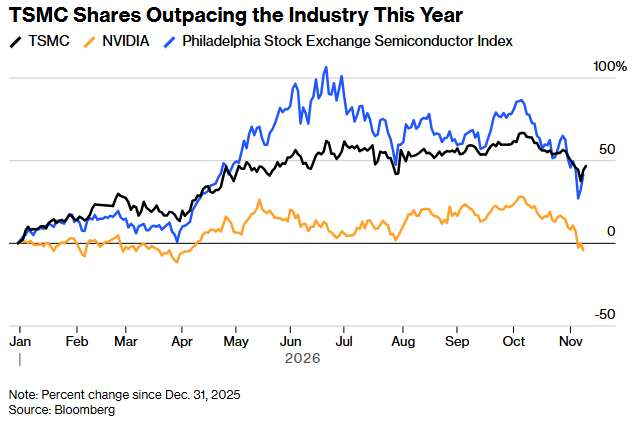
TSMC's stock price performed better than the industry average this year
However, CEO Wei Zhejia stressed that the company is still in a prudent expansion model and is looking for a new production site in Texas while discussing potential cooperation with Elon Musk on the Terafab chip manufacturing project.
So far, the company has successfully accelerated sales growth and capacity expansion, and reiterated that this year's capital expenditure will reach 64 billion US dollars, a record.
Analyst Charles Shum said that under its scenario, TSMC's earnings per share will be 6% to 7% higher than the market's consensus forecast for 2027 to 2028, driven by higher revenue and gross profit margins. Even if production capacity of 250 billion US dollars is built, its advanced process production capacity will actually still be sold out by 2028, thus supporting price increases. As depreciation rises, AI growth slows, and supply catches up, the upside will narrow in 2029.