


EN
Forget Palantir? This IPO Candidate May Be the New "Autonomy Giant" in Defense.
Key Points
From its 2020 IPO to today, AI defense company Palantir's stock has soared 16-fold in share price.
New "autonomy giant" Shield AI may fly a similar path.
The privately owned AI defense company was worth barely $5 billion just last year. It's worth nearly $29 billion today.
If you follow defense stocks -- and artificial intelligence (AI) -- you probably know about Palantir Technologies (NASDAQ: PLTR). Privately owned for years before its September 2020 IPO, Palantir attracted significant investor interest even before it went public. Since Palantir went public, the stock is up 16-fold over barely six years, enough to make many investors into millionaires all on its own.
So what are the chances lightning like that could strike twice?
Missed AI’s "Act 1"? Act 2 Could Be 15x Bigger. Most investors think they missed the AI boat because they didn't buy Nvidia in 2005. But according to our analysts, we’re only at the end of "Act 1"—the R&D phase. "Act 2" is the global rollout. Continue »
Double double trouble in defense
The chances may be better than you think, and amazing as it may sound, there's even a chance it may strike the very same kind of company: a popular defense stock focused on AI called Shield AI.
Much as Palantir was, Shield AI is a company that few people have heard of -- but it's been getting quite a lot of coverage lately and attracting the attention of defense investors. Just last week, defense news site Tectonic reported that Shield AI is raising $2.5 billion in cash at a $28.8 billion valuation to help pay for the acquisition of radar specialist Echodyne.
To put those numbers in context, Tectonic points out that as recently as March, Shield AI was valued at only $12.7 billion. So the valuation has doubled in the last eight months. What's more, as recently as 2025, Shield AI was worth only $5.3 billion. So in fact, the valuation has doubled twice in just the past year.
Introducing Shield AI
What is this defense contracting wunderkind? Well, according to its own website, Shield is a defense tech company with the ambitious goal of using AI-powered autonomy to guide "every military asset: aircraft, drones, ships, satellites, and submarines" by 2030.
Shield calls its own autonomy solution by the totally-not-terrifying name Hivemind -- it's the brain behind the company's V-Bat unmanned aerial vehicle (drone), its X-Bat vertical takeoff and landing fighter jet, and its Aechelon simulation platform for training both drone pilots and drone flight systems. (Aechelon also, incidentally, permits Shield's drones to operate without guidance from global positioning systems.)
As recently as a couple of months ago, I was writing about how Shield's software had become so capable that defense heavyweight L3Harris (NYSE: LHX) was enlisting its help in improving the performance of L3's VAMPIRE counter-drone rocket systems. Just one month later, Shield signed up another defense leader -- Italy's Leonardo -- to use Hivemind to power its Hivemind Proteus helicopter drone.
Elsewhere in the military, the U.S. Air Force has put Shield AI on its short list of candidates to provide autonomy software for its new fleet of Collaborative Combat Aircraft (CCA) drone warplanes.
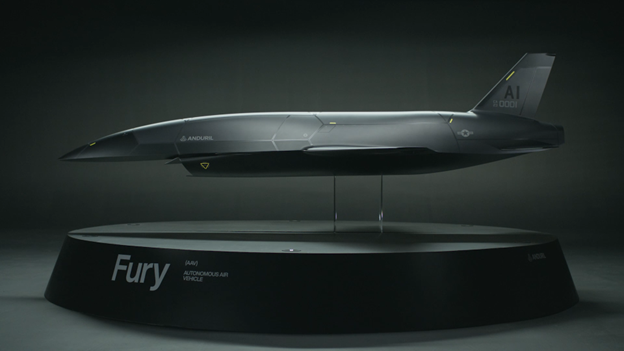
Image source: Anduril.
Why investors should be watching Shield AI
Clearly, Shield AI is a company on the move. Tectonic calls it the new "autonomy giant." It is also, apparently, contemplating an IPO. As Tectonic reports, Shield management is coy about its timetable, but confirms that it is definitely interested in "having the option to go public should we choose to."
And it makes sense that it would.
Company co-founder Brandon Tseng says Shield AI is on course for $540 million in revenue this year, "up more than 80%" from 2025, according to Fortune magazine. Revenue is growing nearly as fast as the company's valuation. What's more, Tseng confirms that "we don't expect growth to slow down."
How to value Shield AI
So what does this imply for Shield AI's valuation? Well, $540 million in revenue on a stock with a $28.8 billion valuation means Shield stock is valued at approximately 53 times sales. That's actually a bit less than what Palantir stock costs (61 times sales), despite Shield being earlier in its growth trajectory and having more room to grow.
Granted, Palantir's a much bigger player in this market. Its $7.3 billion in trailing revenue still dwarfs Shield's $540 million. But with the momentum Shield is showing, that may not remain the case for long. In a growing military market that's clearly very interested in autonomy, Shield AI could prove a popular choice -- for the Pentagon and for IPO investors.
Rich Smith has no position in any of the stocks mentioned. The Motley Fool has positions in and recommends L3Harris Technologies and Palantir Technologies. The Motley Fool has a disclosure policy.