


EN
Diamondback Just Hiked Its Dividend by Over 7%. If You Buy the Stock Here, Keep a Close Eye on Oil Prices.
Energy producers are giving shareholders more income this earnings season. ConocoPhillips (COP) recently raised its ordinary quarterly dividend by 11%, while Diamondback Energy (FANG) announced a 7.3% increase in its quarterly base dividend to $1.18 per share on Nov. 2. Diamondback’s latest raise builds on a 166.67% five-year dividend growth rate, measured before the new increase.
The announcement accompanied third-quarter results showing average oil production of 525,000 barrels per day and approximately $2.6 billion in operating cash flow from its Permian Basin operations. Yet Diamondback’s latest shareholder letter also flagged higher diesel, sand, and water expenses, although its total cash operating costs per barrel edged lower from the previous quarter.
The company remains committed to growing its base dividend, but a bigger payout is only part of the investment case. Do Diamondback’s financial strength and growth prospects make FANG stock worth buying at its current price? Let’s find out.
The Numbers Behind the Higher Payout
Diamondback Energy, headquartered in Midland, Texas, explores, develops, and produces oil and natural gas, primarily in West Texas’s Permian Basin. With approximately $50.11 billion in market capitalization, the company acquires reserves and develops onshore acreage through drilling, completion, and production across its extensive regional asset base.
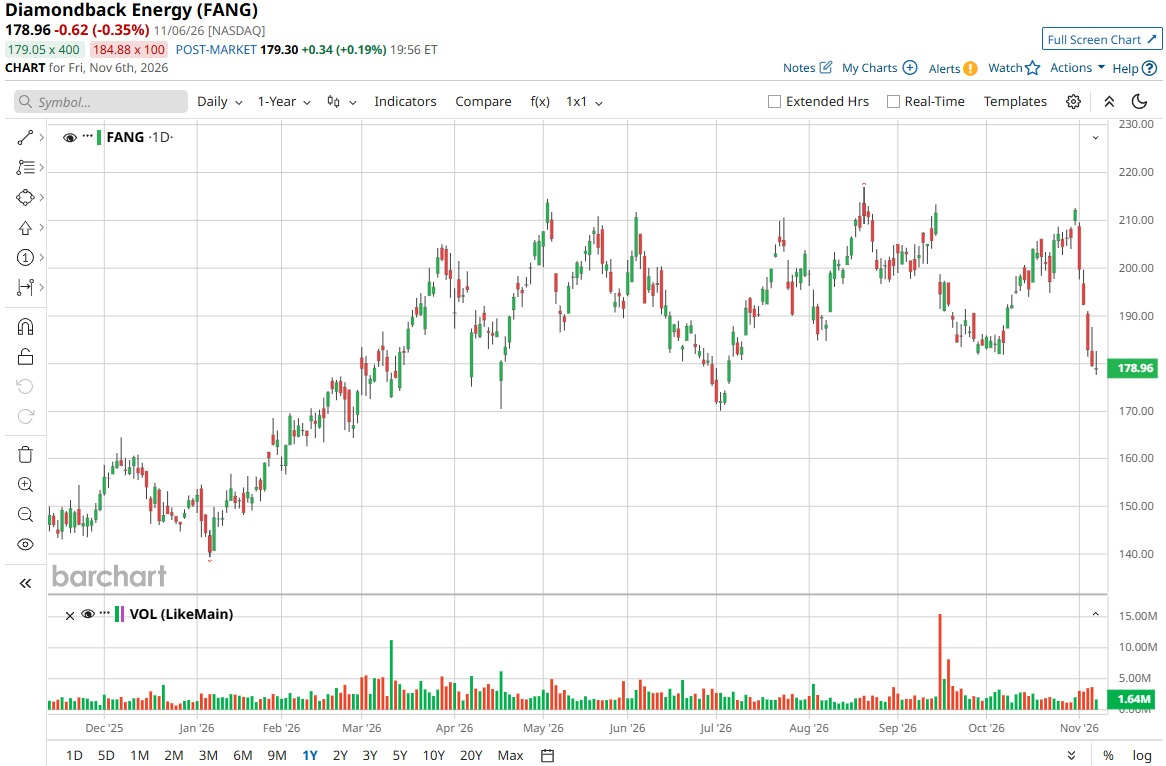
FANG stock finished Nov. 6 at $178.96, delivering a 19% gain year-to-date (YTD) and 27% over the past 52 weeks.
On a cash-flow basis, the stock trades at 5.77 times, a modest premium to the sector median of 5.37x, rather than a clear discount.
Following its 7.3% increase, Diamondback’s quarterly base dividend rises from $1.10 to $1.18 per share, bringing the annual payout to $4.72. That represents 18% year-over-year (YoY) growth and a 2.2% yield.
Previously, the annual payout was $4.40, with the latest $1.10 distribution carrying an Aug. 13 ex-dividend date. The new higher dividend has a record date of Nov. 12 and is scheduled for payment on Nov. 19.
Diamondback released third-quarter 2026 results on Nov. 2, reporting revenue of $5.43 billion, up 38.4% YoY. This exceeded the supplied $4.87 billion consensus by 11.6%, while adjusted EPS of $5.86 surpassed $5.60 expectations by 4.6%.
Their consolidated adjusted EBITDA reached $3.75 billion, representing a 69.1% margin and beating the supplied $3.49 billion forecast by 7.4%. The operating cash inflow totaled $2.6 billion, or $3.2 billion before working-capital changes, alongside approximately $1.0 billion in cash capital expenditures.
Under its own non-GAAP calculations, Diamondback reported $2.1 billion in free cash flow and $2.2 billion in adjusted free cash flow. The company also bought back approximately 1.3 million shares for $251 million.
Alongside those buybacks, Diamondback repurchased $106 million in long-term debt for $103 million, including accrued interest. Those purchases reduced debt while the company continued returning cash to shareholders.
What Could Fuel Diamondback's Growth
Diamondback’s third-quarter oil production grew 4.2% YoY to an average of 525,000 barrels per day. Including natural gas and natural gas liquids, total output averaged 1.034 million barrels of oil equivalent daily.
That performance supported higher full-year targets in the company’s Nov. 2 update. Diamondback raised its 2026 oil-production forecast to approximately 524,000 barrels per day, from its previous target of more than 522,000. Total production guidance increased to approximately 1.015 million barrels of oil equivalent daily, from more than 1 million previously.
Looking ahead, fourth-quarter oil production is expected to average 518,000-528,000 barrels per day. Total production guidance stands at 1.025 million-1.045 million barrels of oil equivalent daily. Those ranges indicate broadly steady oil output compared with the third quarter, rather than a sharp acceleration.
Beyond drilling, Diamondback acquired a 7.5% equity interest in the Solitude Pipeline System, a natural gas pipeline connecting the Permian Basin with Katy, Texas. The investment adds a transportation-infrastructure interest alongside its production operations, although the announcement does not quantify its expected financial contribution.
Together, higher production targets and pipeline ownership give shareholders operational developments to assess alongside the dividend increase. The investment case still depends on converting those assets and additional spending into sustainable cash generation.
How Wall Street Rates FANG Stock
Diamondback is set to report its next set of results on Feb. 22, 2027. Wall Street currently expects fourth-quarter earnings of $6.41 per share, up 268% from the $1.74 the company delivered in the same period a year ago.
Even with that expected growth, Morgan Stanley took a more cautious view. Analyst Devin McDermott cut FANG from “Overweight” to “Equal-Weight,” saying the stock’s gains had outpaced the business’s performance. He kept his $216 target at the downgrade, implying 21% upside, but saw no clear reason to favor FANG over its peers.
Citigroup remained more upbeat. Analyst Scott Gruber kept his “Buy” rating on Aug. 10, while trimming his target from $221 to $220. That target suggests 23% upside from the Nov. 6 closing price.
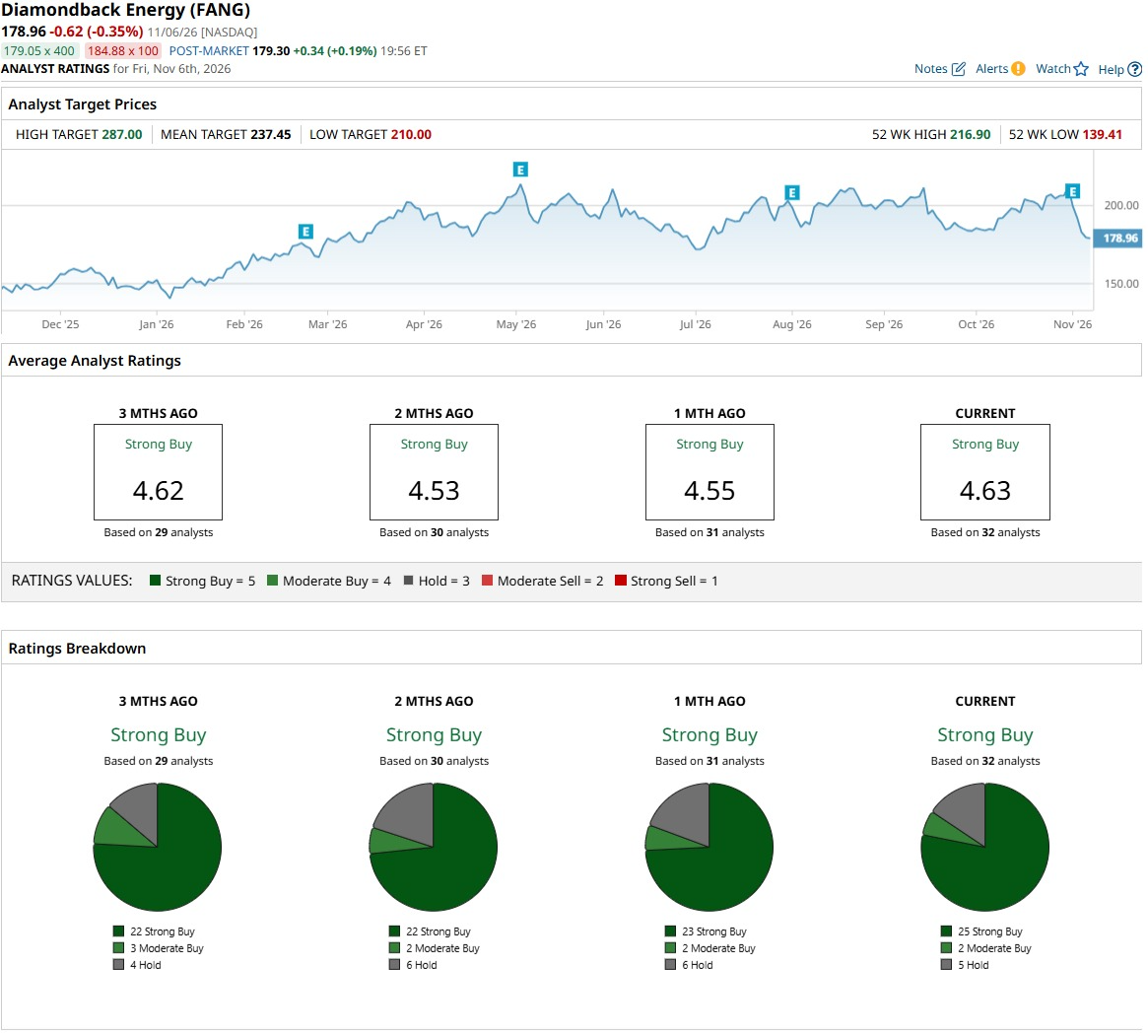
The broader consensus also leans bullish, with FANG stock holding a “Strong Buy” rating across 32 analysts. Their average price target of $237.45 suggests a 33% upside.
Conclusion
Diamondback looks like a reasonable buy here, with strong cash generation, higher production guidance, and a growing dividend supporting the case. Its modest valuation premium means the stock is not a bargain, but expected earnings growth leaves room for further gains. Further upside looks likely if production holds up and spending stays controlled, although weaker oil prices could change that outlook. The dividend sweetens the deal, but sustained cash generation remains the stronger reason to own FANG stock from here.
On the date of publication, Ebube Jones did not directly have a position in any of the securities mentioned in this article. All information and data in this article is solely for informational purposes. For more information please view the Barchart Disclosure Policy here.