


EN
MRVL.US (MRVL.US)'s $115 billion “Marriage of the Century” fell cold! The stock price has fallen by more than 40%, and experts estimate that the probability of completion is only 50%
The Zhitong Finance App noticed that the initial evaluation of Maywell Technology (MRVL.US)'s plan to acquire Lumentum (LITE.US) with a huge investment of 115 billion US dollars to increase AI was not enthusiastic from experts betting on mergers and acquisitions.
According to a number of M&A arbitrage experts, the implied probability of completion of the deal hovers around 50%, reflecting the market's doubts about whether the two companies can complete one of the biggest technology deals in history. The sell-off of the two stocks has caused Lumentum's stock price to be drastically discounted compared to Maywell's full stock price, and this price itself has shrunk.
Since the media first reported on the potential merger at the end of last month, Maywell has dropped nearly 40% and Lumentum has dropped about 35%. Investors questioned the economics of the deal, which was further exacerbated as last week's broader reassessment of AI trading triggered a sharp fall in the stock market.
As of Monday, there was a 14% difference between Lumentum's share price and Mewell's offer. This significant gap reflects the size and risk of the deal. Even though tech stocks rose on the same day, this gap still exists.
Investors have long been wary of long waits and potentially complicated regulatory reviews — the deal is not expected to be completed until 2028. Recent market turmoil has further amplified these concerns and revealed the risk of an all-stock transaction: its strategic logic is largely based on the premise that spending in the field of artificial intelligence data centers and connectivity continues to grow.
Cabot Henderson, an event-driven strategy expert at Jones Trading, said, “It's really difficult to calibrate a deal that takes so long, with an AI cycle that is so fast; moreover, when it's seen as a sign that the market is peaking, it's never a good sign.”
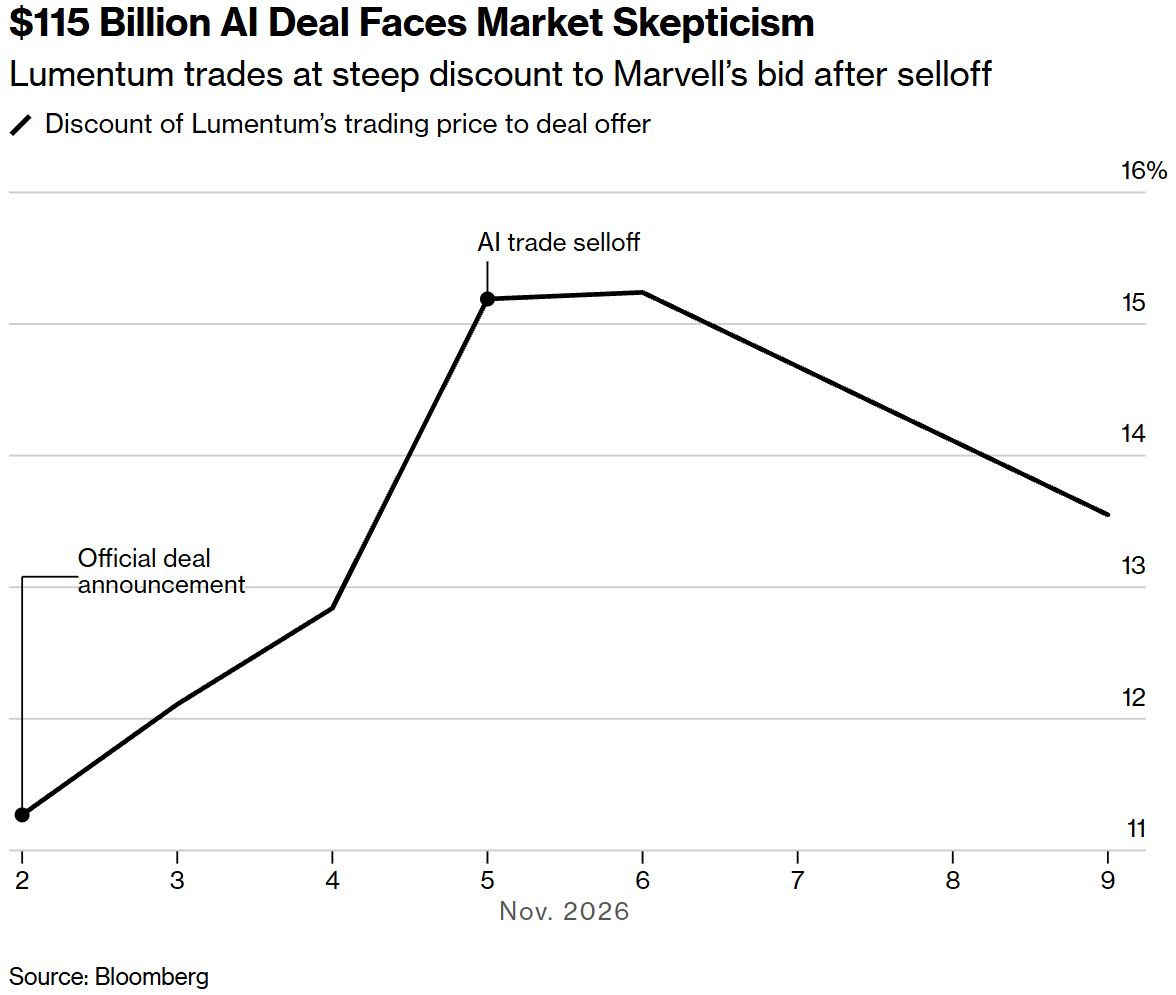
Artificial intelligence transactions worth $115 billion face market questions
Admittedly, it is not uncommon for large deals to initially experience negative market reactions before investors digest the terms and finally accept their strategic logic. However, Henderson pointed out that the magnitude of this round of stock price fluctuations far exceeds normal nervousness. Shareholder votes for both companies will be an impediment to the deal in the near future.
Mywell's investors need to be persuaded: the chipmaker is buying a critical piece of AI infrastructure rather than paying the top price of a cycle for growth that may be difficult to sustain. For Lumentum's shareholders, the overall stock structure adds another layer of uncertainty — the final acquisition premium value they receive will depend on Mywell's share price level when the deal is completed.
At the same time, integrating Mywell's signal processing electronics and optical modules with Lumentum lasers and other key optical components may trigger protracted antitrust scrutiny.
Jennifer Lee, a senior litigation analyst at industry research, said that although the two companies are likely to obtain regulatory approval with possible additional remedies, “China is a variable.” She pointed out that the centralized review agency for Chinese operators is the primary risk of this deal in terms of antitrust and schedule.
China's regulatory scrutiny has previously put a number of deals on hold. Qualcomm (QCOM.US) abandoned the $44 billion acquisition of NXP Semiconductors (NXPI.US) in 2018; Intel (INTC.US) cancelled the $5.4 billion deal to acquire Gaota Semiconductors after failing to obtain approval from Beijing in 2023. Broadcom (AVGO.US)'s $69 billion deal to acquire VMware also experienced months of uncertainty before receiving conditional approval a few days before the critical deadline.