


EN
Learn Why The Bull Case For Canfor (TSX:CFP) Could Change Following Reduced Q3 Loss
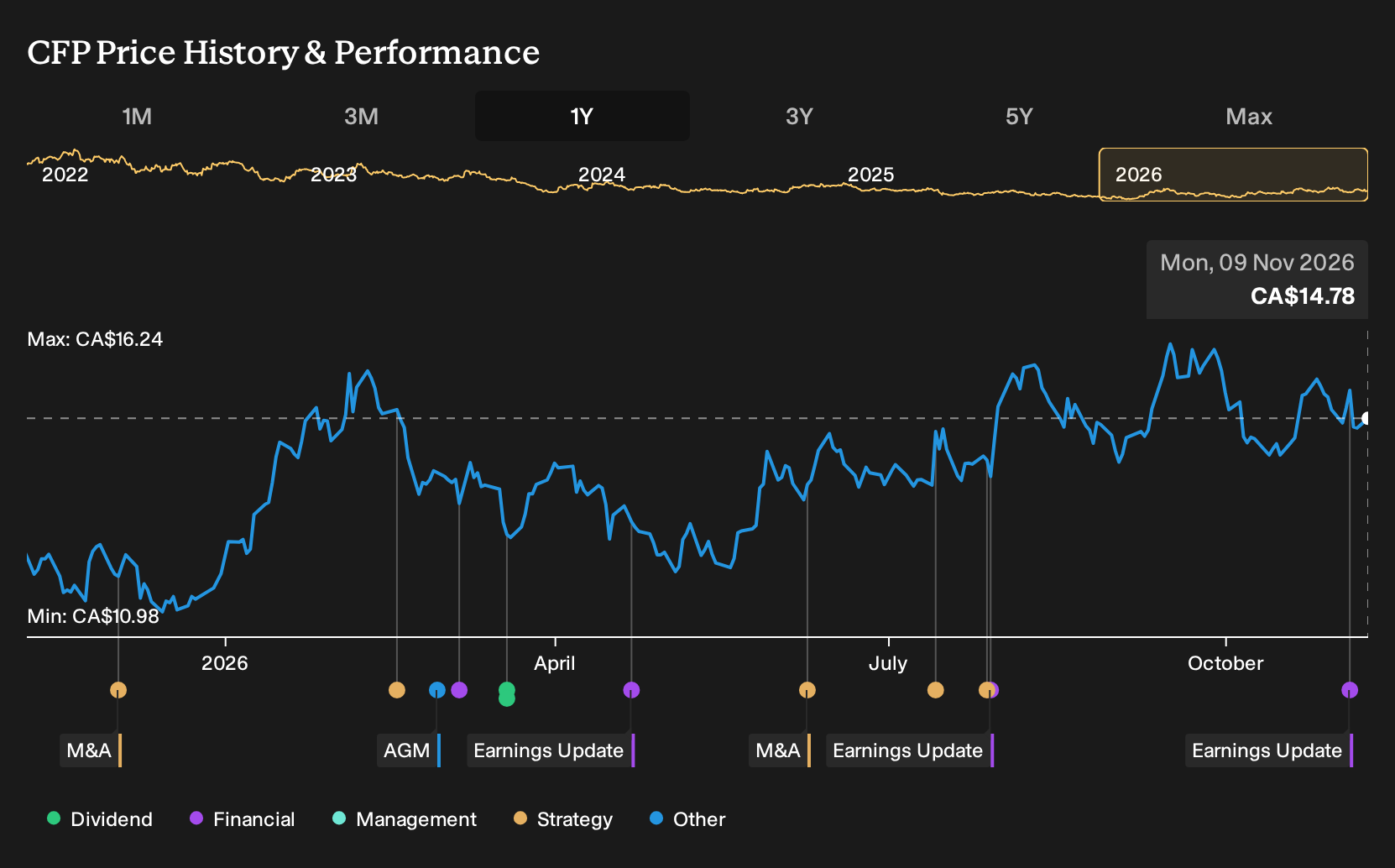
- Canfor reported Q3 2026 sales of C$1,284.8 million and a net loss of C$88.2 million, with both sales and losses differing from the prior year, and also recorded a smaller loss for the nine month period.
- The lumber segment produced strong adjusted EBITDA, and lower European log costs helped offset weak markets, while management highlighted ongoing industry headwinds and a cautious demand outlook.
- We will now look at how Canfor's narrower Q3 loss and cautious demand commentary could reshape the existing investment narrative.
Scan how Canfor compares to other wood and materials businesses under pressure, and see which are holding up better with the curated list of solid balance sheet and fundamentals (5 results).
Canfor Investment Narrative Recap
To own Canfor, you need to be comfortable with a cyclical, commodity exposed lumber and pulp producer that is still loss making but working to tighten its cost base. The analyst consensus Narrative on Simply Wall St focuses on earnings improving as higher cost mills are closed and more production runs through efficient assets. The latest quarter fits that arc, with a smaller loss and solid lumber EBITDA, but does not remove the near term pressure from weak construction demand.
The closest short term swing factor remains demand in North American housing and repair and remodel. Management still views this cautiously, given affordability issues and higher U.S. mortgage rates. On the risk side, the earnings update does little to change bigger structural concerns that analysts have raised, such as fiber availability in Alberta and Sweden, trade duties on Canadian lumber and the drag from softer pulp markets.
The most relevant piece of recent news is management’s guidance that capital spending should fall sharply in 2027 as large projects like Bruza in Sweden and Iron Mountain in Arkansas roll off. Those upgrades were a key part of the analyst consensus Narrative on Simply Wall St, which assumes a shift toward more efficient lumber capacity and eventually higher earnings power. Lower capex could free up cash for balance sheet flexibility once those mills are fully bedded in.
Set against the third quarter numbers, that capex commentary matters for how you think about risk and timing rather than changing the core thesis. Execution on the retooled mill network still carries plenty of operational and integration risk, especially as pulp and paper capacity is refocused on Intercon and specialty paper. For investors, the combination of ongoing losses, a cautious demand view and a winding down investment program keeps attention firmly on whether the reconfigured asset base can run consistently and at lower unit cost through the next part of the cycle.
Canfor's narrative projects CA$6.5b revenue and CA$742.4 million earnings by 2029, based on current analyst estimates of 6.2% yearly revenue growth and an earnings swing of about CA$1.4b from current earnings of a CA$653.5 million loss.
Uncover why Canfor's fair value indicates a 20% potential upside to its current price that could narrow quickly.
Exploring Other Perspectives
Three fair value estimates from the Simply Wall St Community cluster between CA$11.64 and CA$17.71, so retail opinions on Canfor already span a wide band. When you consider risks such as prolonged weak pulp markets and trade duties, it becomes clear that views can diverge sharply. Explore the full range before deciding how this story fits your portfolio.
Explore 2 other Canfor fair value estimates, including one that indicates potential upside of as much as 20% from the current price.
Reach Your Own Conclusion
Don't just follow the ticker. Dig into the data and build a conviction that's truly your own.
- A great starting point for your Canfor research is our analysis highlighting 2 key rewards that could impact your investment decision.
- See our latest analysis for Canfor. The report includes a comprehensive fundamental analysis summarized in a single visual, the Snowflake, making it easy to evaluate Canfor's overall financial health at a glance.
Looking for more Canfor sized investment ideas?
If the Canfor story has you reassessing where risk and quality really meet, it can help to scan a wider field of opportunities before committing fresh capital.
- For investors who want quality and value to line up, consider screening for companies that combine strong fundamentals with attractive pricing through the 6 high quality undervalued stocks.
- If capital preservation matters as much as upside, narrow your focus to businesses with resilient balance sheets and solid financial footing using the list of solid balance sheet and fundamentals (5 results).
- Those hunting for potentially overlooked opportunities can cast a wider net across lesser known but financially robust companies using the 7 high quality undiscovered gems.
Have feedback on this article? Concerned about the content? Get in touch with us directly. Alternatively, email editorial-team@simplywallst.com