


EN
EMEA Revenue Growth Might Change The Case For Investing In Netflix (NFLX)
- Netflix reported 11% year-on-year revenue growth in its Europe, Middle East and Africa segment in Q3 2026, reinforcing the importance of international markets in the business mix.
- The focus on preserving creative freedom across European countries suggests that future performance in EMEA may depend more on local content flexibility than on subscriber additions alone.
- We will now examine how Netflix's investment narrative is influenced by EMEA's 11% revenue increase and the question of creative freedom.
Scan how Netflix's EMEA story compares with other platforms growing off international demand by reviewing the hand picked 19 high quality undiscovered gems.
Netflix Investment Narrative Recap
To own Netflix today, you need to believe the streaming leader can keep turning its scale into durable cash generation through pricing, advertising and disciplined content spend. According to Ivoed, an investor in the Simply Wall St Community who wrote the narrative, the debate is not business quality but how much upside is left as growth moderates. The 11% EMEA revenue increase points to international demand, yet the bigger swing factor still looks like how effectively Netflix can deepen monetisation rather than chase raw subscriber gains.
The most important near term catalyst remains evidence that advertising and pricing can support earnings that are forecast to grow 9.99% per year while keeping engagement healthy. The biggest current risk is that new monetisation pillars, including ads and product experiments, prove more story than economics, at a time when the stock trades on a P/E of 17.6x. The EMEA update does not materially change that balance. It mainly reinforces how much of the execution now relies on getting regional content and local freedoms right.
The recent disclosure that Capital Group Core Equity ETF increased its Netflix position by US$5.9m on 5 November 2026 is the cleanest related data point for this news. That one fund move does not define the thesis, yet it does show at least one large holder leaning in while EMEA revenue grows and creative freedom questions surface. For you as a shareholder, the more useful focus is still on business drivers rather than who owns the stock.
Ivoed argues that Netflix has become a cash generative platform where valuation depends on proof that pricing and advertising translate into stronger free cash flow. The EMEA revenue progress and the incremental institutional buying both sit in that context. They feed into the same core question. Can management convert regional momentum and product levers into the kind of monetisation depth that keeps justifying a premium business at this scale, without eroding viewer satisfaction or overrelying on external funding?
Ivoed’s narrative reaches a fair value of US$82.00 per share for Netflix by assuming revenue expands 11.7% a year and the business settles at a 28.5% profit margin. Together, these assumptions support a cash flow profile that the DCF framework treats as fairly valued around that level.
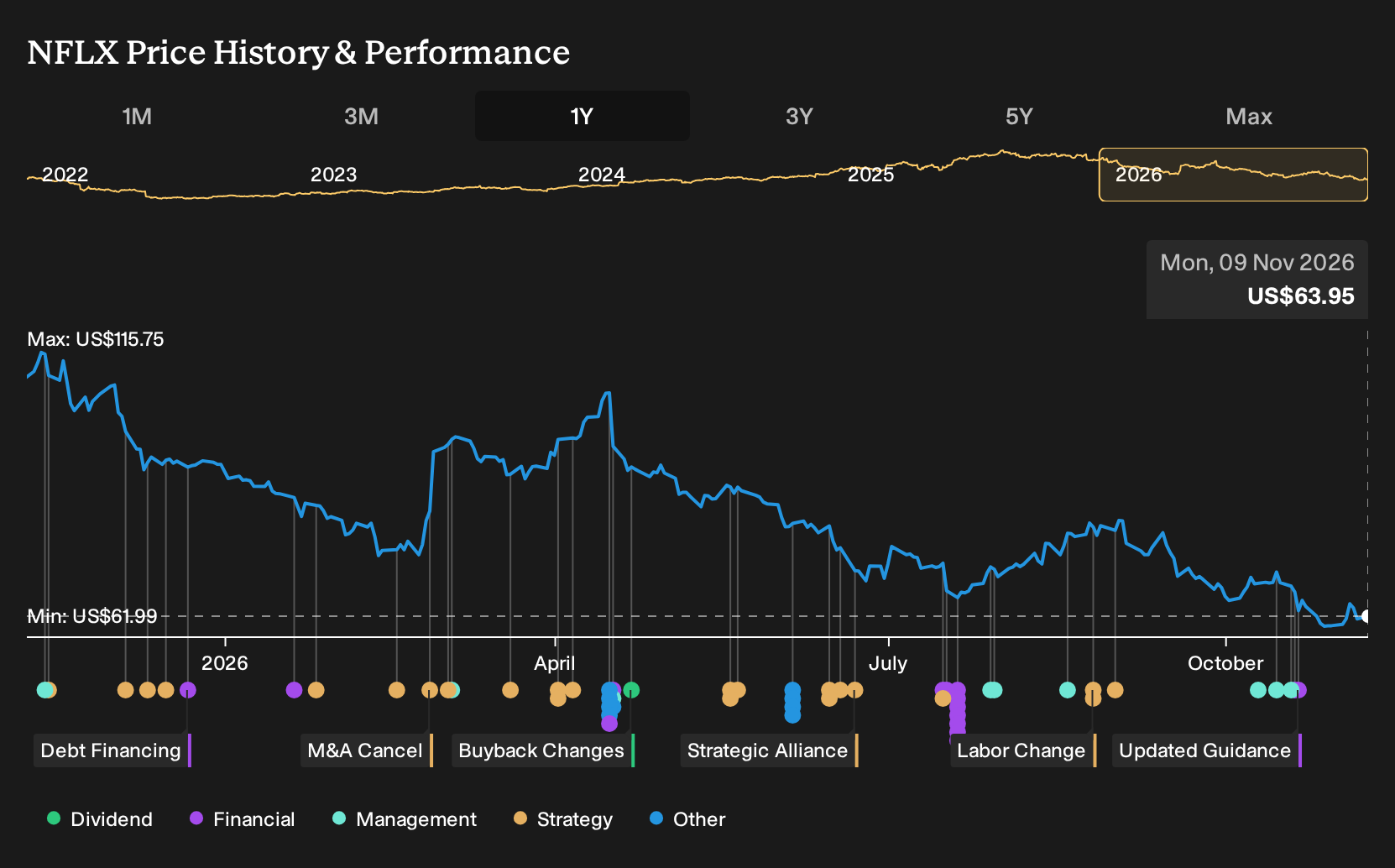
Uncover how Netflix's fair value indicates a 29% potential upside to its current price that could narrow quickly as more investors reassess the stock.
Exploring Other Perspectives
Some of the lowest Netflix analysts were less excited about international momentum and instead focused on regulatory risk. Before this EMEA update, they pencilled in about 9.1% annual revenue growth and a margin slip from 29.7% to 27.2%. That builds a more cautious story. You can now weigh those older forecasts against fresh EMEA data and see which narrative may shift.
Explore 44 other Netflix fair value estimates, including one that suggests as much as 10% downside from the current price.
The Verdict Is Yours
Don't just follow the ticker; dig into the data and build a conviction that's truly your own.
- A great starting point for your Netflix research is our analysis highlighting 3 key rewards that could impact your investment decision.
- See our latest analysis for Netflix. The report includes a comprehensive fundamental analysis summarized in a single visual, the Snowflake, making it easy to evaluate Netflix's overall financial health at a glance.
Looking for more Netflix sized investment ideas?
If Netflix has helped you sharpen what you want from a long term holding, you can apply the same filters across the market using a few focused screeners that surface stocks by quality, resilience and income potential.
- For investors who care most about resilient balance sheets and solid fundamentals, start by scanning the list of solid balance sheet and fundamentals (25 results) so you can shortlist sturdier businesses before digging into the details.
- If your priority is limiting downside risk, widen your watchlist with the 31 resilient stocks with low risk scores and concentrate on companies that score well on stability and financial strength.
- For those building an income focused portfolio, use the 7 dividend fortresses to find yield opportunities that may complement a growth story like Netflix.
Have feedback on this article? Concerned about the content? Get in touch with us directly. Alternatively, email editorial-team@simplywallst.com