


EN
Learn Why The Bull Case For Standard Chartered Stock Could Change Following Raised Guidance
- Standard Chartered reported nine month 2026 results with net income of US$5,410 million and higher earnings per share, raised its full year 2026 income and net interest income guidance, and made several senior leadership changes in board oversight and North American fund finance.
- The combination of upgraded income targets and refreshed leadership in both board committees and fund finance reflects management's focus on earnings quality, controls and balance sheet driven fee income.
- This section now examines how Standard Chartered's raised income guidance reframes the investment narrative investors have been using until now.
Scan beyond Standard Chartered and spot other banks leaning into income guidance upgrades and fee driven balance sheets with our curated list of solid balance sheet and fundamentals (9 results)
Standard Chartered Investment Narrative Recap
Owning Standard Chartered means believing the bank can keep turning affluent wealth inflows, originate to distribute banking and cost discipline into steady earnings while keeping credit costs under control. The analyst consensus Narrative on Simply Wall St leans on that mix, so the raised 2026 income and NII guidance points straight at that thesis. In the near term, execution on the Fit for Growth cost plan and fee driven balance sheet activity looks like the key catalyst.
The biggest near term risk sits on the other side of that equation. Any softness in less visible retail or SME activity, pressure on Global Markets flow income or a need to raise the allowance for bad loans from its currently low 74% level could crimp progress. The leadership changes in audit oversight and fund finance matter here, but the operational story still does most of the heavy lifting.
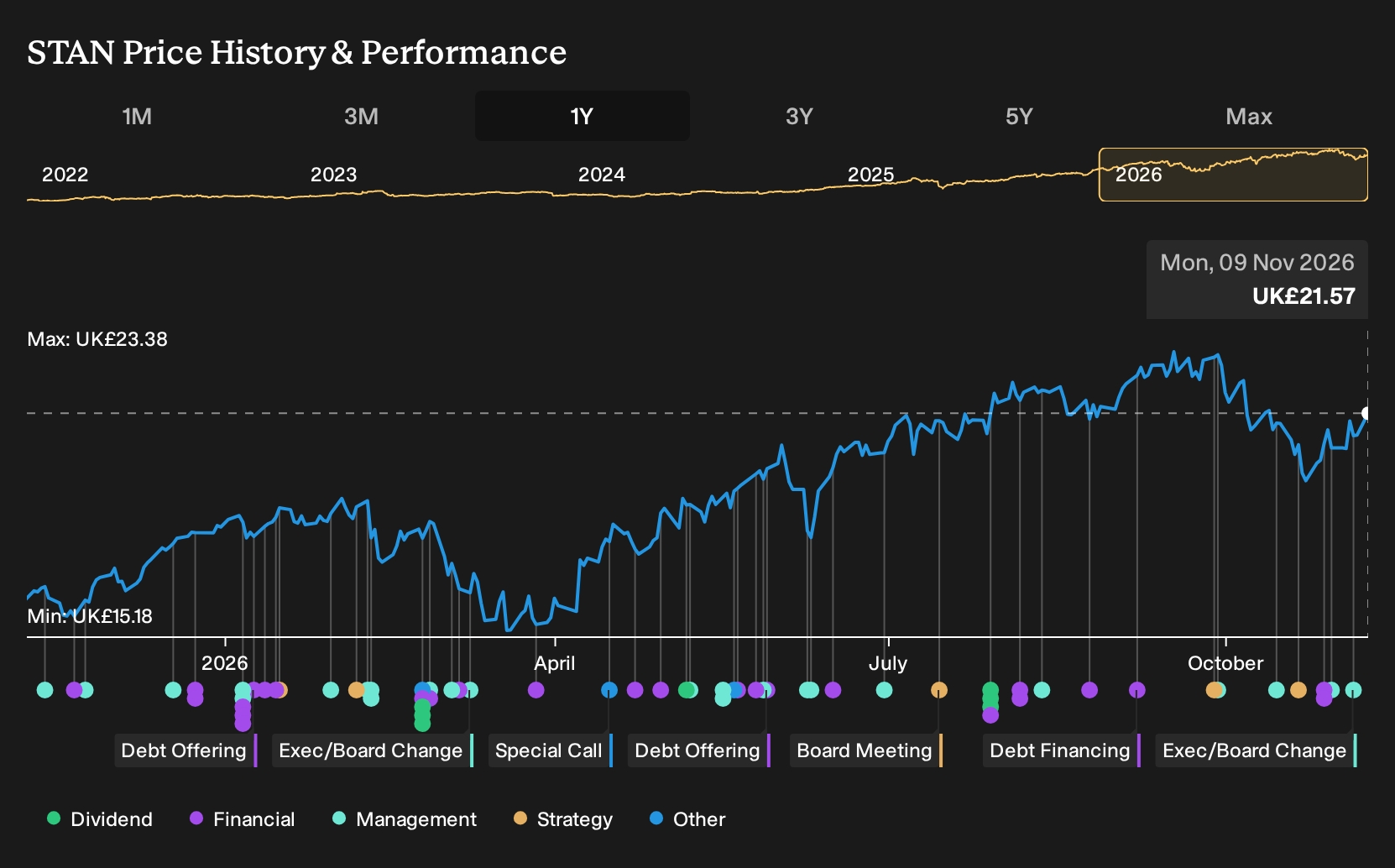
The most relevant fresh data point is the nine month 2026 update, where Standard Chartered reported US$5,410m of net income and basic EPS from continuing operations of US$2.206. Those numbers sit alongside upgraded guidance that now pitches full year total income growth above the prior 5% to 7% range and NII growth around 4% at constant currency, excluding notable items.
That combination gives investors a clearer near term scoreboard for judging whether the fee heavy, capital light narrative is playing out or stalling. If the bank can keep Wealth Solutions income above US$1b per quarter while growing originate to distribute and keeping the cost or income ratio pointed toward the 57% 2028 target, the guidance looks more like an operational bar than a marketing line.
Standard Chartered's narrative projects US$26.9b revenue and US$7.3b earnings by 2029. Analysts are assuming revenue will grow by 7.5% annually, with earnings rising by about US$2b from US$5.3b today to reach that forecast level.
Uncover why Standard Chartered's fair value indicates a 14% potential upside to its current price that may not last much longer.
Exploring Other Perspectives
One alternative view puts far more weight on Standard Chartered’s cost story. The most optimistic analysts were already baking in revenue of about US$27.9b and earnings near US$7.9b by 2029, assuming a richer 12.1x P/E, before this guidance upgrade and governance reshuffle. That kind of confidence can shift, so it may be useful to explore a range of opinions before deciding what fits your own expectations.
Explore 2 other Standard Chartered fair value estimates, including one that suggests as much as 61% upside from the current price.
Form Your Own Verdict
Don't just follow the ticker. Dig into the data and build a conviction that's truly your own.
- A great starting point for your Standard Chartered research is our analysis highlighting 3 key rewards and 1 important warning sign that could impact your investment decision.
- See our latest analysis for Standard Chartered. The report includes a comprehensive fundamental analysis summarized in a single visual, the Snowflake, making it easy to evaluate Standard Chartered's overall financial health at a glance.
Looking for more investment ideas beyond Standard Chartered?
Once you have a handle on Standard Chartered, it can help to widen your watchlist with other companies that match your risk tolerance and income goals using the Simply Wall St Screener.
- If you want potential upside with a margin of safety, start with a curated pool of companies that screen well on quality and value through the 16 high quality undervalued stocks.
- For investors who care most about stability and lower downside risk, focus your search on resilient businesses with healthier profiles using the 4 resilient stocks with low risk scores.
- If your priority is tapping into strong fundamentals away from the market spotlight, broaden your research with a hand picked set of underfollowed opportunities via the 5 high quality undiscovered gems.
Have feedback on this article? Concerned about the content? Get in touch with us directly. Alternatively, email editorial-team@simplywallst.com