


EN
Tidewater (NYSE:TDW) posts better-than-expected sales in Q3 2026

Offshore vessel operator Tidewater (NYSE:TDW) reported Q3 2026 results topping the market’s revenue expectations, with revenue up 5.7% year on year to $360.4 million. Its GAAP profit of $0.35 per share was 53.1% below analysts’ consensus estimates.
For more on Tidewater, read our full research report for free.
Tidewater (TDW) Q3 2026 highlights:
- Revenue $360.4 million vs S&P consensus estimates of $353.3 million (5.7% year-on-year growth, 2% beat)
- EPS (GAAP) $0.35 vs analysts' consensus estimates of $0.75 (53.1% miss)
- Adjusted EBITDA $140.1 million vs analysts' consensus estimates of $131.5 million (38.9% margin, 6.5% beat)
- Operating margin 14%, down from 18.4% in the same quarter last year
- Free cash flow margin 18.3%, down from 19.6% in the same quarter last year
- Market capitalization $3.49 billion
“Looking forward to 2027, we remain encouraged by the progress we observe for continued strength as we progress through next year. We see a number of opportunities continue to emerge associated with each of the activities we support – drilling support, subsea and EPCI support and production support – that should continue to drive vessel demand over the next year. We’ve seen the early benefit of a strengthening market against a tight offshore vessel supply backdrop in our recent leading edge day rates. Broad-based confidence in the offshore cycle continues to improve and we believe that the coming years should provide for a durable set of factors that should allow us to continue to drive earnings and cash flow growth. As such, we are initiating full-year 2027 revenue guidance of $1.70 to $1.75 billion and full-year 2027 margin guidance of 51% to 53%.”
Revenue growth
A company’s long-term performance can give signals about its business quality. Even a bad business, especially in a cyclical industry, can perform well for a year or so, but a top-tier one should exhibit resilience through cycles. Tidewater’s revenue grew at a strong 30.7% compounded annual growth rate over the last five years. Its growth surpassed the average energy upstream and integrated energy company and shows its offerings resonate with customers.
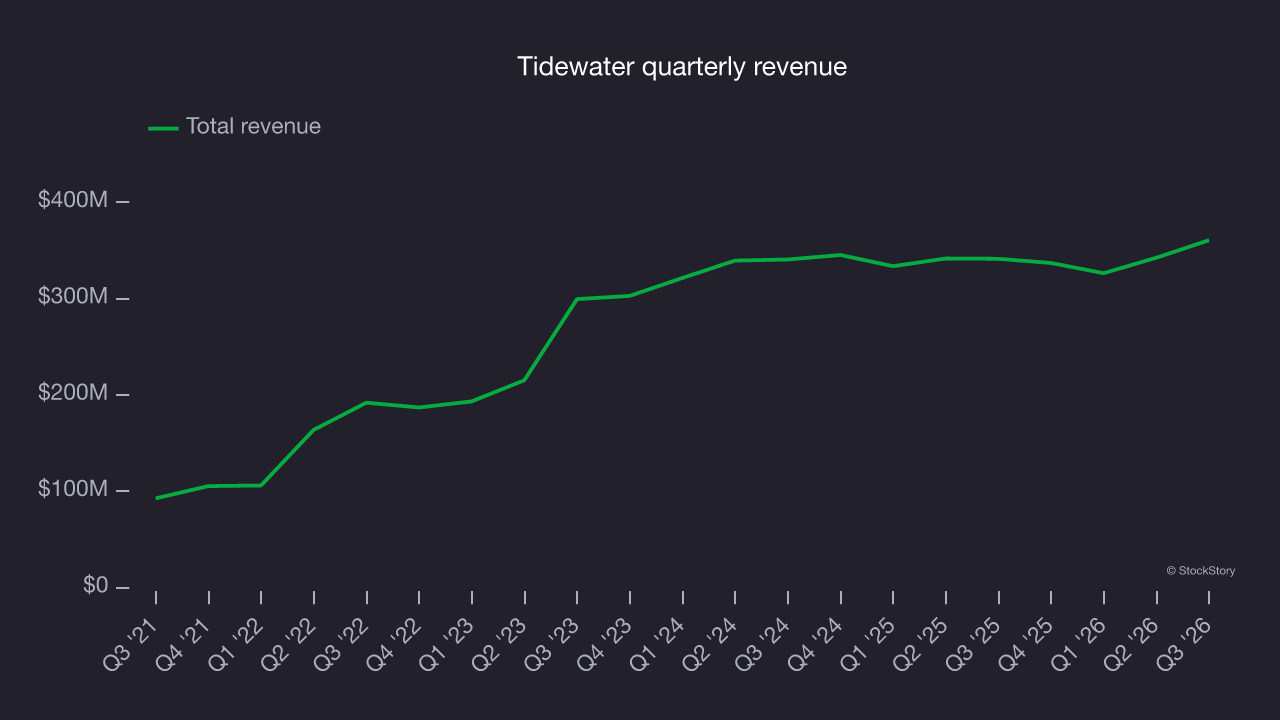
Energy cycles can be long enough that a single five-year period can still reflect one price environment, which is why an additional, decade-long view can help capture through-cycle performance. Tidewater’s annualized revenue growth of 6.7% over the last ten years is below its five-year trend, but the results still suggest decent demand.
This quarter, Tidewater reported year-on-year revenue growth of 5.7%, and its $360.4 million of revenue exceeded Wall Street’s consensus estimates by 2%.
Adjusted EBITDA margin
Tidewater has done a decent job managing its cost base over the last five years. The company has produced an average EBITDA margin of 35.9%, higher than the broader energy upstream and integrated energy sector.
Looking at the trend in its profitability, Tidewater’s EBITDA margin rose by 24.9 percentage points over the last year, as its revenue growth provided operating leverage.
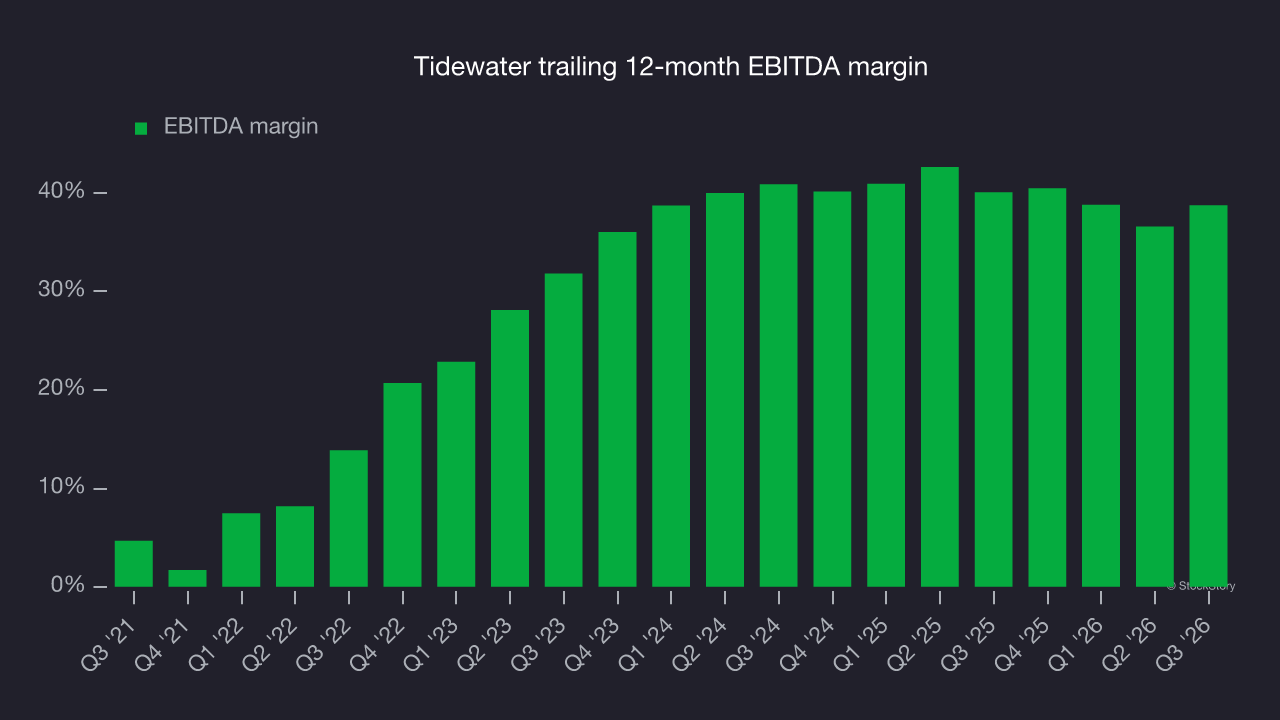
In Q3, Tidewater generated an EBITDA profit margin of 38.9%, up 8.6 percentage points year on year. The increase was a positive sign of improved efficiency. Adjusted EBITDA beat Wall Street’s consensus estimates by 6.5%.
Free cash flow
Adjusted EBITDA shows how profitable a company’s existing wells are before financing and reinvestment decisions, but free cash flow shows how much value remains after paying the cost of replacing those wells. In upstream energy, production naturally declines over time, so companies must continuously reinvest just to stand still. A producer can report strong EBITDA margins yet generate little or no free cash flow if its wells decline quickly or if new drilling is expensive. Free cash flow therefore captures not only how efficiently a company produces hydrocarbons today, but also how costly it is to sustain that production into the future.
Tidewater has shown strong cash profitability, giving it an edge over its competitors and the ability to reinvest or return capital to investors. The company’s free cash flow margin averaged 15.2% over the last five years, a high level for an upstream and integrated energy business.
The level of free cash flow is important, but its durability across cycles is just as critical. Consistent margins are far more valuable than volatile swings driven by commodity prices.
Tidewater’s ratio of quarterly free cash flow volatility to West Texas Intermediate, or WTI, crude price volatility over the past five years was 6.7 (lower is better), indicating strong insulation from commodity swings. This indicates that its cash generation is relatively insulated from swings in commodity prices compared with most peers. This resilience supports access to capital in downturns and positions the company to act as a consolidator when distressed assets come to market at attractive prices.
Why assess stability against commodity prices using free cash flow rather than comparing revenue or EBITDA to WTI in Tidewater’s case? What ultimately matters is not how much revenue or profit a company earns when prices are high but how much cash it can generate when prices are low. Free cash flow is the superior metric because it includes everything from hedging effectiveness to growth and maintenance capex to management behavior during good times and bad.
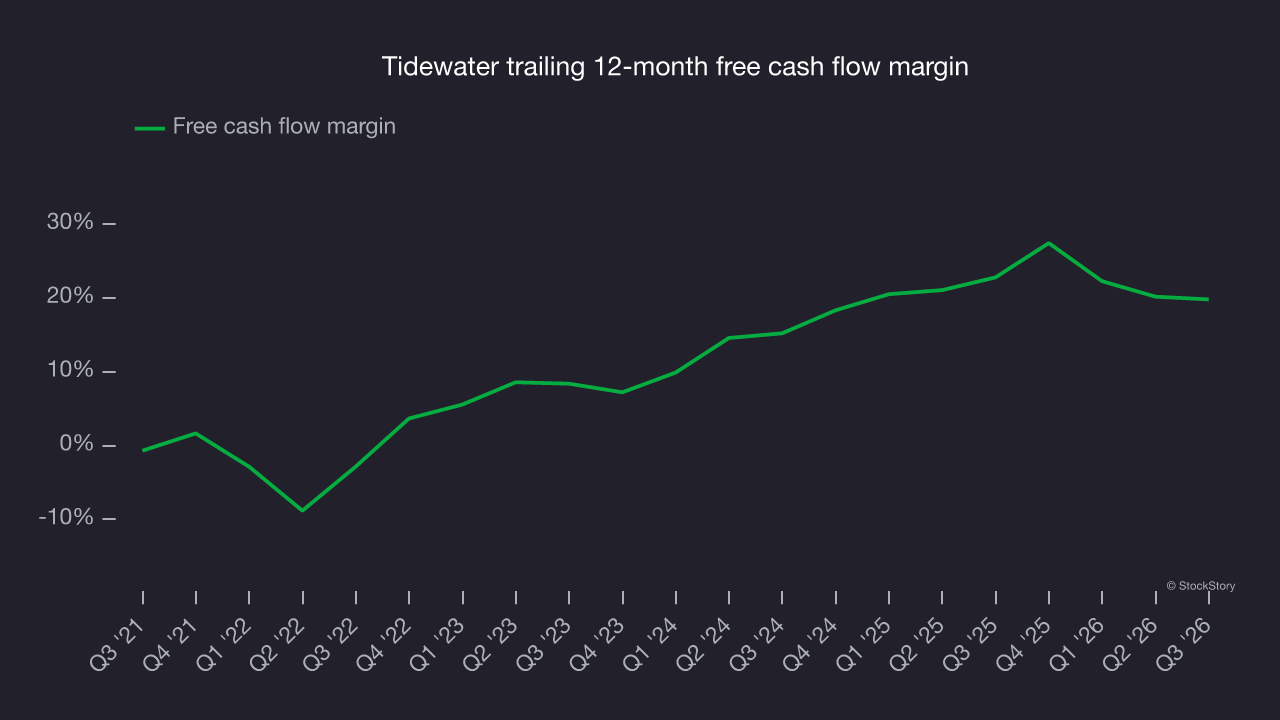
Tidewater’s free cash flow came in at $65.84 million in Q3, equivalent to an 18.3% margin. The company’s cash profitability declined by 1.4 percentage points from the same quarter last year, but it’s still above its five-year average. One quarter’s decline should not carry too much weight because investment needs can be seasonal, causing short-term swings. Long-term trends are more important.
Key takeaways from Tidewater’s Q3 results
Tidewater’s Q3 results were mixed: Revenue beat analysts’ consensus estimates and EBITDA topped Wall Street’s consensus, but EPS missed expectations. Shares remained flat at $71.06 immediately after the release.
The latest quarter matters when deciding whether to invest in Tidewater, but longer-term business quality and valuation matter more. Read our full research report here (it’s free).