


EN
Enphase and Other Solar Stocks Are Up After Democrats Sweep Congress, But I Wouldn’t Chase ENPH Here
U.S. stocks rose sharply on Nov. 4 after midterm election results put Democrats on track to control both chambers of Congress. The S&P 500 ($SPX) gained 1.6%, its best day in three months, while the Dow Jones Industrial Average ($DOWI) added 3% and the Nasdaq Composite ($IUXX) rose 1.4%.
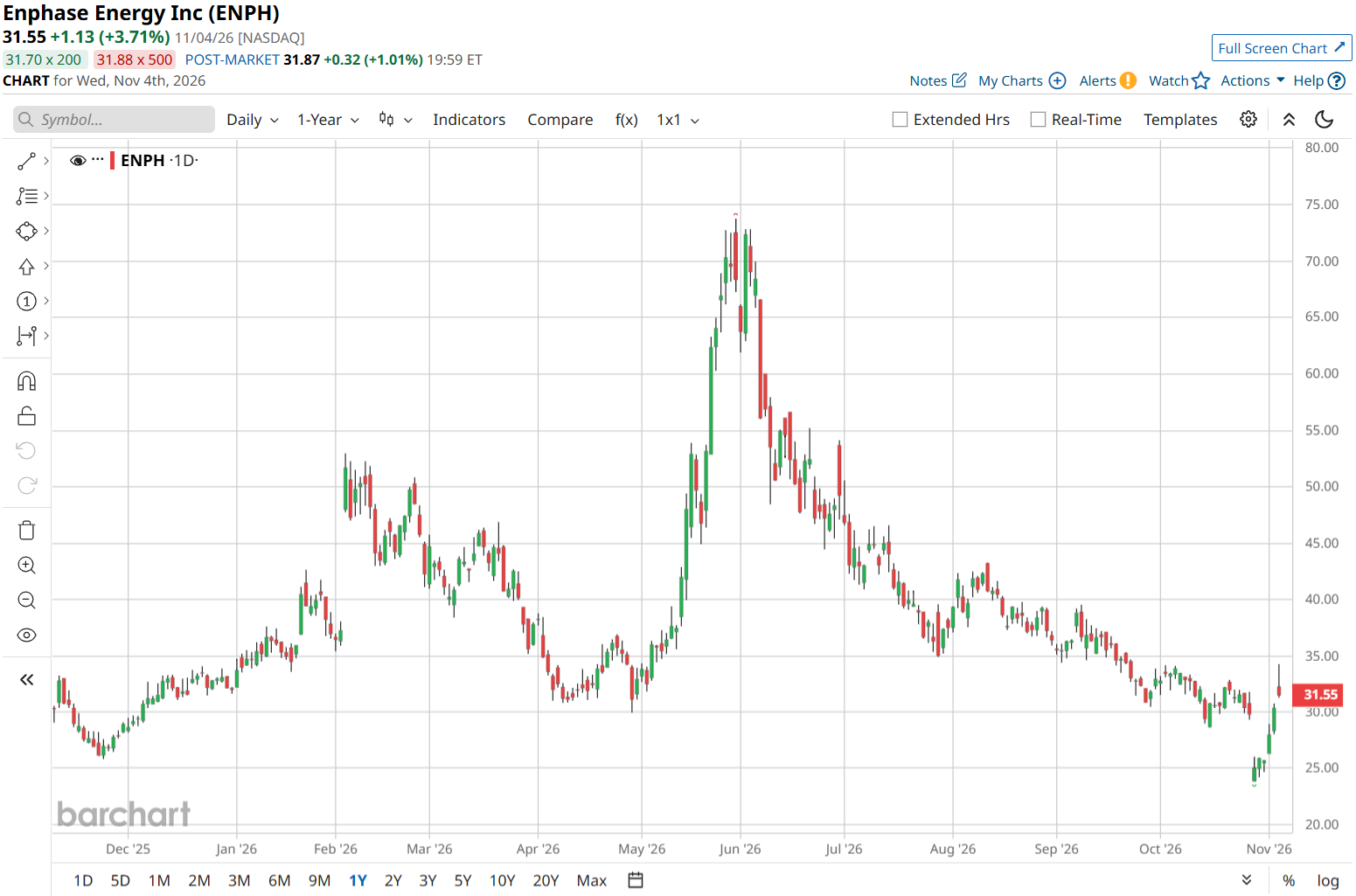
Solar stocks climbed as well, even as Brent crude fell 8.7% to $94.62. Cheaper oil can make switching to renewable energy less appealing, but investors are focused on hopes that a Democrat-led Congress will be more supportive of the solar and wind industries. First Solar (FSLR) gained 4.6% on Nov. 4, while Enphase Energy (ENPH) rose 3.7%.
For Enphase, the rally offers some relief after a disappointing earnings report. Third-quarter revenue fell more than 28% from a year earlier to $293.3 million. The solar microinverter and battery-storage company also forecast Q4 revenue of $225 million to $255 million, below analysts’ $298.6 million estimate.
Still, CEO Badri Kothandaraman bought 10,000 ENPH shares through a trust on Nov. 2, spending about $267,514 at a weighted average price of roughly $26.75. His purchase adds a vote of confidence after the earnings selloff. But with sales still falling, is the political boost enough to make ENPH stock a buy? Let’s find out.
The Policy Bets Behind Solar's Rally
Solar stocks rose after Democrats won control of the House and Senate, securing 54 Senate seats and a clear House majority, with some races still undecided. That ends Republicans’ control of Washington and gives Democrats a way to push back on President Donald Trump’s agenda. Investors are betting the shift could help solar and wind companies.
There’s a reason for that optimism. The Republican-backed One Big Beautiful Bill Act cut clean-energy incentives and ended the residential solar tax credit after 2025. Enphase has pointed to the expired incentive and high borrowing costs as obstacles to demand. Investors now hope Democrats will push to restore support, making solar installations more affordable and helping equipment suppliers win more business.
But a change in Congress does not mean those incentives are coming back soon. Democrats still face Senate voting hurdles and a Republican president who can block legislation. Pictet Asset Management Chief Strategist Luca Paolini expects little meaningful policy change in the near term. For now, the rally looks more like a bet on hope than evidence that Enphase Energy’s sales are about to recover.
The Business Behind the Enphase Stock Rally
Enphase Energy had a tough Q3. The company's Oct. 27 earnings report showed that revenue fell more than 28% year-over-year (YOY) to $293.3 million. Adjusted EPS was $0.41, down from $0.90 a year ago and short of the $0.50 forecast. U.S. revenue rose about 3%, while European revenue fell roughly 11%.
Management also forecast Q4 revenue of $225 million to $255 million, well below Wall Street’s $298.6 million estimate. Shares fell 16% the next day.
Those results weighed on the stock before the election, leaving ENPH stock down 32% over the previous 52 weeks and 22% year-to-date (YTD) as of Oct. 31. With the recent rally, however, ENPH stock is down just 2% over the past year and down 8% YTD.
Enphase Energy is also looking beyond rooftop solar for growth. On Oct. 26, the company announced a partnership with Infineon Technologies (IFNNY) to use what the companies call “the world’s first 900 V gallium nitride (GaN) monolithic bidirectional switch (BDS) devices.” A day later, Enphase demonstrated its IQ Solid-State Transformer, converting 13.8 kV AC directly to 800 VDC to supply AI data centers more efficiently. Full-system rack demonstrations are planned before year-end, followed by customer pilots in 2027. Management sees a potential $1 billion annual revenue opportunity by 2030. That effort joins other growth plans, including the IQ Battery G5 and Propel prepaid lease program, but it remains a longer-term bet rather than a quick fix for weak solar demand.
Wall Street’s Case for Further Gains
Enphase Energy's next earnings release is scheduled for Feb. 2, 2027. Analysts expect a December-quarter loss of $0.02 per share, compared with a $0.33 profit a year earlier, marking a 106% YOY decline. For full-year 2026, analysts expect EPS of $0.34, down 78% from $1.53 a year ago.
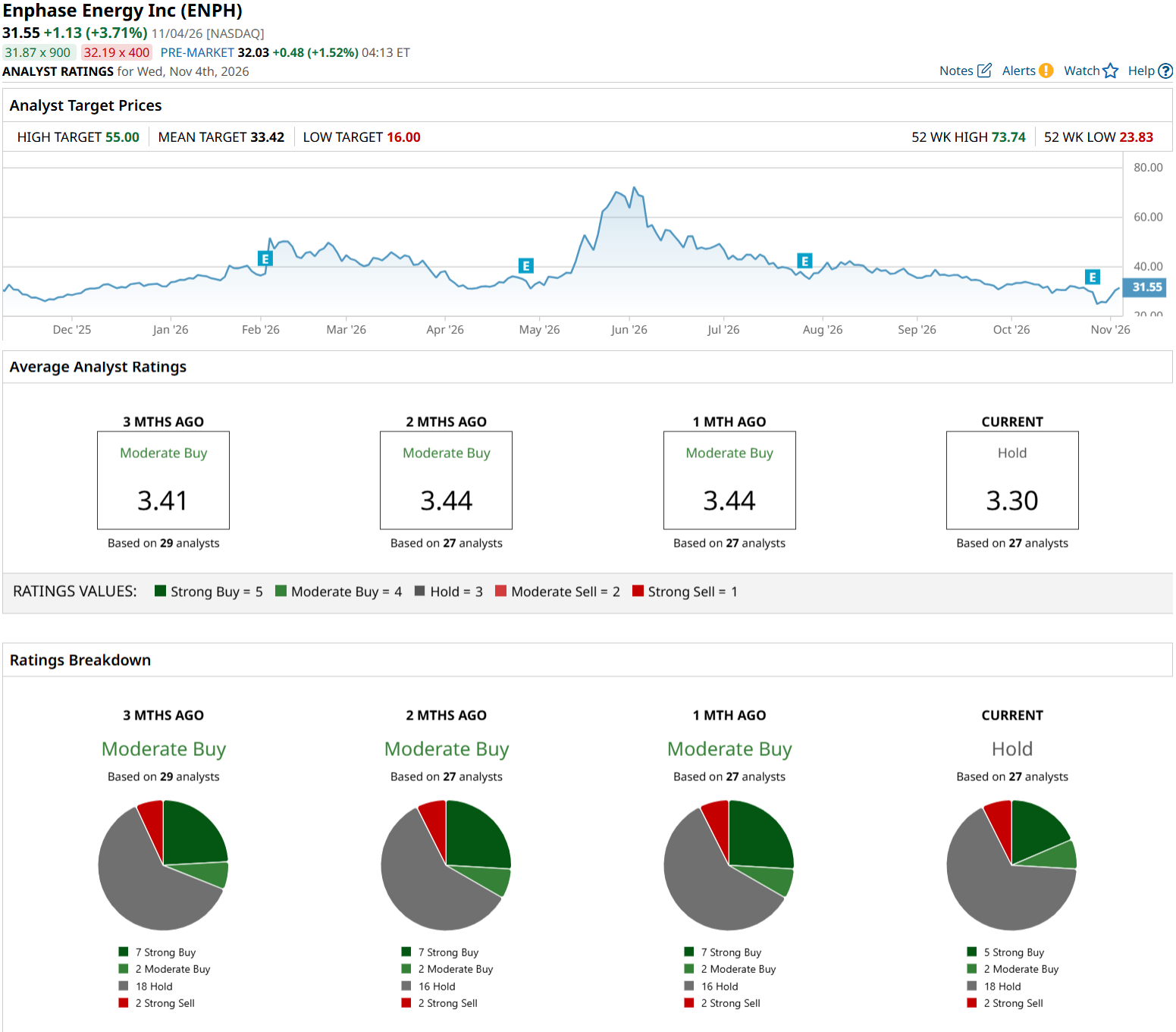
That weak outlook helps explain the cautious analyst calls. JPMorgan Chase analyst Mark Strouse recently cut his price target to $29 from $35, keeping a “Neutral” rating. The analyst cited weaker economic conditions across Enphase’s markets and distributor shipment cuts ahead of Q1. Oppenheimer went further, lowering its rating to “Perform” from “Outperform” and dropping its price target because a recovery in the core business is “not materializing.”
Overall, ENPH stock has a consensus “Hold” rating across 27 analysts with coverage. The average price target of $33.42 suggests potential upside of about 14% from current levels.
Conclusion
ENPH stock looks more like a hold than a name to chase after an election bounce. New buyers should wait for clearer evidence that demand is stabilizing, while existing shareholders have reason to stay cautious rather than add aggressively. Political optimism helps sentiment, but it does not erase falling revenue or disappointing guidance. While the CEO’s recent share purchase is encouraging, it is no guarantee of a turnaround. For the near term, I expect volatile trading with a downward bias as earnings concerns regain attention. A sustained climb likely needs better business results, not just a more favorable balance of power in Washington.
On the date of publication, Ebube Jones did not directly have a position in any of the securities mentioned in this article. All information and data in this article is solely for informational purposes. For more information please view the Barchart Disclosure Policy here.