


EN
Polaris (PII) Returns To Profit, Is It Still A Bargain?
Polaris stock: earnings return to profit and a new racing flagship
Polaris (PII) is back in the black. The powersports maker swung to a third quarter profit and paired that financial update with the launch of its RZR Pro R Factory Boost racing machine.
The earnings rebound and fresh RZR Pro R Factory Boost launch come after a sharp 22.23% 1 month share price return, even though the 90 day share price return is down 10.02% and the 5 year total shareholder return is down 40.34%. Recent momentum looks short term and fragile, which suggests the latest product and racing news is nudging sentiment rather than transforming Polaris’ longer run track record yet.
Scan beyond Polaris to see how other powersports and consumer durables players stack up in our hand-picked 40 high quality undervalued stocks with solid cash flows and balance sheets.
Polaris has just jumped 22% in a month, yet the share price still sits below both analyst targets and some intrinsic value estimates. Where does fair value really land between those goalposts after this rebound?
Most Popular Narrative: 8% Undervalued
On the analyst consensus Narrative on Simply Wall St, Polaris is framed as undervalued, with a fair value estimate of $68.73 against the latest close at $63.07. This comparison puts the recent rebound in a more modest light.
Analysts are assuming Polaris's revenue will grow by 2.3% annually over the next 3 years. Analysts assume that profit margins will increase from -3.5% today to 5.1% in 3 years time.
See why 34 investors see Polaris as 8% undervalued.
Result: Fair Value of $68.73 (UNDERVALUED)
Still, the Polaris narrative can unravel if high interest rates keep big ticket powersports buyers on the sidelines, or if commodity costs squeeze those forecast margin gains.
Find out about the key risks to this Polaris narrative.
Polaris valuation check: a different lens
The Simply Wall St DCF model presents a cooler picture of Polaris compared with the analyst fair value narrative. On this view, PII at $63.07 trades above an estimated future cash flow value of $53.57, which implies the shares screen as overvalued rather than undervalued.
DCF work can be sensitive to long term margin and discount rate assumptions, so the gap between the $68.73 analyst fair value and a $53.57 cash flow estimate raises a simple question: Which set of expectations do you trust more when real money is on the line?
Look into how the SWS DCF model arrives at its fair value.
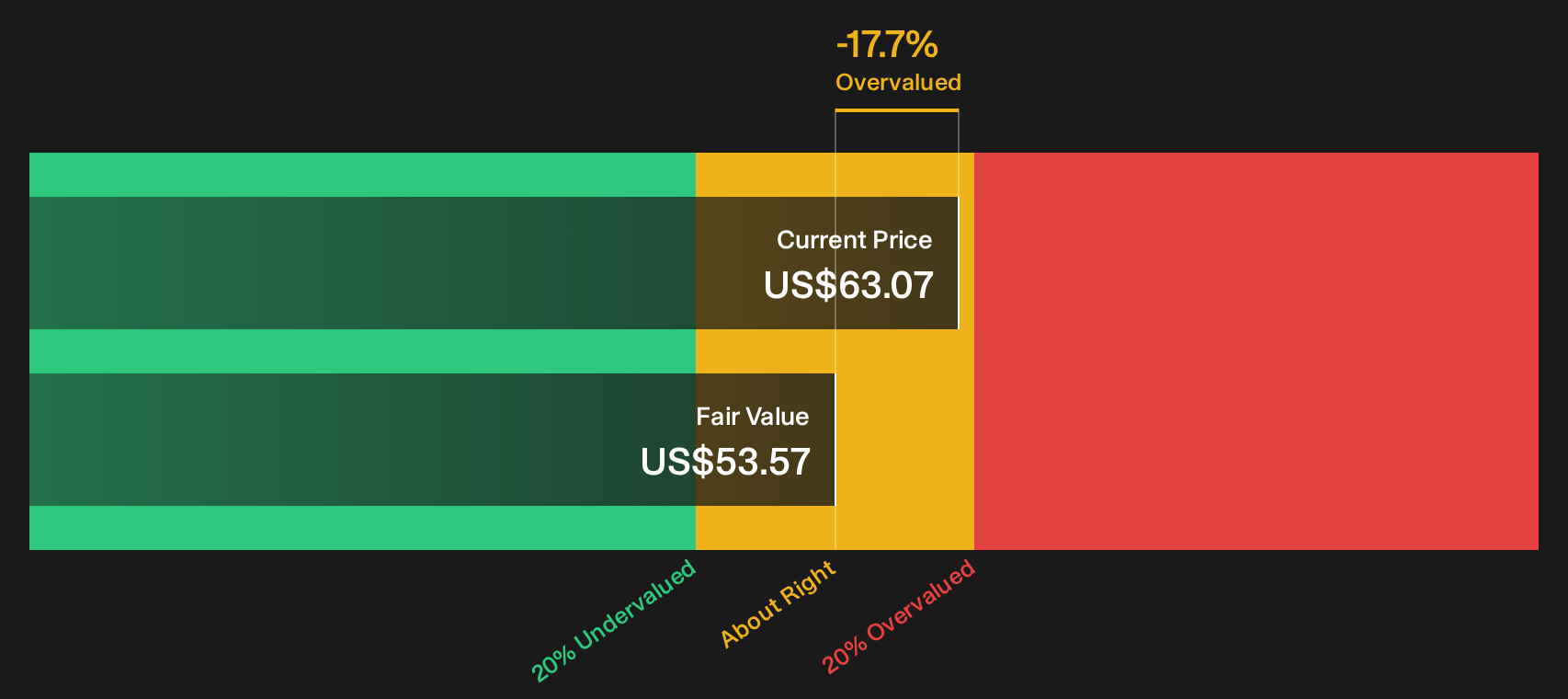
Simply Wall St performs a discounted cash flow (DCF) on every stock in the world every day (check out Polaris for example). We show the entire calculation in full. You can track the result in your watchlist or portfolio and be alerted when this changes, or use our stock screener to discover 40 high quality undervalued stocks. If you save a screener we even alert you when new companies match - so you never miss a potential opportunity.
Next Steps
Mixed signals around Polaris can be confusing, so trust the data and move quickly to test the downside risk against the upside potential with 2 key rewards and 2 important warning signs
Looking for more Polaris investment ideas?
Polaris is only one piece of your portfolio puzzle, and casting a wider net with curated screeners can reveal opportunities you might otherwise overlook.
- Target steadier candidates by reviewing a 31 resilient stocks with low risk scores that filters for resilient businesses with lower overall risk profiles.
- Hunt for potential bargains by scanning a 19 high quality undiscovered gems that surfaces companies with strong fundamentals that many investors may be missing.
- Strengthen your core holdings by using a list of solid balance sheet and fundamentals (25 results) that focuses on businesses with healthier financial foundations.
Have feedback on this article? Concerned about the content? Get in touch with us directly. Alternatively, email editorial-team@simplywallst.com