


EN
SpaceX Stock Is Down More Than 13% in the Past Month. How to Play the Selloff Here.
The stock market rarely moves in a straight line. Just when a stock seems unstoppable, a mix of geopolitical tensions, political uncertainty, AI spending worries, or plain old profit-taking can quickly change the mood on Wall Street. SpaceX (SPCX) has experienced that shift.
After an exceptionally enthusiastic IPO debut in June 2026, the Elon Musk-led space giant quickly captured Wall Street's imagination, with its valuation soaring past $2.6 trillion at its June highs. However, the excitement has since given way to a rather uncomfortable reality.
SpaceX’s shares have plunged 13% over the past month, wiping out hundreds of billions of dollars in market value. The selloff gained momentum following an Oct. 22 share lockup expiration, concerns surrounding Starlink’s operations in Ukraine, and broader technology-sector weakness. More recently, Democrats’ sweeping midterm victories have added another layer of uncertainty, with investors bracing for tougher scrutiny of Musk’s government contracts and AI ambitions.
So, with SPCX now under considerable pressure, is this selloff an opportunity to consider, or a warning to stay on the sidelines?
About SpaceX Stock
Founded in 2002 and headquartered in Starbase, Texas, SpaceX operates across space transportation, satellite communications, and artificial intelligence (AI). Its reusable Falcon rockets and Dragon spacecraft have reshaped the economics of spaceflight, while Starship is designed to take exploration deeper into space. Starlink has also grown into a global satellite-broadband business serving consumers, enterprises, and governments.
After expanding into AI through xAI, SpaceX now has Cursor under its wings, adding a leading AI coding platform to its growing technology ecosystem. Together, these businesses give SpaceX several long-term growth engines beyond rockets. Its market capitalization currently stands at around $1.8 trillion.
SpaceX may be firing on all cylinders as a business, but its stock performance has been a different story. Since going public on June 12 at $135 per share, SPCX initially enjoyed a spectacular run, quickly climbing above $200 and hitting a record high of $225.64 within its first three trading sessions. However, the excitement did not last long. Concerns about its expensive valuation soon caught up with the stock, sending it tumbling to an all-time low of $104.83 on Aug. 3.
The shares later recovered as investors looked ahead to the company’s first public earnings report, but strong business growth was not enough to keep Wall Street happy. Investors instead focused on SpaceX’s enormous AI spending plans, triggering another sharp pullback. More recently, worries about its capital requirements, potential share dilution, and Musk’s suggestion of a possible Tesla merger have added to the uncertainty.
Its telecom ambitions have also faced some roadblocks. On Oct. 28, T-Mobile (TMUS) CEO Srini Gopalan pushed back against a proposed arrangement that would help SpaceX compete more directly in mobile services, although the existing Starlink partnership remains intact.
Then there’s the political uncertainty, which added another wrinkle. Musk reportedly spent around $450 million backing Republican candidates and causes during the midterms, but the results did not go as planned, with most Musk-backed candidates losing. The outcome rattled investors, sending SpaceX's shares lower amid concerns about potential political backlash and increased scrutiny of Musk’s business interests and government contracts.
But there have been some brighter moments, too. SPCX jumped 8.6% after Musk offered an upbeat revenue outlook, pointing to a faster shift toward commercial and AI-driven business. A broader tech-stock recovery also helped sentiment. Despite the recent turbulence, SPCX remains up roughly 6% over the past three months.
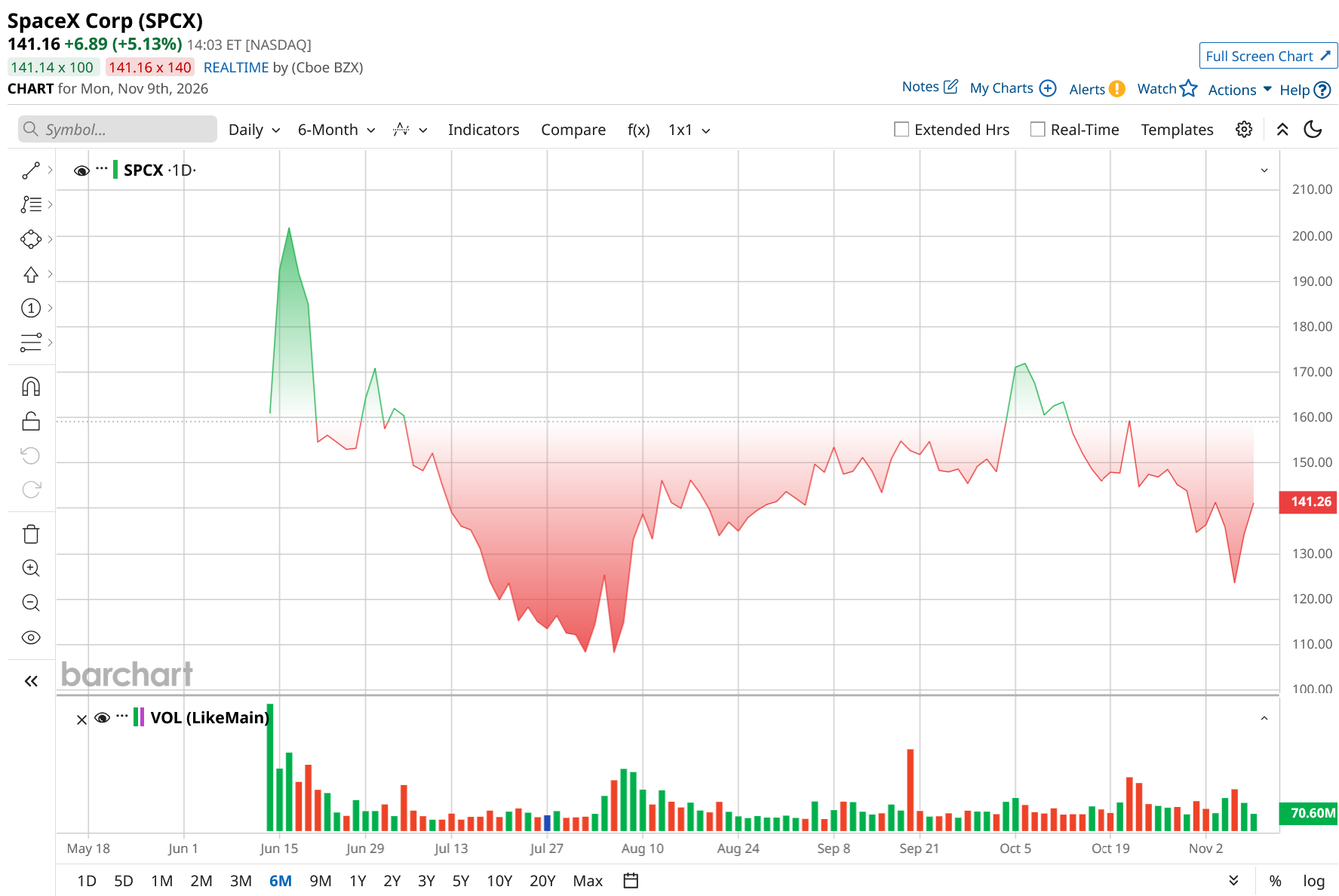
SPCX stock is hardly cheap at current levels. It trades at 577.4 times forward earnings and 37.3 times forward sales, suggesting investors are paying a hefty premium for its future growth potential. Clearly, the valuation reflects much more than SpaceX's current business, with Wall Street banking heavily on its ambitious AI infrastructure and space exploration plans.
A Closer Look at Q3 Numbers and Outlook
SpaceX released its third-quarter earnings report on Oct. 20, and the Elon Musk-led company reported a remarkable 161% year-over-year (YoY) jump in revenue to $14.6 billion, comfortably beating Wall Street’s expectations. Even more impressive, SpaceX went from having a loss of -$1.1 billion in the year-ago quarter to making a profit of $4.4 billion, or $0.35 per share. That was more than twice what analysts had expected.
But the biggest growth driver was not Starlink or its rocket business. It was AI. SpaceX has renamed its AI division “Super Intelligence,” bringing together its computing infrastructure, AI models, and software operations. The division generated $7.6 billion in revenue in the third quarter, an astonishing 830% YoY jump. In fact, it contributed more than half of SpaceX’s total revenue, moving ahead of Starlink’s $5.2 billion connectivity business.
This marks a significant shift in how investors should look at SpaceX. The company is no longer just about getting rockets into orbit or building a global satellite network. It is increasingly positioning itself as a major player in AI infrastructure, with massive data centers designed to provide the computing power needed to train and run advanced AI models. By the end of September, SpaceX had 1.7 gigawatts of computing capacity. And according to Musk, demand is hardly a problem. He said companies ranging from major hyperscalers to smaller businesses were regularly approaching SpaceX for more computing resources. Demand is reportedly strong enough that the company could rent out its available capacity several times over.
SpaceX is also using this infrastructure to support its own AI ambitions, including products such as Grok and the Cursor coding platform it acquired. However, building out this business is anything but cheap. The company spent $19.6 billion on capital expenditures during the quarter, more than twice its $8.8 billion in adjusted EBITDA. The Super Intelligence division alone accounted for $16.4 billion of that spending. And Musk is not thinking small. He has discussed expanding computing capacity to 13 gigawatts by the end of 2027, although that remains an ambitious target rather than a guaranteed outcome.
Meanwhile, Starlink continues to do plenty of heavy lifting. Its connectivity business generated $5.2 billion in revenue, up 69% YoY, and had 13.6 million consumer subscribers at the end of September. SpaceX is also looking to push further into the U.S. mobile market. Its spectrum acquisition plans and regulatory approval for a proposed 15,000-satellite constellation could give Starlink additional room to expand its connectivity services and reach more customers.
Management also sounded upbeat about what lies ahead. CFO Bret Johnsen projected Q1 2027 revenue of $33 billion to $37 billion, comfortably above Wall Street’s average estimate. He pointed to better visibility into the company’s computing contract pipeline over the next six months, suggesting that demand for its AI infrastructure could remain strong. Musk went a step further, suggesting SpaceX could reach $500 billion to $1 trillion in annual recurring revenue by the end of 2027. That’s an enormous ambition, especially when compared with what analysts currently expect, so investors may want to take that target with a healthy dose of caution.
For now, Wall Street’s estimates paint a more measured picture. Analysts expect fourth-quarter revenue of approximately $22.9 billion and EPS of $0.30. For fiscal 2026, consensus EPS stands at roughly $0.19. However, the outlook improves considerably in fiscal 2027, when analysts expect EPS to jump significantly YoY to $4.10. SpaceX has plenty of growth opportunities ahead, but its enormous AI spending and ambitious expansion plans also leave investors with plenty to think about.
What’s Wall Street’s Take on SPCX Stock Now?
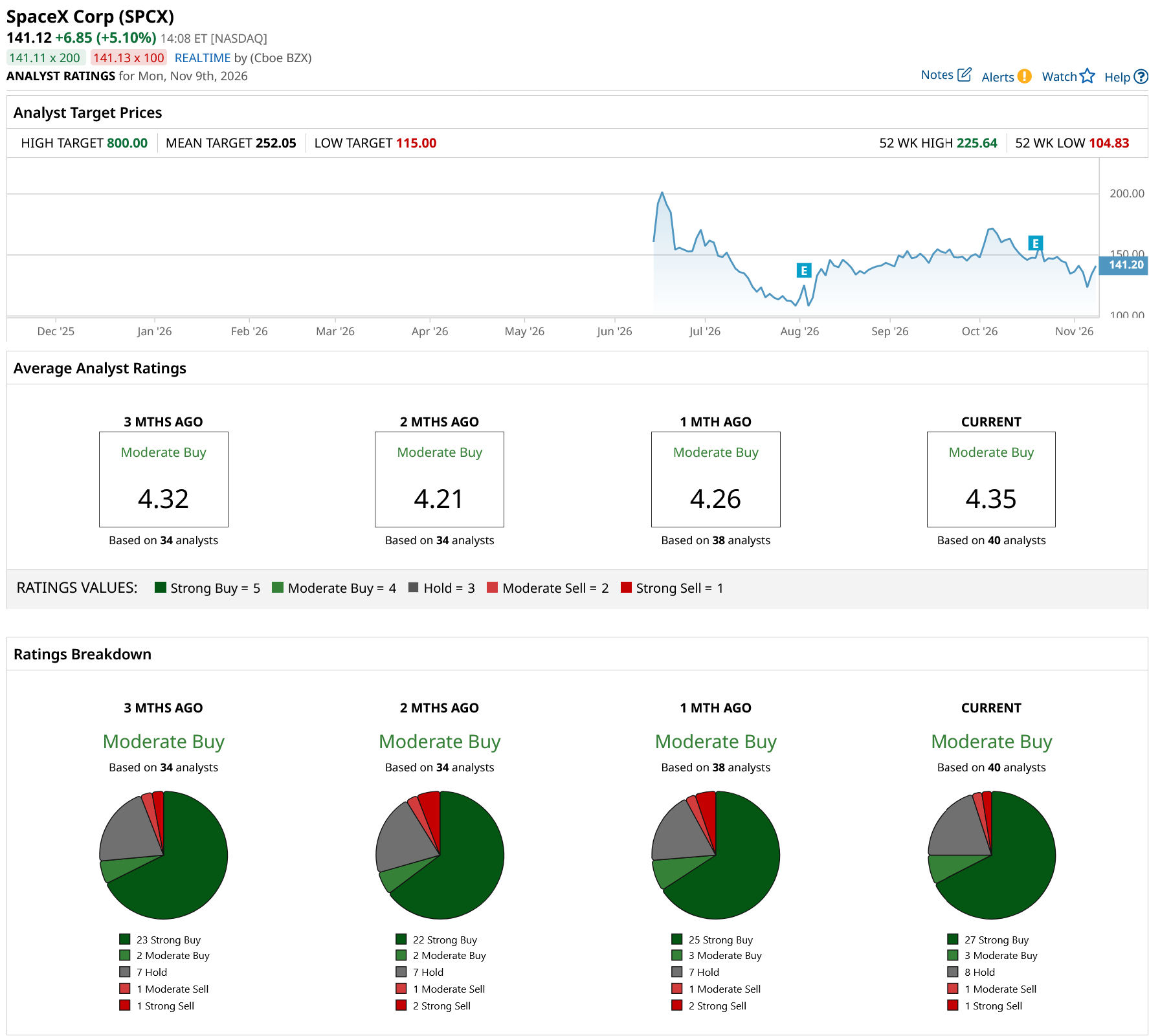
Overall, SPCX stock carries a “Moderate Buy” rating. Of the 40 analysts covering the stock, 27 recommend a “Strong Buy,” three have a “Moderate Buy,” eight are playing it safe with a “Hold,” one is advising a “Moderate Sell,” and the remaining one analyst is outright skeptical, suggesting a “Strong Sell.”
At current levels, the average price target of $252.05 suggests that SPCX stock has an upside potential of 79%. Meanwhile, the Street’s highest price target of $800 implies SPCX could rally as much as 467%.
On the date of publication, Sristi Suman Jayaswal did not directly have a position in any of the securities mentioned in this article. All information and data in this article is solely for informational purposes. For more information please view the Barchart Disclosure Policy here.