


EN
Warren Buffett’s Successor Is Doubling Down on Berkshire Hathaway Stock. You Probably Shouldn’t
Berkshire Hathaway (BRK.A) (BRK.B) released its Q3 2026 earnings over the weekend. The company’s operating income, which is the earnings it gets from its multiple wholly-owned businesses, fell year-over-year (YoY) in the quarter and fell short of estimates. Meanwhile, the conglomerate, which also has a sprawling portfolio of publicly traded companies and counts Apple (AAPL) and Alphabet (GOOG) (GOOGL) among its top five holdings, doubled down on share repurchases, spending $9.6 billion on buybacks.
Berkshire Has Doubled Down on Buybacks
Notably, Berkshire did not repurchase any shares for five consecutive quarters, stretching up to Q4 2025, which was incidentally the last quarter under Warren Buffett’s leadership. The “Oracle of Omaha” was succeeded by Greg Abel, and under his watch the company recommenced repurchases, starting with $235 million in Q1, raising it to $4.5 billion the next quarter.
It would also be pertinent to look at Berkshire’s buyback policy. Until 2018, it used to repurchase shares only as long as they were up to 1.2x of the book value, but subsequently, the company made the policy flexible, giving more discretion to Buffett to buy back the shares. Now, the buyback policy calls for the CEO to consult the chairman, a post that now rests with Howard Buffett.
Meanwhile, even as Berkshire increased the pace of share buybacks to a multi-quarter high, it was a net seller of stocks in Q3, which means it sold more stocks than it bought. Berkshire holds massive cash on its balance sheet and has often been starved for deployment options. It held around $357 billion in cash at the end of September after adjusting for unsettled Treasury bills. While that number has come off its record highs, thanks to the Q2 buying spree and the surge in buybacks, it is comparable to the total value of publicly traded stocks the company holds.
Outperformed Over the Last Month
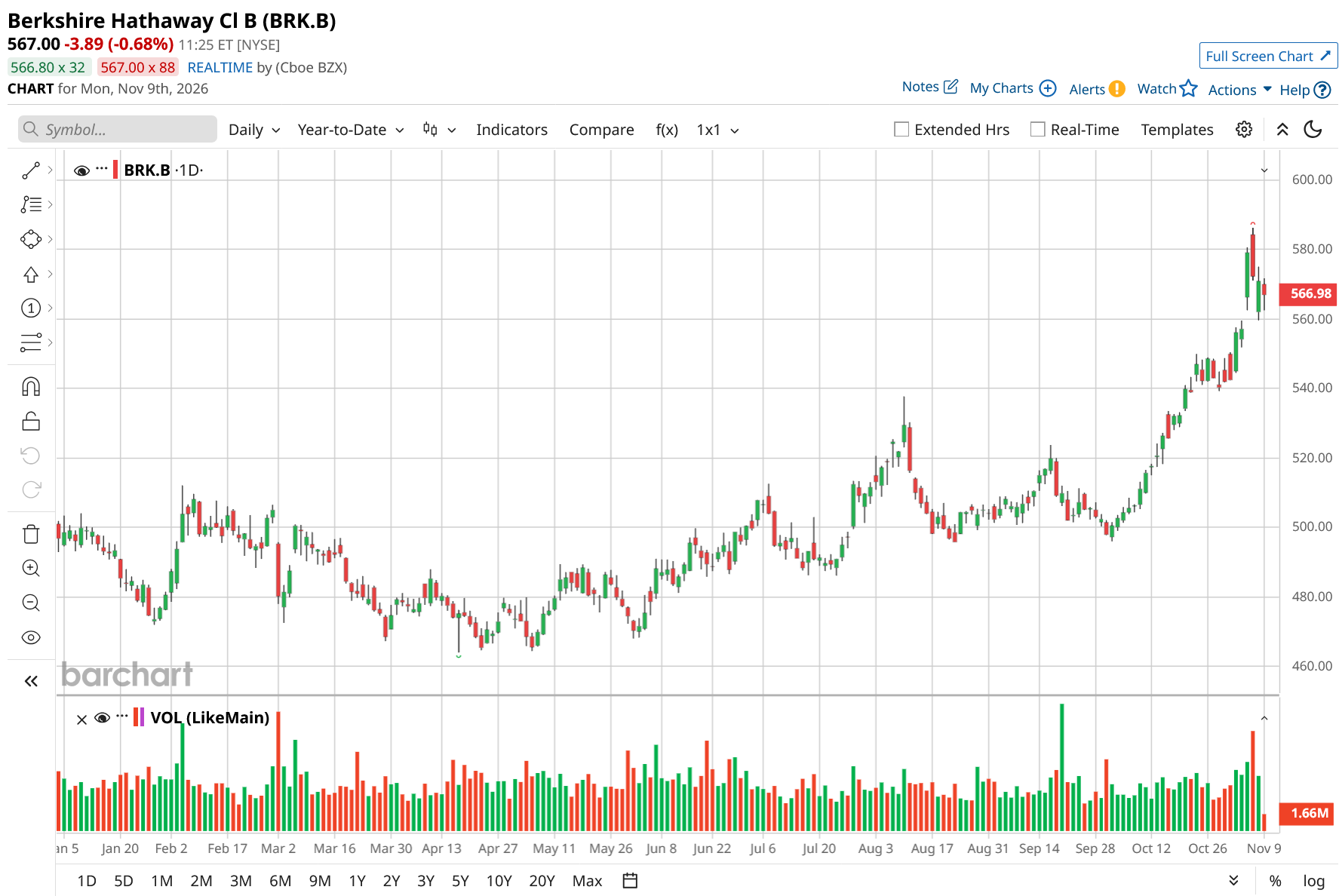
While tech stocks have looked shaky amid growing apprehensions over the artificial intelligence (AI) trade, and the Nasdaq Composite ($NASX) entered the correction territory, Berkshire shares have outperformed, gaining nearly 10% over the last month. In my previous article, I noted that while Berkshire could close the year higher than where it then traded, investors shouldn’t expect fireworks in the back half of the year.
However, weakness in AI trade has led to a rotation into other names, including Berkshire. The stock is considered a relative safe haven given how conservatively the business has been historically run under Buffett and now deceased Charlie Munger.
The company has a massive cash pile, and Abel has plenty of dry powder to play around with if markets fall meaningfully. He has also shown an inclination to buy tech shares, and Berkshire has gradually increased its stake in Alphabet under his leadership. On that note, Buffett admitted that it was he who initiated the position last year.
How to Play BRK.B Stock?
Despite owning AI names like Alphabet, Berkshire is among the “anti-AI” plays. Its defensive nature would also be in play as investors get wary of the macro turmoil and seek safety. However, after the recent rally, I find it difficult to build a case for buying BRK.B stock even though the company signaled confidence in its valuations by aggressively repurchasing shares last quarter.
Valuing a conglomerate like Berkshire can be perplexing given the various moving parts. Moreover, the company’s accounting earnings tend to be skewed as they capture mark-to-market gains and losses on its portfolio of publicly traded securities. Price-to-book value is, however, a good yardstick; no wonder the company had it as a benchmark for buybacks until a few years back.
Berkshire’s price-to-book value multiple has expanded to 1.63x times. The multiple peaked at around 1.8 times last year and is now towards the upper end of its historical range. With Berkshire losing the “Buffett premium” that was a key driver of its valuations, I find the current multiples to be a bit stretched, albeit not exorbitant yet. Overall, I would steer clear of Berkshire stock at these levels and wait for a better entry point, as the margin of safety—a concept Buffett popularized—is not compelling here.
On the date of publication, Mohit Oberoi had a position in: GOOG . All information and data in this article is solely for informational purposes. For more information please view the Barchart Disclosure Policy here.