


EN
AST SpaceMobile Is Gunning for Space, and a New Space Force Win Could Be the Fuel ASTS Stock Needs
Valued at a market cap of $9.7 billion, AST SpaceMobile (ASTS) designs and develops the constellation of BlueBird satellites in the United States.
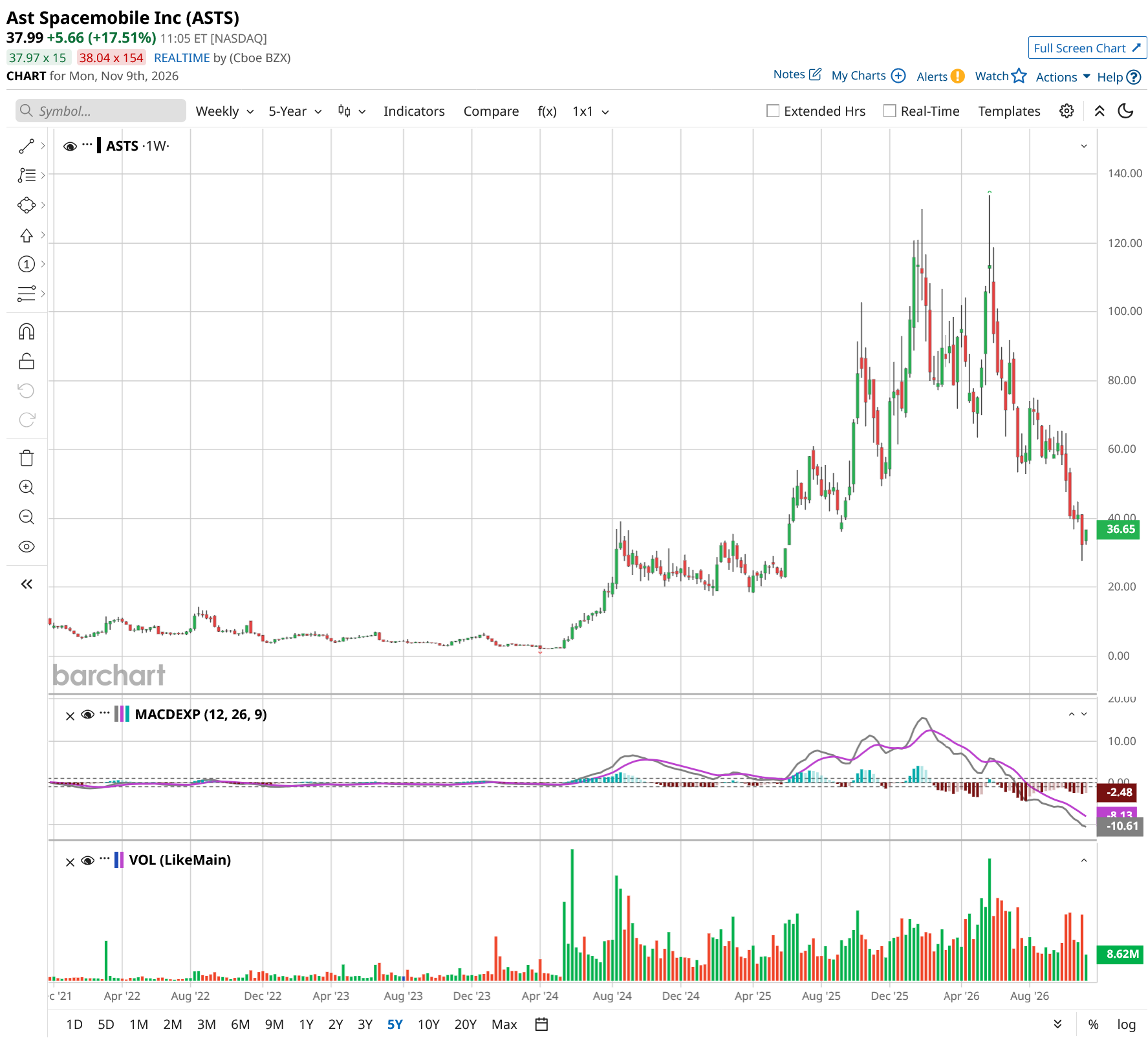
The company provides a cellular broadband network in space to be accessible directly by smartphones for commercial use and other applications. Its SpaceMobile service provides cellular broadband services to end-users who are out of terrestrial cellular coverage. Despite a sizable rally Monday morning, the space-tech stock is still down 76% from all-time highs and flat year-to-date (YTD), grossly underperforming the broader markets.
How AST SpaceMobile Plans to Bring Broadband to Your Phone
The company’s BlueBird satellite carries a giant antenna of about 2,400 square feet. AST says these are the largest phased arrays ever placed in low Earth orbit. The goal is to provide services for standard, unmodified smartphones, so users would not need any special equipment. Nearly 6 billion mobile phones are in use, yet many people still lose service regularly.
AST works with carriers, and management said it has more than 60 mobile network operator partners covering over 3 billion subscribers. AT&T (T), Verizon (VZ), Vodafone (VOD), and Rakuten (RKUNY) are on the list. So far, 13 spacecraft are in orbit, while beta service is targeted for later in 2026, and commercial service could begin with as few as 45 satellites.
Gets a Seat at the Space Force Table
According to a company statement, AST will support STR, the prime contractor, under a U.S. Space Force contract. It aims to advance sensing capabilities using AST's commercial space technology, and the government program is meant to test commercial ideas for national security.
AST says it has worked with STR on related efforts before, building on its experience operating technology in space. Chris Ivory, CEO of AST SpaceMobile Defense, pointed to the hardware. He cited “the largest phased array ever deployed in low Earth orbit.”
AST SpaceMobile is gaining traction among government clients. On the Q2 call, President Scott Wisniewski said AST won three new government contracts, the funded value of which topped $100 million.
Wisniewski said radar accounts for most of the company’s U.S. government sales, while CEO Abel Avellan added that radar work uses government spectrum.
Why AST SpaceMobile Wants Its Own Rocket
AST already builds its own satellites, and now it wants its own ride to space. Avellan says a company-owned rocket will give it “regular unconstrained access to orbit.” Named Blacklift, the 20-ton rocket will be reusable and carry up to five BlueBirds per launch. It will use Miranda and Vira engines from Firefly Aerospace (FLY).
AST signed a deal with Firefly to deliver engines for the first three Blacklift rockets and provide engineering services over three years. AST will also acquire a perpetual license to make the Miranda and Vira engines.
Around $800 million is an upfront payment under that license agreement, which includes $400 million in cash plus 10 million to 14 million shares of Class A common stock. The other two $250 million payments are under the supply and services agreement, for engines and for engineering support. In return, AST gets a perpetual license to build the engines at a new U.S. facility.
An analyst asked how many launches AST has contracted for the rest of 2026 and 2027, excluding Blue Origin. Wisniewski said 10 launches are booked with two providers, with a target of one launch every month or two.
He said Blue Origin has made progress after its May anomaly, but AST is not counting on it in its numbers. CFO Andrew Johnson said buying or partnering to vertically integrate would help “mitigate risks associated with third-party launch providers.”
What the Q2 Numbers Say
In Q2 of 2026, AST SpaceMobile reported revenue of $31.5 million, an increase of over 100% sequentially. Management maintained its full-year revenue forecast of $150 million and $200 million.
The company ended Q2 with a backlog of $1.3 billion. Most of the backlog is tied to non-government deals, but the newest additions were mostly government contracts. Wisniewski expects government to grow the fastest in the near term.
AST SpaceMobile holds around $3.7 billion in cash after a July sale of $1.15 billion in convertible notes. Notably, it spent $610 million in capital expenditures in Q2, up from $257 million in Q1. It forecasts Q3 capital spending between $350 million and $425 million, while cost per satellite, launch included, totals around $22 million.
ASTS Stock: a Buy, Hold, or Sell?
Analysts forecast revenue to increase from $70.9 million in 2025 to $3.4 billion in 2030. Between 2026 and 2030, capital expenditures are projected to total $6 billion. However, Wall Street expects the company to turn free cash flow positive in 2029. In fact, free cash flow is projected to expand from $502 billion in 2029 to $1.1 billion in 2030.
AST SpaceMobile targets about 45 satellites in orbit by early 2027, and management said its revenue plan depends on successful launches and contract milestones. The 2027 goal of nearly $1 billion in revenue assumes a first full year of commercial service. The rocket adds another project to an already full plate. AST is still building satellites and expanding its factories while its own launches are not planned to start until late 2028.
Armed with $3.7 billion in cash, a $1.3 billion backlog, and 60 carrier partners, AST Space Mobile is well-capitalized and offers significant revenue visibility. However, heavy spending, back-loaded revenue, and launch risk could act as near-term headwinds.
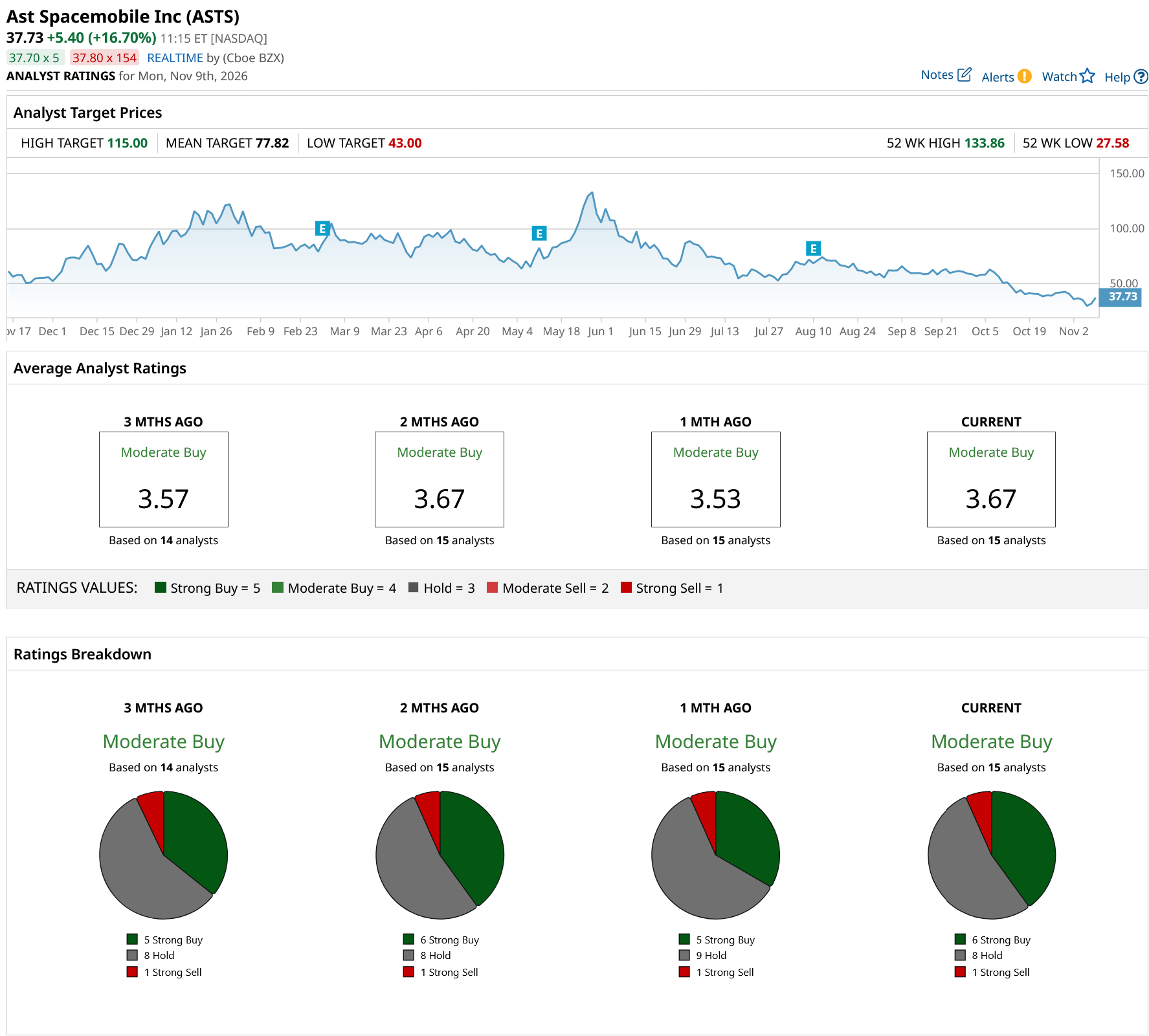
If ASTS stock is priced at 20x forward FCF, it could more than double within the next two years. If the multiple expands to 30x, the stock could surge over 200% from current levels. Out of the 15 analysts covering ASTS stock, six recommend “Strong Buy,” eight recommend “Hold,” and one recommends “Strong Sell.” The average ASTS stock price target is $77.82, above the current price of about $38.
On the date of publication, Aditya Raghunath did not directly have a position in any of the securities mentioned in this article. All information and data in this article is solely for informational purposes. For more information please view the Barchart Disclosure Policy here.